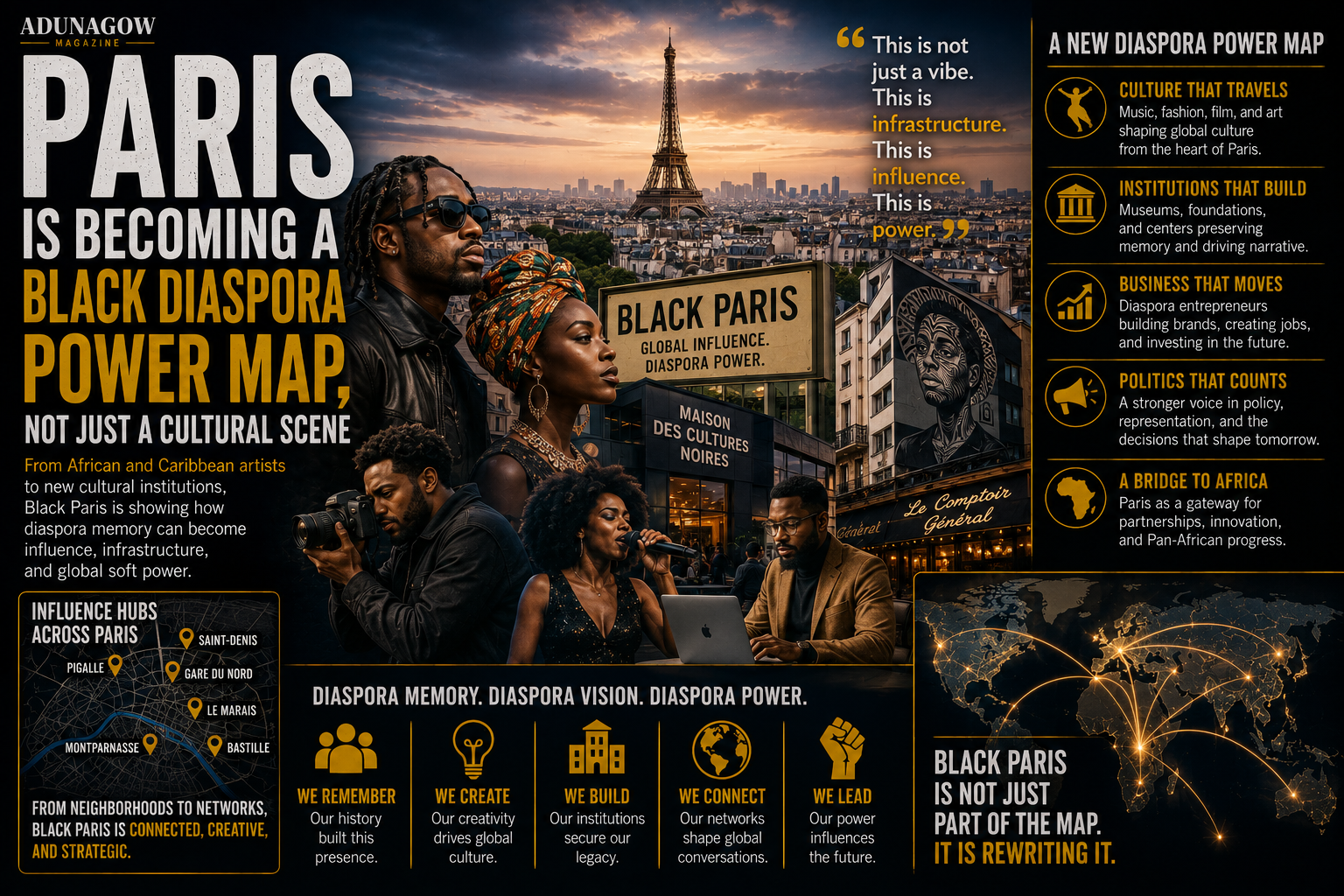
From African and Caribbean artists to new cultural institutions, Black Paris is showing how diaspora memory can become influence, infrastructure, and global soft power.
Paris has long sold itself to the world as a capital of art, fashion, literature, and style. But one of the city's most important cultural stories is not the postcard version of Paris. It is Black Paris: the living network of African, Caribbean, Afro-French, and wider diaspora communities that have helped shape the city's creative identity for generations.
That story is gaining renewed attention now because it is no longer only being told as memory. It is becoming infrastructure.
A new Guardian feature published on July 1, 2026 frames Paris as a powerful nexus for Black cultural expression, shaped by communities with roots in Africa, the Caribbean, and France's own Black population. The piece traces a line from the salons and writers connected to negritude to today's artists, festivals, fashion spaces, music scenes, and cultural institutions.
For ADUNAGOW readers, the real story is bigger than Paris nightlife or cultural cool. It is about what happens when diaspora creativity becomes visible enough to build institutions, influence city identity, and change how African-descended communities are seen.
From Presence to Power
Black culture in Paris is not new. African, Caribbean, and Black American artists and thinkers have moved through the city for decades, often using Paris as a place to write, perform, organize, debate, and imagine freedom beyond the limits placed on them elsewhere.
What feels different now is the public naming of that influence.
Centre Pompidou's "Black Paris" exhibition, which traced Black artists in France from the 1950s to 2000, placed African, Caribbean, and American artists inside a major institutional frame. The exhibition presented the work and presence of 150 artists from Africa, the Americas, and the Caribbean, making a broader argument: Black artists were not visitors to French culture. They were part of its making.
MansA, the Maison des Mondes Africains, pushes that argument into the present. The institution describes itself as a house for African worlds and their diasporas, with programming across exhibitions, film, performance, debate, residencies, and research. Its Paris venue opened in October 2025 as a space for experimentation and transmission.
That matters because culture becomes power when it gains rooms, records, stages, archives, and institutions.
A Diaspora That Refuses to Flatten Itself
One reason Black Paris matters is that it refuses to reduce the diaspora to one identity.
Paris holds Senegalese, Cameroonian, Malian, Congolese, Guadeloupean, Martinican, Haitian, Afro-French, Black American, and other Black experiences in constant conversation. Those identities overlap, but they are not identical. The strength of the city is not that it creates one simple Black story. The strength is that it makes many African worlds visible in the same urban space.
That complexity is important for diaspora media. Too often, Black global culture is discussed through the loudest commercial markets alone. Paris offers another view: a place where language, colonial history, migration, art, religion, music, food, and politics collide in ways that cannot be explained by one trend cycle.
The result is a cultural map that is both French and not fully contained by France. It is African, Caribbean, European, and global at the same time.
Soft Power Beyond the Continent
ADUNAGOW has covered African soft power through music, fashion, film, sport, and the return economy. Black Paris belongs in that same conversation.
African soft power is not only built in Lagos, Accra, Dakar, Abidjan, Johannesburg, or Nairobi. It is also built in the cities where African and Afro-descended communities gather, create, translate, and negotiate identity in public.
Paris is one of those cities.
When African designers influence fashion language, when Afro-French musicians shape mainstream sound, when Caribbean and African artists receive institutional attention, and when a place like MansA creates a public home for African worlds, diaspora culture stops being background color. It becomes leverage.
That leverage can influence tourism, publishing, film, education, museum programming, youth identity, and the way European publics understand Africa and its descendants.
The Opportunity and the Warning
The opportunity is clear: Black Paris can become a stronger bridge between Africa, the Caribbean, Europe, and the wider diaspora. It can help younger generations see themselves as heirs to serious intellectual, artistic, and political traditions. It can also create more space for African creative industries to circulate through Europe on stronger terms.
But the warning is also important.
Visibility is not the same as equality. A city can celebrate Black culture and still fail Black communities in housing, policing, employment, media representation, and political power. Museums can display Black creativity while institutions still struggle to share authority. Festivals can spotlight African culture while artists still fight for funding and ownership.
That is why the Black Paris story should not be told as a simple celebration. It should be told as a test.
Can a major European capital move beyond consuming African and diaspora culture and actually support the people, institutions, and communities that produce it?
Why It Matters Now
The timing matters because diaspora culture is increasingly central to how global cities brand themselves. African music, fashion, sport, art, food, and film are not side stories anymore. They are part of the main global cultural economy.
Black Paris shows that the African diaspora is not waiting for permission to matter. It is building networks, shaping taste, preserving memory, and creating new institutions.
For ADUNAGOW readers, the lesson is direct: the future of African influence will not be measured only by what happens on the continent. It will also be measured by how African worlds organize themselves across the diaspora.
Paris is one of those maps.
And right now, that map is becoming harder to ignore.
Read Next
- The New African Soft Power Story Is Happening in Music, Fashion, and Film
- Meet the Africans Building the New Diaspora Return Economy
- Juneteenth Through African Eyes: A Freedom Holiday for the Whole Diaspora
- Ghana's Reparations Summit Turns a Historic UN Vote Into a Global Test
Sources
- The Guardian: https://www.theguardian.com/news/2026/jul/01/paris-nexus-black-culture-diaspora-the-long-wave
- MansA: https://mansa.fr/en/
- MansA about page: https://mansa.fr/en/a-propos/
- Paris Je t'aime listing for MansA: https://parisjetaime.com/eng/culture/mansa-house-of-african-worlds-paris-p4714
- Centre Pompidou Black Paris exhibition: https://www.centrepompidou.fr/en/program/calendar/event/VRo249Y
Discover more from ADUNAGOW Magazine
Subscribe to get the latest posts sent to your email.