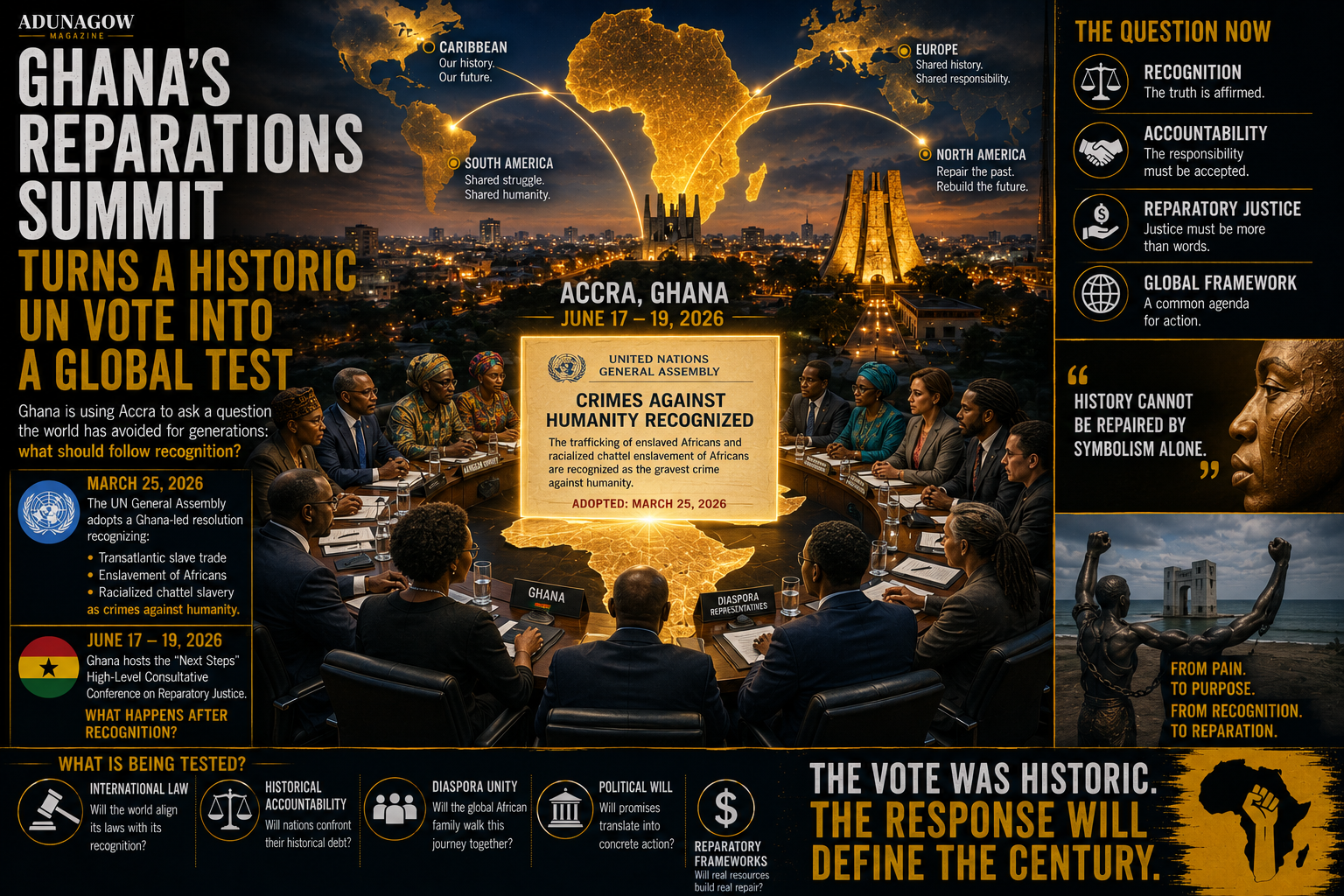
Ghana is using Accra to ask a question the world has avoided for generations: what should follow recognition?
From June 17 to 19, 2026, Ghana is hosting the "Next Steps" High-Level Consultative Conference on reparatory justice, a major gathering designed to translate a landmark United Nations resolution into a common framework of action. The timing matters. On March 25, 2026, the UN General Assembly adopted a Ghana-led resolution recognizing the trafficking of enslaved Africans and racialized chattel enslavement of Africans as the gravest crime against humanity.
That vote did not settle the reparations debate. It sharpened it.
Now, in Accra, the conversation moves from moral recognition to institutional design. Heads of state, ministers, legal experts, civil society leaders, historians, researchers, and representatives from more than 80 countries are expected to gather around one urgent question: how can historical truth become practical justice?
For Africa and the global African diaspora, this is not a ceremonial meeting. It is a test of political seriousness.
From remembrance to architecture
Reparatory justice is often discussed as if it were only about money. That framing is too small.
The Accra conference is positioned around a broader agenda: historical truth, restitution of cultural property, inclusive dialogue, reconciliation, legal frameworks, and durable institutions that can carry the work beyond speeches and anniversaries. The official conference framing speaks of turning political momentum into concrete institutional commitment.
That phrase is important because the reparations debate has never lacked memory. It has lacked machinery.
Across Africa, the Caribbean, the Americas, and Europe, people of African descent have long argued that the transatlantic slave trade did not simply end and disappear. It reshaped economies, borders, racial hierarchies, cultural loss, family histories, and the global distribution of power. The UN vote gave that argument new international visibility. Ghana's conference is now testing whether visibility can become structure.
Why Ghana's role matters
Ghana is not entering this debate as a bystander. It has long positioned itself as a symbolic and political bridge between the African continent and the diaspora.
Accra is a powerful location for this conversation because Ghana carries both historical weight and modern diplomatic ambition. The conference includes a Juneteenth-related commemoration at Osu Castle, a former slave-trade site. That setting makes the issue impossible to reduce to abstract legal language. It connects the conference directly to memory, place, and the human cost of the system being discussed.
But Ghana's larger move is strategic. By leading the UN resolution on behalf of African Union member states and hosting the follow-up gathering, Ghana is trying to help organize a global African agenda that reaches beyond national borders. The issue links African governments, Caribbean states, civil society, scholars, cultural institutions, and diaspora communities that have often pushed in parallel rather than as one coordinated force.
That coordination is the real story.
The vote revealed the fault lines
The March 25 UN resolution passed with 123 countries voting in favor. Three countries voted against it: the United States, Israel, and Argentina. Fifty-two abstained, including the United Kingdom and European Union member states.
Those numbers matter because they show both momentum and resistance.
Supporters saw the vote as a historic recognition of one of the foundational crimes of the modern world. Critics raised legal concerns, including arguments about retroactivity, reparations, and whether the language creates a hierarchy among crimes against humanity.
ADUNAGOW readers should understand both sides of the diplomatic reality. The resolution is politically meaningful, but it is not a magic switch. It does not automatically produce payments, restitution, apologies, or legal enforcement. What it does create is a new reference point: a formal global recognition that advocates can use to push institutions, governments, museums, universities, and international bodies toward action.
That is why Accra matters. The conference is where advocates begin asking what the next layer of action should look like.
What action could mean
Reparatory justice can include direct compensation, but it can also include other forms of repair: returning stolen cultural artifacts, supporting educational initiatives, correcting historical records, funding development partnerships, building memorial institutions, opening archives, creating legal panels, and establishing mechanisms for dialogue between affected communities and states that benefited from slavery and colonial extraction.
The strongest version of this agenda is not built on symbolism alone. It requires measurable commitments.
For the diaspora, that distinction matters. Many people of African descent already understand the emotional argument. The next phase must answer practical questions. Who sits at the table? What institutions will monitor commitments? How will Africa, the Caribbean, and diaspora communities coordinate? What role should museums, banks, universities, churches, and former colonial powers play? How will young Africans and diaspora youth be included in a process that could shape identity and policy for decades?
These are not easy questions. But they are the right questions.
A diaspora story with global consequences
The Accra conference belongs in ADUNAGOW's lane because it is more than a diplomatic headline. It is a diaspora consequence story.
It asks whether people of African descent can transform shared history into shared leverage. It asks whether African states can speak with enough coordination to influence global institutions. It asks whether remembrance can move beyond annual statements and into policies that affect education, culture, restitution, development, and dignity.
The danger is that the story becomes trapped in predictable reactions: supporters celebrate, opponents dismiss, and the world moves on. Ghana's challenge is to prevent that cycle by turning recognition into a process that can be tracked.
For readers across Africa and the diaspora, the most important question is not whether the conference produces one perfect solution. It is whether it creates a stronger platform for sustained action.
History has already been named. Now the work is to decide what repair should look like.
Read Next
- From Year of Return to the 17th Region: Is Ghana Finally Giving the Diaspora Real Power?
- Africa Has a Record World Cup Moment. Will Africans Be Allowed Into the Room?
Discover more from ADUNAGOW Magazine
Subscribe to get the latest posts sent to your email.