Africa's World Cup Breakthrough: Nine Teams, One Continental Statement
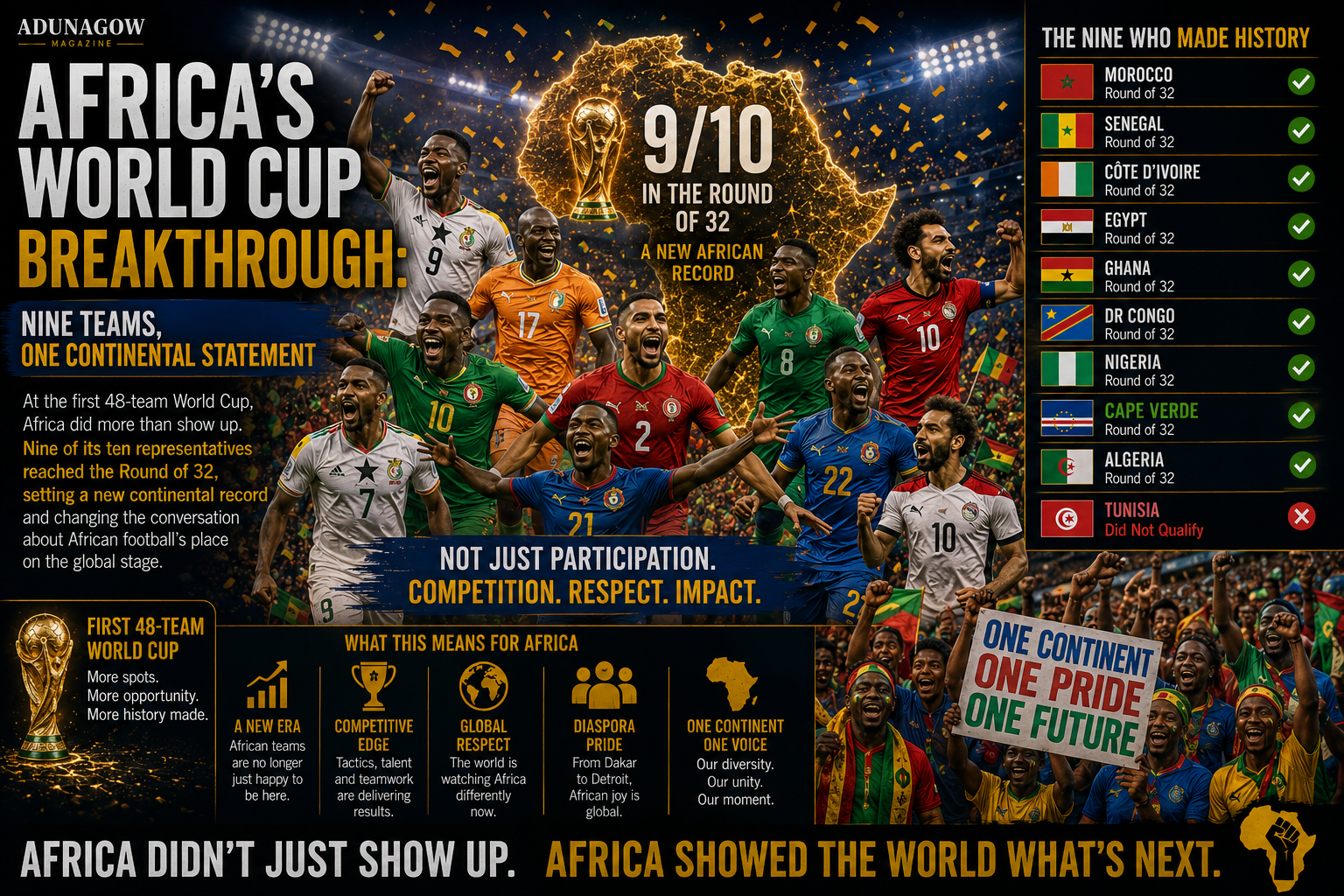
At the first 48-team World Cup, Africa did more than show up. Nine of its ten representatives reached the Round of 32, setting a new continental record and changing the conversation about African football's place on the global stage.
Africa has spent decades asking for a bigger World Cup stage. In 2026, when that stage finally arrived, the continent did something more powerful than simply fill the extra space. It competed.
Nine of Africa's ten teams at the 2026 FIFA World Cup have advanced to the Round of 32, a historic breakthrough that turns the expanded tournament into a continental statement. Morocco, South Africa, Senegal, Ivory Coast, Ghana, Cape Verde, Egypt, DR Congo and Algeria are through. Tunisia is the only African side that did not move on.
For African football, this is not a small statistical improvement. It is a reset of expectation.
The previous record for African teams in a World Cup knockout stage was two, reached in 2014 and again in 2022. Now, in the first World Cup expanded from 32 to 48 teams, Africa has sent nine teams into the next phase. The scale matters. The symbolism matters. But most importantly, the performances matter.
This was not a story built on one miracle run or one golden generation carrying the continent's hopes alone. It was a wider signal of depth. North Africa, West Africa, Central Africa, Southern Africa and the island nation of Cape Verde all found their way into the knockout conversation. That geographic spread is what makes the moment larger than a tournament headline.
DR Congo and Algeria delivered the final push. On June 27, DR Congo beat Uzbekistan 3-1 in Atlanta, securing its place among the last 32. The same night, Algeria survived a dramatic 3-3 draw with Austria in Kansas City to become the ninth African team through. Those results completed a picture that had been forming across the group stage: African teams were no longer just dangerous opponents. They were consistent enough to survive the first cut.
That distinction is important. For years, African teams have been described through the language of potential. Athletic potential. Technical potential. Cultural passion. Talent export. The praise often came with an implied limit: exciting, but not organized enough; gifted, but not deep enough; emotional, but not tactically complete.
This World Cup challenges that old frame.
Morocco entered the tournament with the confidence of a team that had already changed history in Qatar, where it became the first African nation to reach a World Cup semifinal. Its 2026 campaign has carried the weight of that new standard. South Africa's progress is equally significant, marking a breakthrough for a country with deep football culture and a long hunger for global validation. Senegal, Ivory Coast, Ghana and Egypt bring familiar football pedigree, but their advancement as part of a broader continental wave gives their success a different texture.
Then there is Cape Verde, one of the stories of the tournament. In its debut World Cup campaign, Cape Verde reached the knockout stage and finished ahead of established football nations in its group. For a small island country with a powerful diaspora footprint, the achievement speaks to one of modern football's defining truths: talent pipelines are no longer confined by geography alone. Identity, migration, scouting, coaching and global club systems are creating new maps of possibility.
That is why this moment will resonate beyond stadiums in North America. For African fans on the continent and across the diaspora, the Round of 32 is not just a sports bracket. It is evidence of a wider transformation in confidence, infrastructure and ambition.
The expanded World Cup format will naturally invite debate. Some will argue that more teams simply made it easier for more African sides to advance. But that explanation is too thin. Expansion opened the door; African teams still had to walk through it under pressure. They still had to earn points, manage games, recover from setbacks and survive groups filled with teams from every major football region.
The better question is not whether the format helped. It is what African teams did with the opportunity.
They turned representation into results.
That matters for the Confederation of African Football, for national federations, and for the next generation of players watching from Lagos, Dakar, Accra, Kinshasa, Abidjan, Cairo, Johannesburg, Algiers, Praia and Casablanca. It also matters commercially. Success at the World Cup increases visibility, strengthens domestic football brands, raises player market value, and gives sponsors a clearer reason to invest in African football ecosystems.
For too long, African football has exported stars faster than it has exported institutional power. The continent has produced elite players for the world's biggest clubs, but national teams have often struggled to turn individual brilliance into sustained tournament progress. A nine-team knockout presence does not solve those structural challenges overnight, but it changes the leverage. It gives federations, broadcasters, brands and governments a stronger case to invest in systems that match the talent.
This is where the story becomes bigger than football. Sport has always been one of Africa's most visible global languages. When African teams succeed at the World Cup, they do not only carry flags. They carry narratives of confidence, competence and belonging on one of the world's most watched stages.
The next phase will be harder. The Round of 32 introduces single-elimination pressure, where one mistake can end a campaign. Some African teams will face traditional powers. Some will be underdogs. Some may go no further. But even before the knockout matches begin, the group stage has already delivered a continental milestone.
Africa asked for more seats at the World Cup. In 2026, it did not just occupy them.
It made them count.
Discover more from ADUNAGOW Magazine
Subscribe to get the latest posts sent to your email.