Standfirst: Ten African teams will compete at the 2026 FIFA World Cup, the continent's biggest presence ever. But as the tournament opens, visa barriers, paperwork problems, and the exclusion of a leading African referee are raising a harder question: what does representation mean if Africans are still fighting for access?
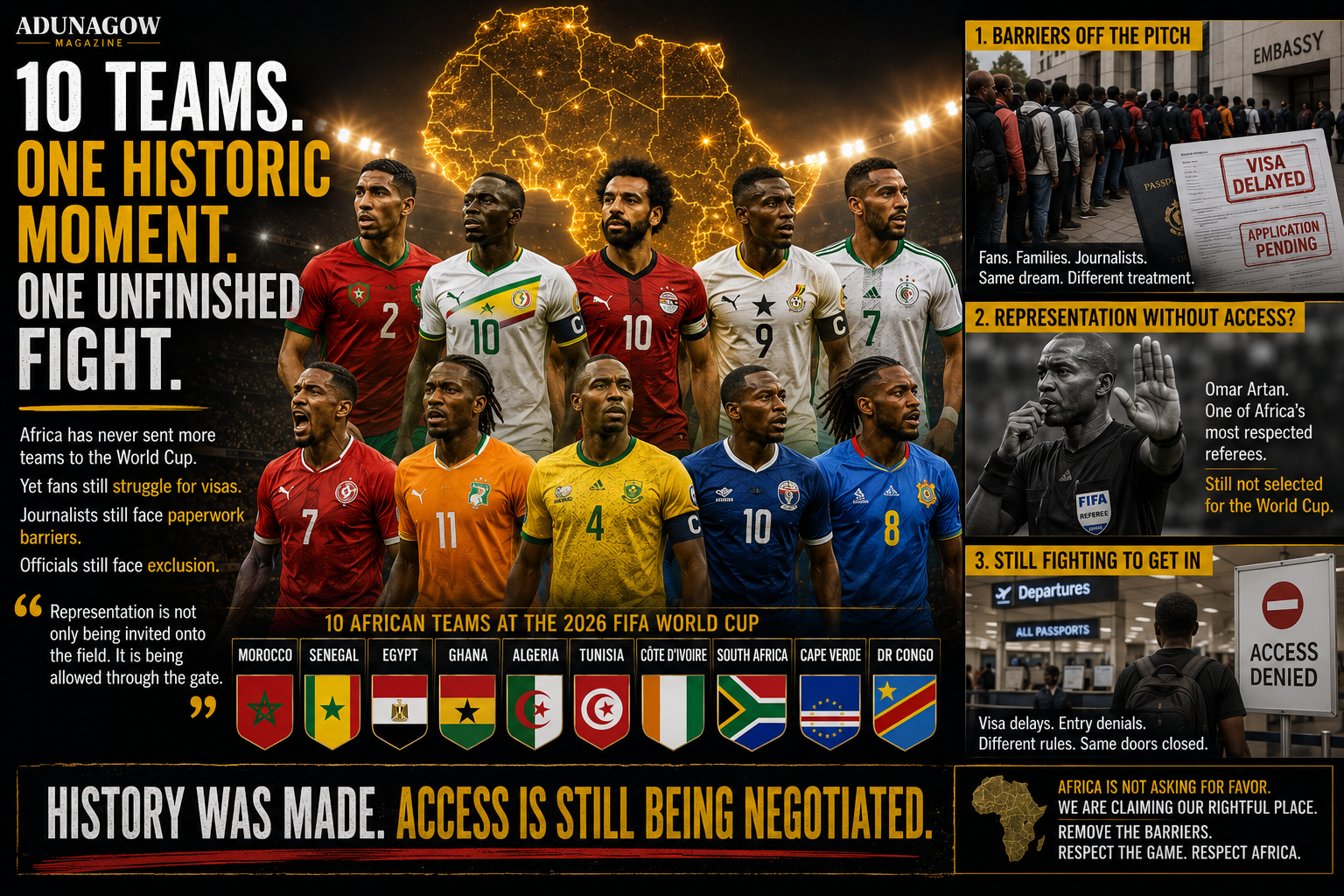
Africa is entering the 2026 FIFA World Cup with a record 10 teams, a milestone that should feel like a continental celebration before the first whistle even blows.
Algeria, Cape Verde, Cote d'Ivoire, DR Congo, Egypt, Ghana, Morocco, Senegal, South Africa, and Tunisia will carry African hopes into the first 48-team men's World Cup. For a continent that watched Morocco become the first African men's team to reach a World Cup semi-final in 2022, this expanded presence is not symbolic decoration. It is evidence of growth, ambition, talent development, and a wider belief that Africa's football future is no longer waiting for permission.
But as the tournament opens, another story is unfolding around the edges of the pitch. Africa has more teams in the room than ever before. The question is whether African fans, officials, journalists, families, and communities will be able to enter that room fully.
The case of Somali referee Omar Abdulkadir Artan has become the clearest human symbol of that contradiction. Artan, widely described in recent reporting as one of Africa's top referees and selected for the tournament, was denied entry to the United States and will miss the World Cup. FIFA has said immigration and visa decisions are controlled by host governments, not the football body itself. That distinction matters. ADUNAGOW is not independently asserting the reason for the denial beyond what has been reported. But the impact is still real: an African official chosen for the world's biggest football stage will not be there.
The access concerns do not stop with Artan. Reporting around the tournament has pointed to broader travel complications, including high visa costs, partial restrictions affecting some African countries, fears of border questioning, and the earlier threat of a $15,000 visa bond for fans from several African qualified nations before that bond was waived for eligible ticket holders. South Africa's delayed travel has also been reported in connection with Mexican entry documentation, a reminder that not every access problem should be flattened into the same political story.
That factual caution is important. Paperwork problems, immigration restrictions, security checks, visa costs, and host-country rules are not always the same thing. But together, they reveal a familiar global pattern: African excellence is welcomed when it makes the spectacle richer, while African mobility remains contested at the gate.
This is why the 2026 World Cup is bigger than football for Africa and its diaspora.
The tournament will be broadcast as a festival of global unity. Stadiums will be filled with flags, brands will celebrate diversity, and African players will provide the skill, drama, rhythm, and emotion that make the World Cup marketable across continents. Yet for many African supporters, the ability to attend may depend not only on money and passion, but on paperwork, interviews, processing uncertainty, and the quiet fear that a valid trip can still become an interrogation.
That tension is deeply familiar to diaspora communities. Africans living in the United States, Canada, Europe, the Caribbean, and across the world know what it means to be celebrated for culture while questioned for movement. They know the pride of seeing African names on global stages and the frustration of watching African passports carry heavier suspicion than African talent.
For ADUNAGOW readers, the issue is not whether host countries have the right to manage borders. They do. The issue is whether global institutions that profit from African participation are willing to defend African access with the same energy they use to market African excellence.
FIFA can say, accurately, that governments control immigration. But FIFA also controls the architecture of a global tournament. It chooses hosts, builds commercial expectations, sells the dream of worldwide belonging, and benefits from the presence of communities whose flags, songs, stories, and players make the event feel global. If the World Cup is truly for the world, access cannot be treated as someone else's administrative footnote.
Africa's record 10-team presence deserves celebration. Cape Verde's qualification is historic. DR Congo's return carries emotional weight. Morocco, Senegal, Ghana, Egypt, Tunisia, Algeria, Cote d'Ivoire, and South Africa bring deep football cultures and global fan bases. This is a moment of continental confidence, and it should be covered with pride.
But pride should not require silence.
The measure of representation is not only how many African teams appear in the tournament draw. It is also whether African referees can officiate, whether African journalists can report, whether African families can travel, whether diaspora fans can gather without fear, and whether African participation is treated as belonging rather than exception.
The 2026 World Cup may still become a breakthrough tournament for African football. It may give the continent its first men's finalist, its first champion, or another generation-defining run. But before the goals arrive, the access question already matters.
Africa has earned its place on the pitch. Now the world must answer whether Africans are welcome in the stands, in the media zones, in the officiating teams, and in the full life of the tournament they help make unforgettable.
If global sport wants African brilliance, it must also respect African mobility. Otherwise, the message is too familiar: the talent is invited, the culture is monetized, but the people are still asked to prove they belong.
Read Next
- How Senegal Turned Diaspora Identity Into World Cup Power — and Why the Money Story Still Matters
- When Africans Must Be Evacuated From Africa, Unity Is No Longer A Slogan
- Wiyaala’s 2014 World Cup Anthem for Ghana’s Black Stars Team
Discover more from ADUNAGOW Magazine
Subscribe to get the latest posts sent to your email.