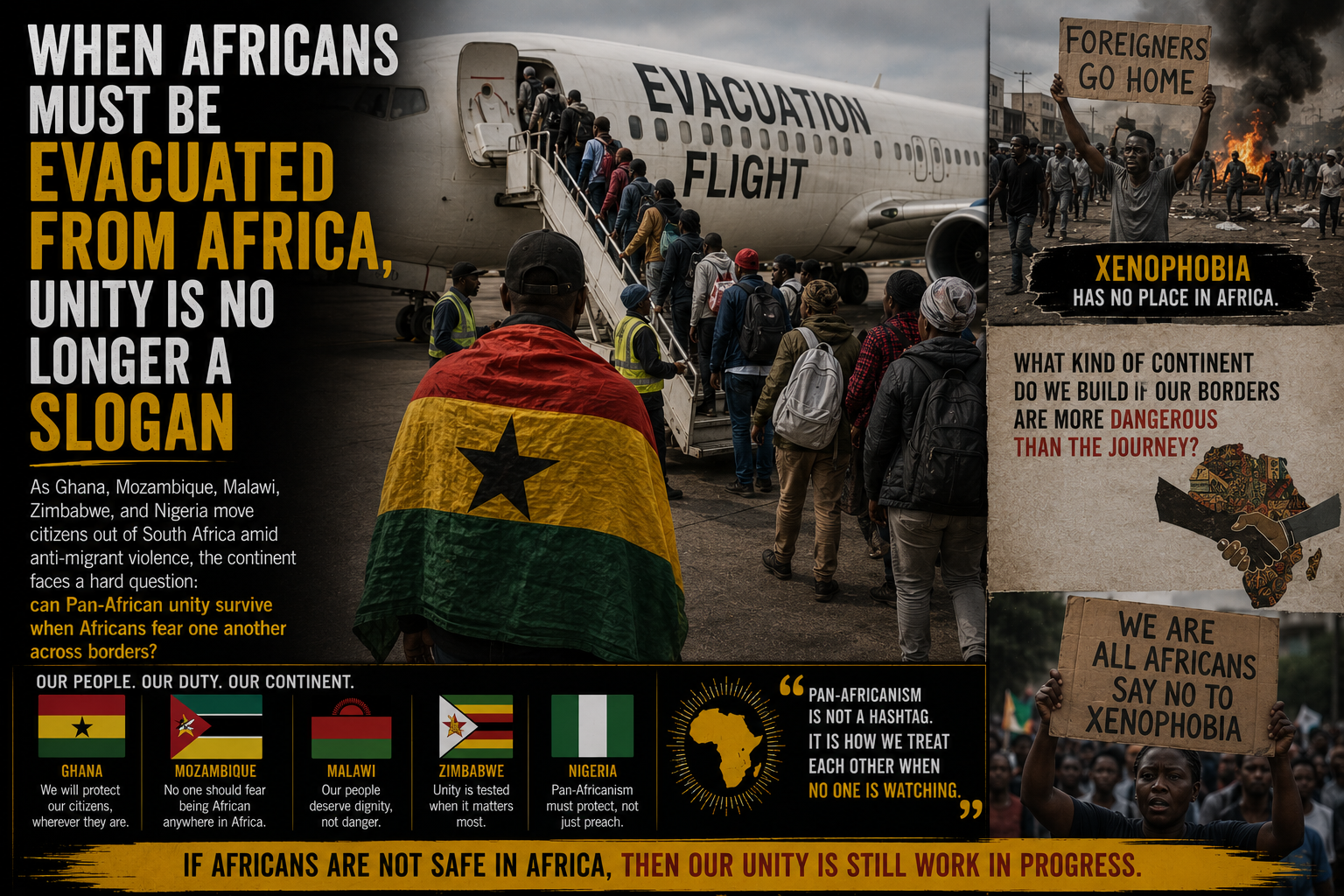
As Ghana, Mozambique, Malawi, Zimbabwe, and Nigeria move citizens out of South Africa amid anti-migrant violence, the continent faces a hard question: can Pan-African unity survive when Africans fear one another across borders?
There are moments when a continent's biggest ideals are tested not in summit halls, but at airport gates.
That is where Africa finds itself now, as multiple African countries move citizens out of South Africa amid renewed anti-migrant violence and fear. Ghana has evacuated citizens. Mozambique, Malawi, and Zimbabwe have brought people home or begun repatriation efforts. Nigeria has screened more than 1,000 citizens for voluntary return, with the first batch expected in Lagos on Thursday, June 11.
The image is painful because it carries a question bigger than any one border: what does African unity mean if Africans must be evacuated from another African country for their own safety?
South Africa's migration tensions are not new. The country has wrestled for years with unemployment, pressure on public services, crime fears, and weak migration management. Those pressures are real. They deserve serious government action, honest public debate, and fair enforcement of the law.
But mobs cannot be immigration policy. Fear cannot be a border system. And no economic frustration gives ordinary citizens the right to intimidate, assault, displace, or hunt African migrants.
That is why this story matters beyond South Africa. It is a test of law, dignity, and Pan-African trust.
A Crisis With Continental Consequences
Premium Times reported on June 10 that at least five African countries have repatriated citizens or are working toward repatriations from South Africa. Ghana, it reported, has evacuated about 1,000 citizens after earlier flights in May. Mozambique has repatriated about 700 citizens following the reported killing of five Mozambicans. Malawi received a first group of 171 returnees, including women and children who had taken shelter after harassment and violence. Zimbabwe reportedly evacuated around 139 nationals.
Nigeria's case is now central to the story. Nigerian authorities began verification and screening for citizens who wanted to leave South Africa, with more than 1,000 screened. The Nigerian government had previously raised concern after the deaths of two citizens, and Foreign Affairs Minister Bianca Odumegwu-Ojukwu said Nigeria was unhappy with South Africa and may consider retaliatory measures.
This is no longer only a local policing issue. It has become a diplomatic issue, a migration issue, and a moral issue.
South African President Cyril Ramaphosa has acknowledged public concern over illegal migration while warning against vigilantism. AP reported that Ramaphosa said only authorized government officials can act against violations of the law. That distinction matters. A state can enforce immigration law. A mob cannot.
The Guardian also reported rising fear among immigrants as anti-migrant groups push a June 30 deadline for undocumented foreign nationals to leave. Whether framed as protest, frustration, or political pressure, the result is clear: many African migrants now feel exposed.
The Danger Of Scapegoating
South Africans are right to demand jobs, services, security, and honest governance. No serious African publication should pretend those pressures do not exist. But scapegoating migrants is a shortcut that avoids the harder truth.
Unemployment, corruption, housing stress, weak service delivery, and crime are governance problems. Migrants may become easy targets, especially when politicians and activists turn frustration into suspicion. But blaming African foreigners for structural failures does not fix the structures.
It only breaks something else: trust between African people.
That trust matters. African countries speak often about unity, regional trade, continental integration, free movement, and shared destiny. The African Continental Free Trade Area is built on the idea that people, goods, capital, and ideas should move more intelligently across African borders. Diaspora communities are constantly encouraged to invest, return, visit, build, and reconnect.
But if African movement is met with violence, those dreams shrink.
The issue is not whether every person has a legal right to remain in South Africa. Immigration systems matter. Documentation matters. Border enforcement matters. The issue is whether enforcement will be handled by law or by intimidation. Once mobs become the message, every African migrant becomes vulnerable, including those with valid papers, families, businesses, and years of contribution.
Why The Diaspora Should Pay Attention
For Africans in the diaspora, this story feels familiar even when the geography is different.
Across the world, Africans know what it means to be praised for culture while questioned for movement. They know what it means to be welcomed as talent, labor, music, food, fashion, and sporting excellence, yet treated with suspicion when crossing borders. They understand the emotional cost of proving belonging again and again.
That is why South Africa's current crisis cuts deeply. It is not only about migrants in one country. It is about the fragile status of Africans everywhere mobility becomes political.
When Ghana flies citizens home, when Nigeria screens more than 1,000 people for return, when Mozambican families grieve, when Malawians and Zimbabweans leave under fear, the message travels far beyond Pretoria, Johannesburg, Cape Town, or Mossel Bay. It tells the diaspora that African belonging is still unfinished work.
ADUNAGOW's mission is to celebrate African contribution and ask informed questions about the continent's future. This is one of those questions: can Africa build the future it advertises if Africans do not feel safe among Africans?
What Real Unity Requires
Pan-African unity cannot mean ignoring migration concerns. It must mean handling them with law, dignity, and responsibility.
South Africa's government must protect migrants from violence while improving migration management in a transparent way. African governments must protect citizens abroad without turning every crisis into nationalist theatre. Regional bodies must treat anti-migrant violence as a continental warning, not a recurring embarrassment to be condemned and forgotten.
There is also a responsibility on media and citizens. Viral videos, rumors, and inflammatory language can turn fear into fuel. Responsible coverage must hold governments accountable without painting entire populations as villains.
South Africa is not one thing. It is home to people who oppose xenophobia, people who are frustrated by state failure, people who have welcomed neighbors from across the continent, and people who have joined dangerous anti-migrant movements. The same complexity exists across Africa. The goal is not to shame a country. The goal is to defend a principle.
Africans should not have to flee Africans.
The continent's future depends on trade, education, migration, creativity, and cooperation. It depends on students crossing borders, entrepreneurs building across markets, artists collaborating, workers moving safely, and families knowing that African identity can mean more than a passport stamp.
If this moment becomes only another cycle of outrage, it will fade. If it becomes a serious conversation about migration governance, anti-vigilante enforcement, returnee support, and continental dignity, it can still produce something useful.
The flights leaving South Africa are a warning. They say that unity cannot survive as ceremony alone. It has to be protected in neighborhoods, police stations, embassies, border posts, media platforms, and the everyday choices of citizens.
When Africans must be evacuated from Africa, the slogan has failed the people.
The work now is to make sure the people do not fail each other.
Read Next
- When Africans Become Foreigners to Africans: South Africa’s Xenophobia Crisis Tests Pan-African Unity
- Ghana’s Emergency Return Flight From South Africa Is a Warning About African Mobility, Belonging, and Diaspora Protection
- Meet the Africans Building the New Diaspora Return Economy
Discover more from ADUNAGOW Magazine
Subscribe to get the latest posts sent to your email.