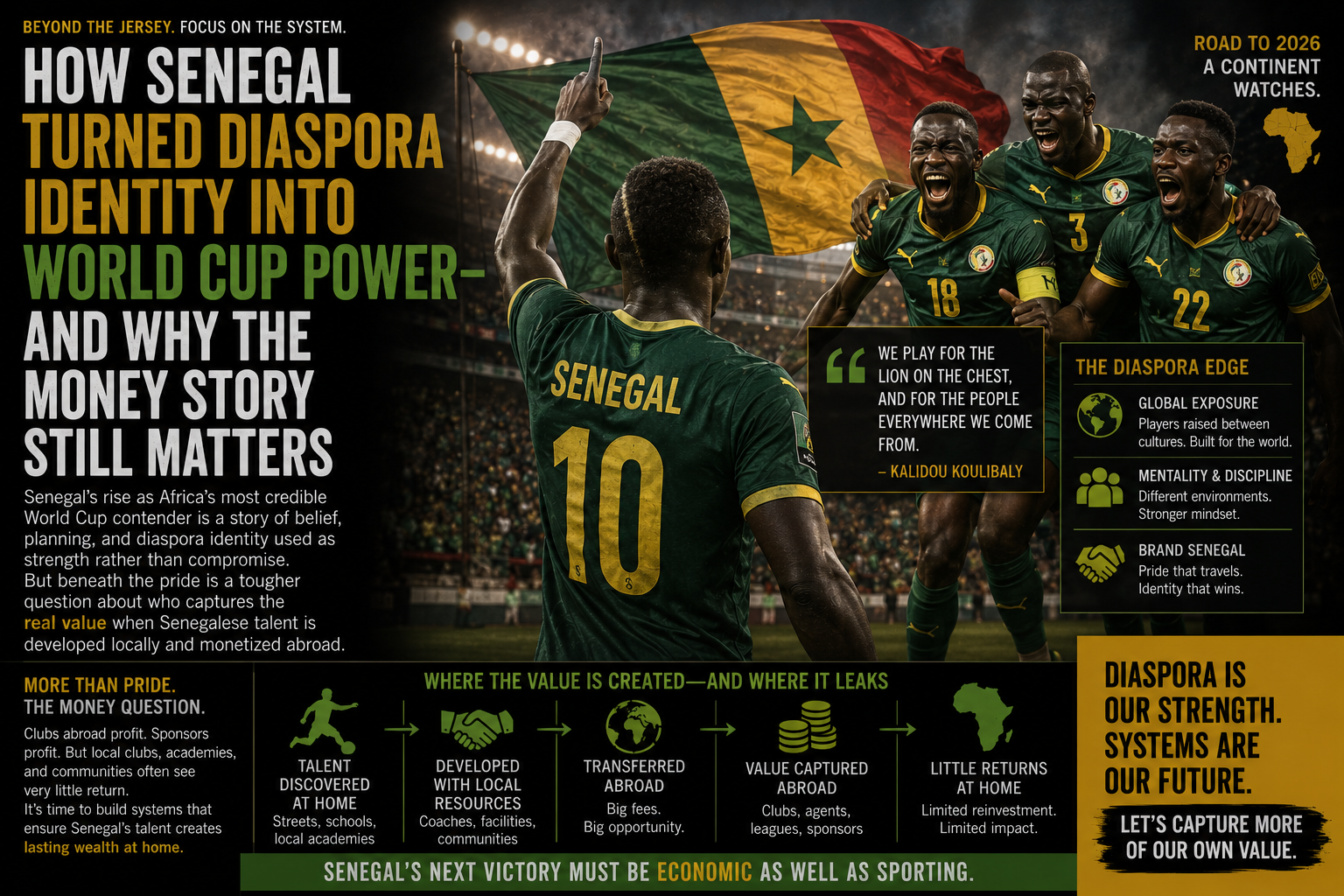
Senegal’s rise as Africa’s most credible World Cup contender is a story of belief, planning, and diaspora identity used as strength rather than compromise. But beneath the pride is a tougher question about who captures the real value when Senegalese talent is developed locally and monetized abroad.
Senegal’s World Cup story has reached a new level because it no longer sounds like hopeful continental hype.
It sounds credible.
Al Jazeera reports that Senegal coach Pape Thiaw said he would step aside if he did not believe his team could win the World Cup. That kind of statement would sound reckless from many national teams. From Senegal, right now, it lands differently. The same report argues that Senegal have been Africa’s most consistent national side of the past decade and notes that the federation recently convinced French-born talents Ibrahim Mbaye and Mamadou Sarr to represent Senegal.
That is already enough to explain why the team is entering World Cup 2026 conversations with genuine weight. But the richer ADUNAGOW story goes beyond tournament optimism.
This is also a story about diaspora identity, national confidence, and the economics of African talent.
Senegal Has Made Diaspora Identity Look Like Strength, Not Dilution
For years, some football conversations across Africa treated diaspora recruitment as if it were a backup plan — useful when local systems fell short, but somehow less authentic than a purely homegrown national team. Senegal’s rise helps dismantle that shallow thinking.
What the current moment shows is that diaspora identity does not weaken national identity when handled with seriousness. It can deepen it.
Players born or developed partly abroad do not automatically stand outside the nation’s story. In many African contexts, they are part of the nation’s wider reality. Families migrate. Children grow up between cultures. Talent develops across borders. Identity stretches without disappearing. Senegal appears to understand that better than most.
That is why the federation’s success in convincing French-born players like Mbaye and Sarr matters beyond squad depth. It signals that Senegal is building a national football project confident enough to pull its global talent network inward instead of treating diaspora identity as awkward or secondary.
Readers who have followed ADUNAGOW’s wider focus on Africa’s World Cup moment and the question of who gets to access it, Africa visa openness and return pathways, and why African soft power stories matter when they carry structural meaning will recognize why this is such a powerful narrative. Senegal is showing that global African identity can be converted into national strength on the biggest stage.
The Pride Story Is Real. So Is the Extraction Story Beneath It.
That celebration should not prevent a more uncomfortable question.
Al Jazeera reports that 13 of the 28 players in Senegal’s 2025 AFCON squad came through Senegalese academies. Yet those academy-developed players reportedly generated only around €100,000 in transfer fees for their academies across 13 moves, while later transfers by European clubs reached €81.2 million and total career transfers reached €411 million.
Those numbers expose something far bigger than football bookkeeping.
They suggest that Senegal is helping produce world-class value while capturing only a thin slice of the financial reward at the earliest stages. In other words, the country can build talent, inspire pride, strengthen the national team, and still watch the richest commercial upside travel outward.
That is why this story matters so much for diaspora readers and African development thinkers. It is not only about whether Senegal can challenge the world’s best on the pitch. It is also about whether African systems are learning how to hold onto more value from the excellence they create.
This is a familiar continental pattern. African talent becomes globally admired, but the institutions closest to its formation often remain the least rewarded. Football makes that pattern visible because the numbers are so dramatic and the spotlight is so global. But the same tension appears in culture, business, technology, and migration: African brilliance circulates widely, while ownership and reward are often captured elsewhere.
That is what makes Senegal’s World Cup rise such a rich ADUNAGOW story. It allows pride and critique to sit in the same frame.
Senegal deserves admiration for building one of Africa’s most coherent football identities. It deserves credit for proving that diaspora-linked players can strengthen national purpose rather than complicate it. And it deserves respect for entering the World Cup conversation with real authority.
But the money story still matters. If African football systems are good enough to produce elite talent, then the long-term development question is whether they can also become strong enough to retain more of the value that talent generates.
That is the next frontier.
Senegal may yet give Africa one of its proudest World Cup runs. If it does, the world will celebrate the players, the style, the confidence, and the flag.
ADUNAGOW’s harder question is what remains after the applause: can African excellence become not only visible, but better owned?
Read Next
- Africa’s World Cup Moment
- The New African Soft Power Story Is Happening in Music, Fashion, and Film
- Meet the Africans Building the New Diaspora Return Economy
Discover more from ADUNAGOW Magazine
Subscribe to get the latest posts sent to your email.