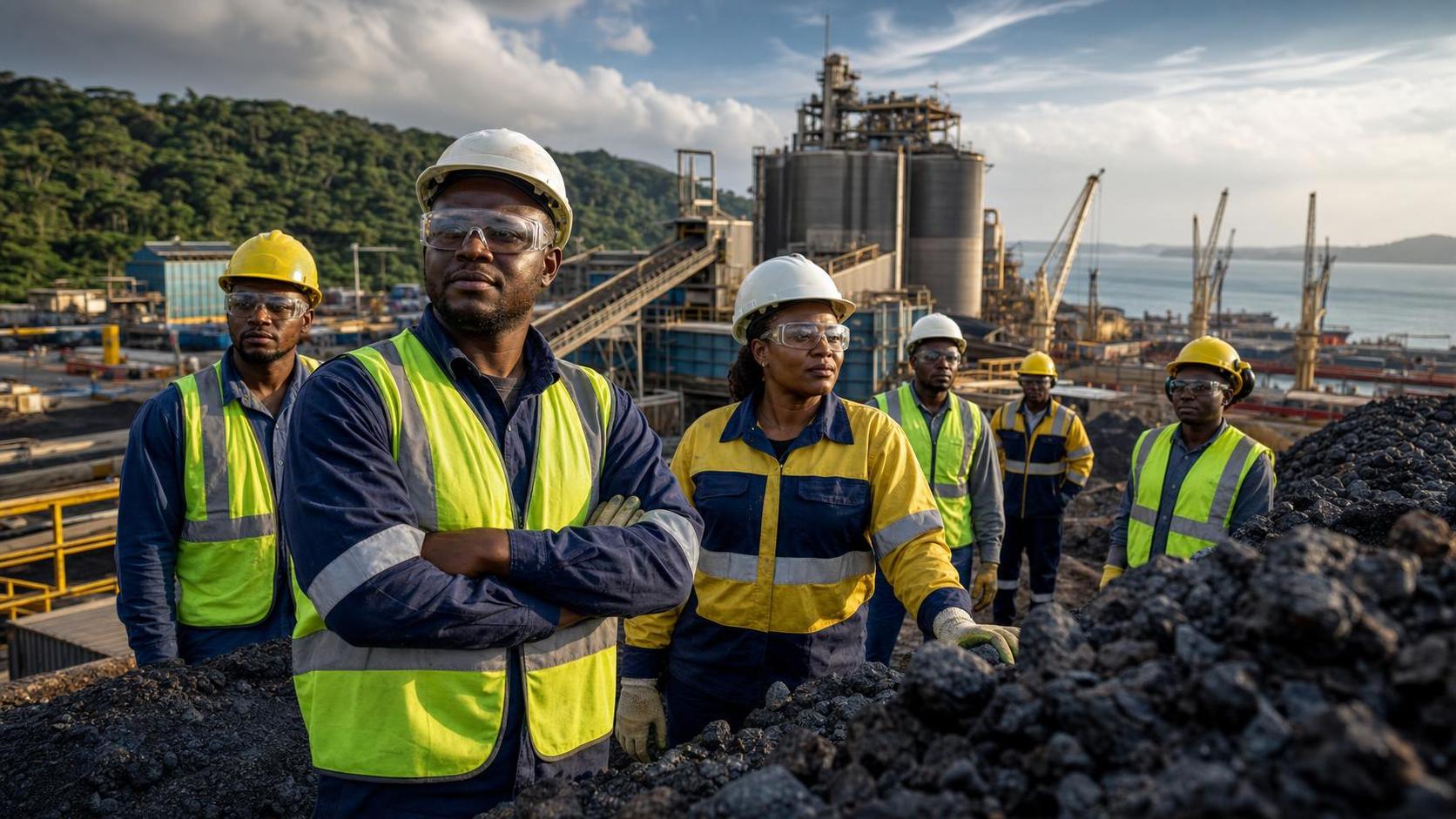
Gabon's Manganese Deal Tests Africa's New Value-Add Ambition
Gabon and Eramet have signed a roadmap to study more manganese processing inside Gabon. The bigger question is whether Africa can keep more industrial value where its minerals are mined.
Gabon is making a bigger demand of the global mineral economy: do not just take the ore. Help build the industry too.
During President Brice Oligui Nguema's state visit to France, Gabon signed a structured memorandum of understanding with French mining group Eramet and its Gabonese subsidiary Eramet Comilog. The agreement, signed in Paris on 20 July 2026, lays out a roadmap to study manganese processing inside Gabon by the end of 2031.
That may sound technical. It is not.
Manganese is a strategic mineral for steelmaking and, increasingly, for parts of the battery and energy-transition economy. Gabon is one of the world's major manganese producers, but the old extractive model has been familiar across Africa: minerals leave as raw materials, while the higher-value processing, manufacturing, technology, finance, and industrial services happen somewhere else.
This agreement is important because it points in a different direction. According to Eramet, the roadmap will study processing up to 700,000 tonnes of manganese ore per year inside Gabon. The options include a manganese oxide plant near Libreville, a revamped Moanda Metallurgical Complex, and a new coastal manganese alloy plant. The plan also includes a local biochar sector using forestry by-products and a "Made in Gabon" industrial seed fund intended to support 3,000 industrial jobs.
For ADUNAGOW readers, the story is not simply that Gabon signed another mining agreement. The story is that an African country is trying to move from royalties to industrial capability.
That distinction matters. Royalties can help national budgets. But processing minerals at home can create a wider ecosystem: engineers, technicians, logistics providers, energy infrastructure, industrial suppliers, training programs, small businesses, and export knowledge. Done well, value addition can turn a mine into a platform for broader development.
Done poorly, it can become another announcement with a ribbon-cutting photo and little durable change.
That is why this deal should be read with both optimism and discipline. Eramet describes the agreement as a roadmap under study, not a final investment decision. The industrial scenarios still depend on technical feasibility, economic conditions, environmental requirements, energy supply, logistics, and formal investment choices. Gabon is also expected to ensure the energy solutions needed for a proposed new alloy plant.
In other words, the promise is real, but execution is the test.
Gabon has already signaled that it wants a new bargain around manganese. Africanews reports that Libreville has pushed toward processing all ore before export, with a January 2029 deadline discussed as part of that ambition. Eramet has previously acknowledged Gabon's crude manganese export-ban plan and said its Comilog and Setrag operations sustain more than 10,000 Gabonese jobs.
The deeper question is whether the next generation of African resource deals will be built around leverage, partnership, and local industrial capacity, or whether the continent will keep exporting the foundation of global industries while importing the finished value.
This is also a diaspora story.
Diaspora professionals often talk about investing in Africa through real estate, remittances, or small businesses. Those remain important. But Africa's next growth chapter will also need industrial engineers, energy specialists, logistics operators, environmental experts, financiers, lawyers, researchers, and entrepreneurs who understand value chains. A manganese processing roadmap in Gabon is not only a national mining story. It is a signal of where serious African opportunity may be moving.
The political context should not be ignored. President Oligui Nguema came to power after Gabon's 2023 military takeover, and France-Gabon relations carry a long history of power imbalance, resource interests, and public suspicion. That makes the execution even more important. A deal like this cannot be judged only by the press release. It should be judged by who benefits, who is trained, what is built, what is owned locally, and whether ordinary Gabonese people see real economic opportunity.
Still, the direction is worth watching.
Across the continent, African governments are under pressure to stop being price-takers in global supply chains. Critical minerals, energy transition demand, and geopolitical competition have given resource-rich African countries new bargaining space. The strongest use of that space is not simply to demand more money upfront. It is to demand more processing, more skills, more infrastructure, more local suppliers, and more African ownership of the future economy.
Gabon has not completed that transformation. No single MOU can do that.
But the message is clear: the old model is no longer enough. Africa cannot keep supplying the rocks while others build the factories, patents, jobs, and balance sheets.
If Gabon turns this roadmap into real plants, reliable power, skilled jobs, and local enterprise, the manganese deal could become more than a mining headline. It could become part of a new African value-add playbook.
Read Next
- AfCFTA Has A Local Business Problem. Solving It Could Change African Trade
- Nigeria-Morocco Gas Pipeline: West Africa's 7 Billion Test Of Regional Power
- Cote d'Ivoire Just Pulled In 80 Billion in Development Pledges. The Real Test Is Who Builds the Future
Discover more from ADUNAGOW Magazine
Subscribe to get the latest posts sent to your email.