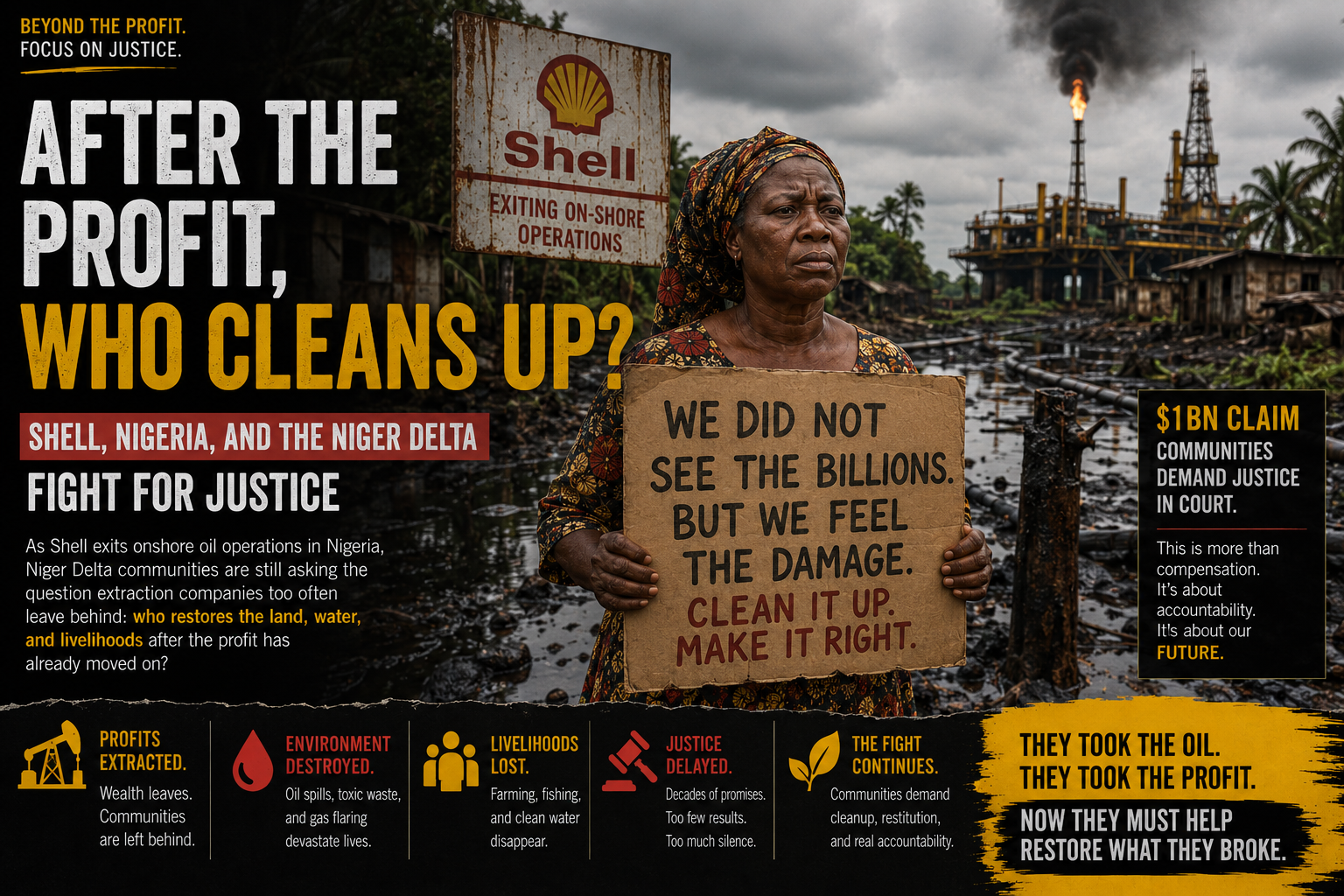
As Shell exits onshore oil operations in Nigeria, Niger Delta communities are still asking the question extraction companies too often leave behind: who restores the land, water, and livelihoods after the profit has already moved on?
For decades, Nigeria's Niger Delta has carried the weight of a global energy bargain: oil leaves, revenue flows, companies report earnings, governments collect taxes, and communities are left to live beside poisoned creeks, damaged farms, and mangroves that no longer feed the people who once depended on them.
Now, as Shell moves away from onshore oil extraction in Nigeria, the question facing the Niger Delta is not only whether pollution happened. It is who is responsible for making communities whole after the business model has already delivered its profits.
Recent reporting by The Times alleges that court documents in a UK High Court class action say Shell continued transporting crude through Nigeria's Nembe Creek Trunk Line for years despite internal warnings about spill risks. The pipeline, according to that report, was repeatedly targeted by thieves and had a capacity of about 150,000 barrels per day. Communities from Bille and Ogale argue that more than 100 spills between 2011 and 2013 contaminated land and water, undermining farming and fishing livelihoods. Shell denies liability, saying pollution was largely caused by oil theft, sabotage, and illegal refining, and says documents have been presented without full context.
That denial matters for fairness. The Niger Delta's oil crisis is not simple. Sabotage, theft, and illegal refining have worsened environmental damage and made pipeline protection dangerous and complex. But the central accountability question remains: when oil infrastructure pollutes a community, who has the power, money, and legal responsibility to clean it properly?
For many Niger Delta residents, the answer cannot be outsourced to delay.
Amnesty International USA described the Bodo community's legal fight as a historic moment in May 2025, noting that two major 2008 spills from Shell's then-Nigerian subsidiary devastated mangrove habitat and affected lives and livelihoods. Shell settled with the Bodo community in 2014, but Amnesty says the promised cleanup remains contested and that contamination continues to pose health risks. The legal claim now involves Renaissance Africa Energy Company Limited, following Shell's divestment from its Nigerian subsidiary SPDC in March 2025.
This is where the story becomes bigger than one company, one lawsuit, or one pipeline. It becomes a test of what a just energy transition means for African communities.
If multinational companies can extract for decades, sell assets, and leave before old damage is fully remediated, then "transition" becomes another word for abandonment. The world moves toward cleaner energy, but polluted communities are told to wait, litigate, prove, appeal, and survive.
A 2024 report covered by The Guardian and produced by SOMO argued that Shell should not be allowed to leave the Niger Delta before taking responsibility for historical pollution and the safe decommissioning of abandoned oil infrastructure. Shell's position, as quoted in that report, emphasized that onshore divestments are part of a wider reconfiguration of Nigeria's oil and gas sector, with domestic companies playing a growing role and regulators reviewing divestment requirements.
That may be true. Nigeria has every right to build domestic capacity and reshape control of its resources. But African ownership cannot become a shield for inherited damage. A transfer of assets should not mean a transfer of suffering from boardrooms to villages.
The Niger Delta's pain is also a diaspora issue. Africans abroad send remittances, invest in home communities, advocate for better governance, and carry the reputational burden of a continent too often portrayed through crisis. But environmental injustice is not a natural African condition. It is the result of decisions: how infrastructure is maintained, how regulators are funded, how courts respond, how companies disclose risk, and how seriously the world treats African lives when profit is at stake.
Amnesty International and CEHRD warned as far back as 2013 that oil spill investigations in the Niger Delta were deeply flawed, with companies sometimes able to shape the evidence used to determine cause, volume, cleanup adequacy, and compensation. They also acknowledged that spills can be caused by corrosion, poor maintenance, equipment failure, sabotage, and theft. That complexity should push regulators toward stronger independent investigation, not weaker accountability.
For ADUNAGOW's readers, the human issue is direct: a polluted creek is not an abstract environmental statistic. It is a kitchen without safe water. It is a fisherman without fish. It is a farmer watching soil turn against seed. It is a child growing up where extraction has already left, but danger remains.
Shell denies liability in current claims and points to sabotage, theft, illegal refining, and the responsibility of Nigerian authorities for infrastructure protection. Those arguments will continue to be tested in court. But the moral question does not have to wait for a final judgment: communities that powered decades of wealth should not be left to beg for restoration.
The Niger Delta deserves more than compensation headlines. It deserves transparent cleanup funds, independent spill investigations, enforceable decommissioning plans, public disclosure, health monitoring, and legal systems that do not turn justice into a generational inheritance.
After the oil leaves, someone must still clean the water.
The question is whether the world will make polluters answer before they disappear from the scene.
Read Next
- After the Profit, Who Cleans Up? Shell, Nigeria, and the Niger Delta Fight for Justice
- America Wants Congo’s Cobalt — But Africa Wants More Than Extraction
- Dangote’s 1.4 Million BPD Refinery Expansion Could Change Africa — But Will Nigerians Feel the Benefit?
Sources
- The Times
- Amnesty International USA
- The Guardian / SOMO
- Amnesty International / CEHRD
- BBC reporter summary
Discover more from ADUNAGOW Magazine
Subscribe to get the latest posts sent to your email.