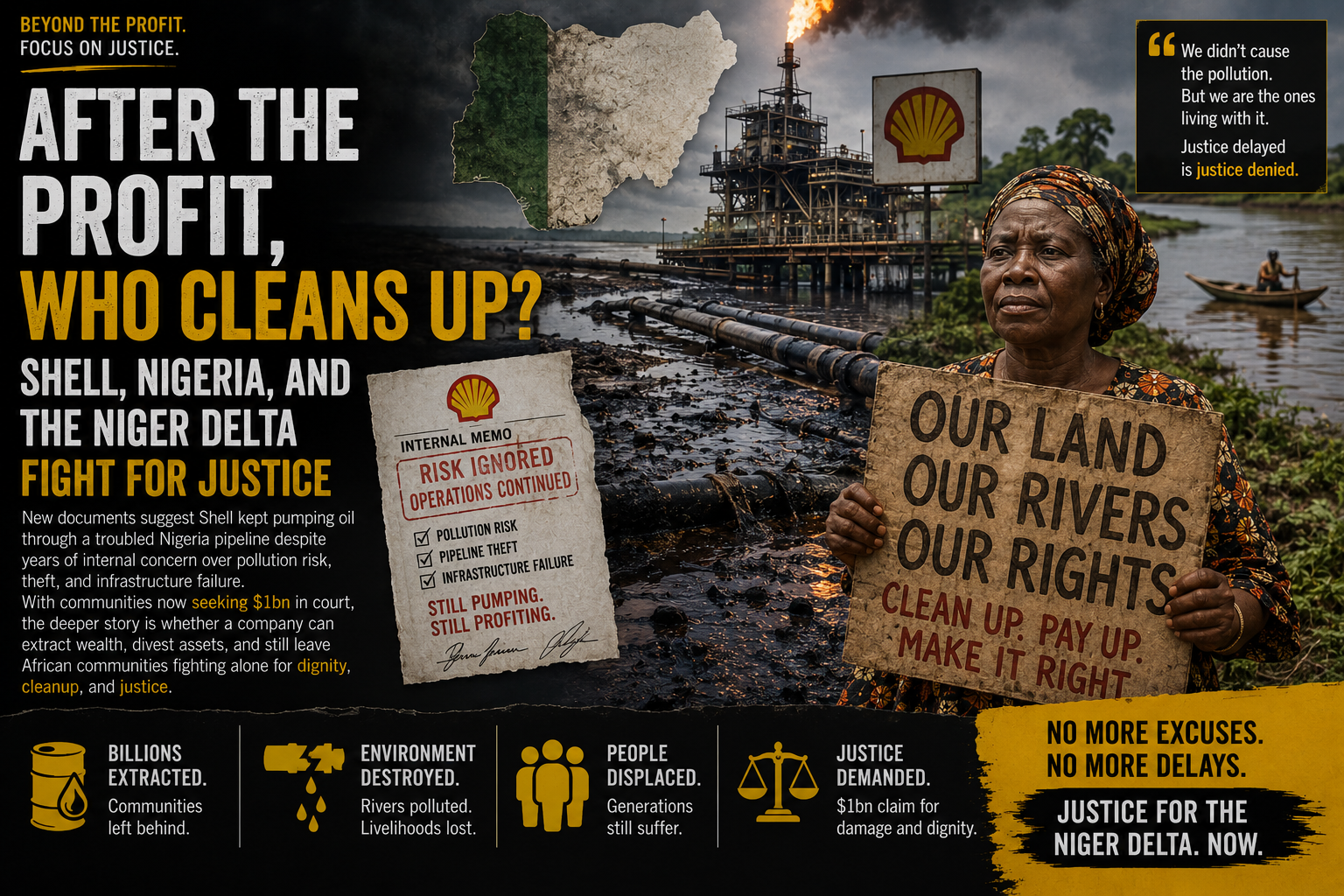
New documents suggest Shell kept pumping oil through a troubled Nigeria pipeline despite years of internal concern over pollution risk, theft, and infrastructure failure. With communities now seeking $1bn in court, the deeper ADUNAGOW story is whether a company can extract wealth, divest assets, and still leave African communities fighting alone for dignity, cleanup, and justice.
A new document trail has pulled one of the Niger Delta’s oldest questions back into sharp focus: when the profit has already been made, who is still expected to carry the damage?
The BBC reports that internal documents disclosed in ongoing UK legal proceedings suggest Shell continued operating the Nembe Creek Trunk Line for years despite internal concern dating back to 2008 over pollution risk, theft, attacks, and pipeline condition. The same reporting says the line could carry up to 150,000 barrels of oil a day and that communities are now seeking $1bn in the case, including $250m in compensation and $750m for environmental clean-up. If those allegations are ultimately proven in court, they would sharpen the case that warning signs were not only visible, but operationally tolerated for years.
That is what makes this bigger than one pipeline, one lawsuit, or one round of public outrage. It is about whether extraction companies can spend decades profiting from African land, restructure or divest when liability pressure grows, and still leave the hardest work of justice to the communities who were harmed.
The Niger Delta has lived with oil pollution for so long that there is always a risk of public numbness. Numbers become familiar. Spills become recurring. Corporate statements begin to sound procedural. But familiarity should not be confused with normality. BBC notes that the UN says at least 13 million barrels of crude have been spilled in at least 7,000 incidents in Nigeria since 1958. That is not background texture. It is a record of accumulated loss measured across land, water, livelihoods, and memory.
What Communities Are Really Fighting For
The easiest mistake in stories like this is to reduce them to a technical dispute over pipes, sabotage, and liability percentages. That framing may suit courtrooms and corporate defenses, but it does not capture what cleanup means in lived terms.
For communities in the Niger Delta, remediation is not abstract. It is about whether fishing waters can sustain life again. It is about whether farmland can produce without poisoning the ground beneath it. It is about whether children grow up surrounded by the inheritance of contamination or the possibility of repair. It is about dignity — the refusal to accept that some African communities should function as permanent sacrifice zones in the global energy economy.
That is why this story belongs beside ADUNAGOW’s wider reporting on Nigeria’s accountability battles beyond corruption headlines, the politics of industrial power and who benefits from energy systems, and how public trust erodes when communities keep carrying the cost of powerful decisions.
These are not separate themes. They are connected by one stubborn African question: when institutions and corporations fail, who is made to absorb the damage in everyday life?
The Shell case matters now because the answer still seems too often to be ordinary communities.
THISDAYLIVE reports that legal fights around Shell’s Niger Delta legacy remain active on multiple fronts. In Nigeria, a Federal High Court in Yenagoa has adjourned a suit challenging Shell’s divestment from onshore assets, with plaintiffs arguing that the sale did not follow Petroleum Industry Act guidelines and also seeking remediation for decades of pollution. In the UK, a full London High Court trial is due in 2027 over pollution allegations affecting the Bille and Ogale communities, after a preliminary ruling that opened the door to Shell potentially being held responsible for legacy pollution and negligence claims.
That timing matters. It means this is not a story about an old wound that has already been settled. It is a story unfolding in real time, precisely as Shell’s onshore exit changes the corporate landscape.
Can Divestment Outlast Responsibility?
That is the real accountability test.
Renaissance Energy Africa acquired Shell’s onshore and shallow-water assets in March 2025. In narrow corporate terms, that may look like transition. In moral terms, it raises a harder question: can responsibility be transferred as easily as assets appear to be?
A company may sell fields, pipelines, or operating positions. But can it sell the memory of what communities say was known? Can it sell away the cost of polluted creeks, damaged livelihoods, and years of delayed remedy? Can it exit the infrastructure while communities remain trapped inside the consequences?
This is where the Shell story becomes a powerful diaspora issue. Many Africans abroad already know the broad outline of Niger Delta pain. What makes this moment newly urgent is that internal records appear to sharpen the question of known risk. That shifts the conversation from vague historical tragedy toward a more pointed accountability frame: if risk was visible, if harm kept mounting, and if communities kept warning that life on the ground was degrading, then post-profit justice becomes the minimum test of seriousness.
That seriousness must include cleanup, not only compensation. Compensation can acknowledge harm, but remediation speaks to whether damaged places are allowed to live again. It also must include dignity. Too often, African environmental cases are narrated as if communities are asking for charity rather than asserting a right: the right not to have land, water, and survival permanently discounted because powerful actors made money first.
The most important part of the story, then, is not simply what Shell argues in court or what plaintiffs can prove at each procedural stage. It is the larger principle under pressure. Development cannot mean an Africa where extraction profits global markets while local communities inherit poisoned futures and endless paperwork.
Real accountability in the Niger Delta would look more concrete than corporate regret language. It would mean credible remediation, enforceable responsibility, legal seriousness that does not reward delay, and public recognition that community dignity is part of the cost of doing business — not an optional extra once profit has passed.
That is the question now hanging over Shell’s Nigeria legacy.
Not only what happened, but whether justice in the Niger Delta can outlast the dealmaking, the divestment, and the long habit of treating African damage as negotiable.
Read Next
- Nigeria’s 75-Year Corruption Verdict Could Redefine Elite Accountability
- Dangote Refinery Expansion and the Politics of Industrial Scale
- When the Reform President Becomes the Accountability Test
Discover more from ADUNAGOW Magazine
Subscribe to get the latest posts sent to your email.