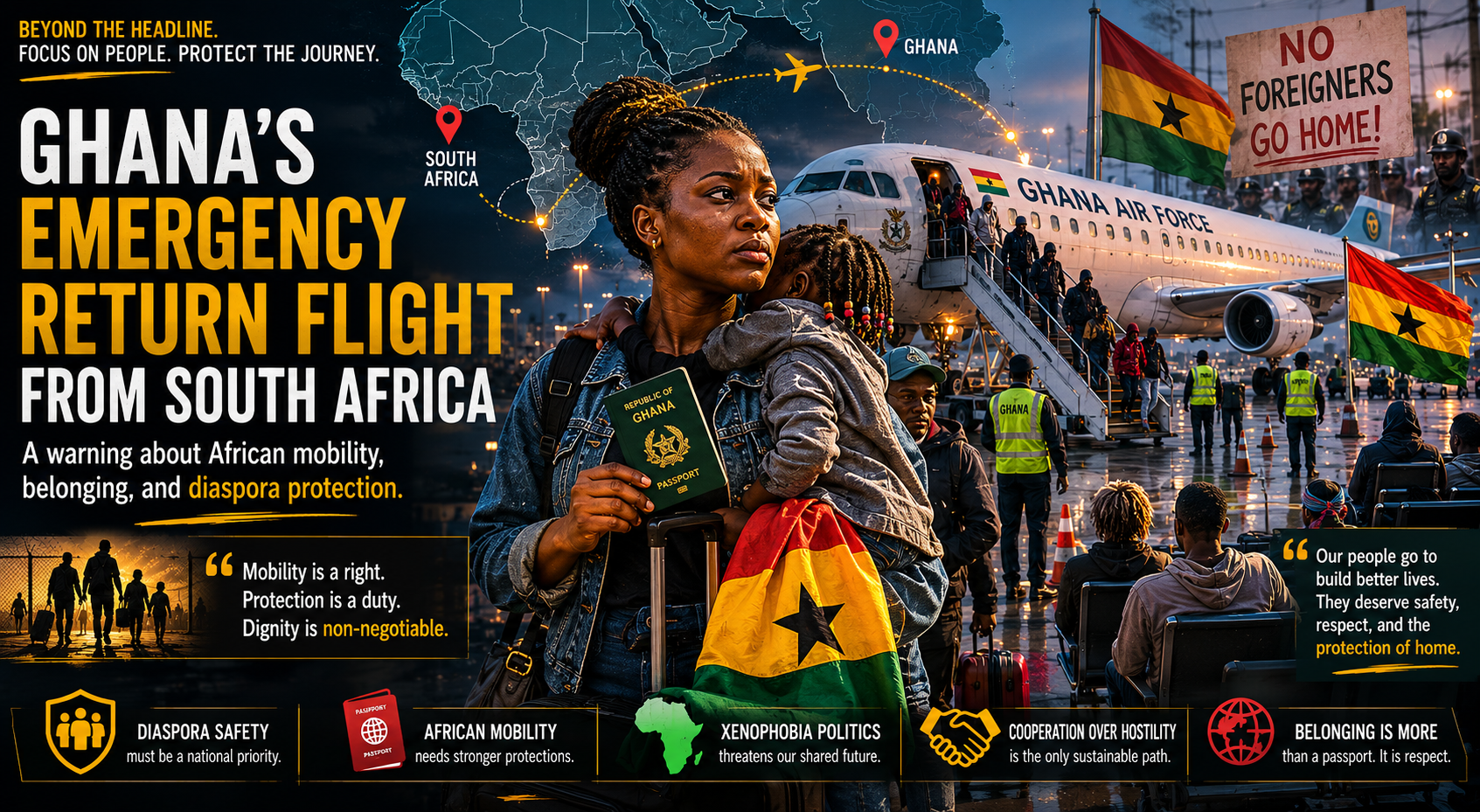
Ghana’s emergency evacuation of nearly 300 citizens from South Africa is bigger than a single repatriation flight. It is a sharp warning that African mobility still remains fragile when anti-immigration politics turns ordinary migrants into targets of fear, pressure, and public hostility.
Ghana’s emergency evacuation of citizens from South Africa is the kind of story that should make the continent pause.
A charter flight carrying 297 Ghanaian citizens has already landed in Accra after Ghana organized repatriation from South Africa, according to BBC reporting. The same report says around 800 Ghanaians registered for evacuation, while Ghana estimates that roughly 25,000 of its citizens live in South Africa. France 24 separately reported that about 300 Ghanaians returned home on the emergency flight. The immediate trigger was a wave of anti-immigration protests linked to a group called March and March, which has demanded immigration reform and set a 30 June deadline for undocumented migrants to leave.
Those are the headline facts. But the deeper story is not only about one flight or one protest movement.
It is about what happens when Africans no longer feel secure living in another African country.
That is why this story matters far beyond Ghana and South Africa alone. It is a diaspora story, a dignity story, and a stress test for the promise of African mobility.
The Flight Home Is Also a Sign of Continental Failure
Repatriation can be a necessary act of state protection. Ghana deserves credit for acting instead of pretending fear on the ground would disappear on its own. When citizens feel exposed abroad, governments have a duty to respond seriously. That part matters.
But the plane itself is also evidence of something that has gone wrong.
A return flight can bring citizens home, but it cannot hide the fact that belonging inside Africa still feels conditional for too many Africans. If people working, studying, trading, and raising families elsewhere on the continent can suddenly become targets of political anger, then mobility inside Africa is not yet as secure as the rhetoric around African unity often suggests.
That is the sharper ADUNAGOW frame. This is not just an immigration story happening in South Africa. It is a warning that African movement still becomes fragile when economic pressure, populist politics, and anti-foreigner narratives start feeding each other.
Readers who have followed ADUNAGOW’s coverage of Africa visa openness and the return economy, South Africa’s earlier xenophobia panic and the fracture of Pan-African trust, and African remittance rails as systems of family connection and trust will recognize the deeper pattern: movement is not only about legality. It is also about whether people feel protected, seen, and socially legitimate where they live.
Pan-African Language Means Little If Ordinary Africans Still Feel Expendable
South Africa has long carried a painful history of xenophobic violence and anti-migrant hostility. That history gives the current moment an especially heavy emotional charge. Even before violence reaches the worst possible point, the atmosphere of threat can already change daily life. People pull back. Businesses slow. Families panic. Community trust weakens. Every rumour feels heavier because history has taught people what escalation can look like.
That is why this moment should not be discussed as though it is only about undocumented migration or border administration. Those are real policy questions, but they do not erase the human meaning of what is happening.
The human meaning is simple: Africans living in another African country should not have to wonder whether politics will suddenly strip them of safety or dignity.
This is where the story becomes bigger than South Africa itself. If Pan-Africanism is supposed to mean anything in practical terms, it has to show up in how African societies treat African migrants during moments of pressure. Not only in conference speeches. Not only in slogans. In real life.
That is why Ghana’s response should prompt two serious follow-up questions. First, what real reintegration support will returnees receive once the emergency flight headlines fade? Second, what does continental protection look like when anti-immigration politics turns inward against fellow Africans?
Those are not abstract questions. They are development questions. A forced or pressured return can disrupt income, schooling, businesses, savings, and family plans overnight. Diaspora protection is not complete when the plane lands. It must also include a credible pathway for restarting life with dignity.
For ADUNAGOW, that is the constructive angle worth holding onto. Ghana’s intervention shows that African states can act to protect their people. But the bigger lesson is more uncomfortable: the continent still has not resolved the gap between celebrating mobility in principle and safeguarding migrants in practice.
That gap matters now because African mobility is supposed to be part of the future — economically, culturally, and politically. If that future is to mean anything, ordinary Africans must be able to move, work, and build across the continent without feeling one protest cycle away from rejection.
Ghana’s emergency return flight is therefore not just a rescue story.
It is a warning about belonging.
Read Next
- South Africa’s Xenophobia Panic Is Testing Pan-African Trust
- The Visa Wall Is Not Just About Travel. It Is About African Economic Exclusion.
- The Diaspora Money Paradox: Africa Depends on Remittances, but Sending Money Home Still Costs Too Much
Discover more from ADUNAGOW Magazine
Subscribe to get the latest posts sent to your email.