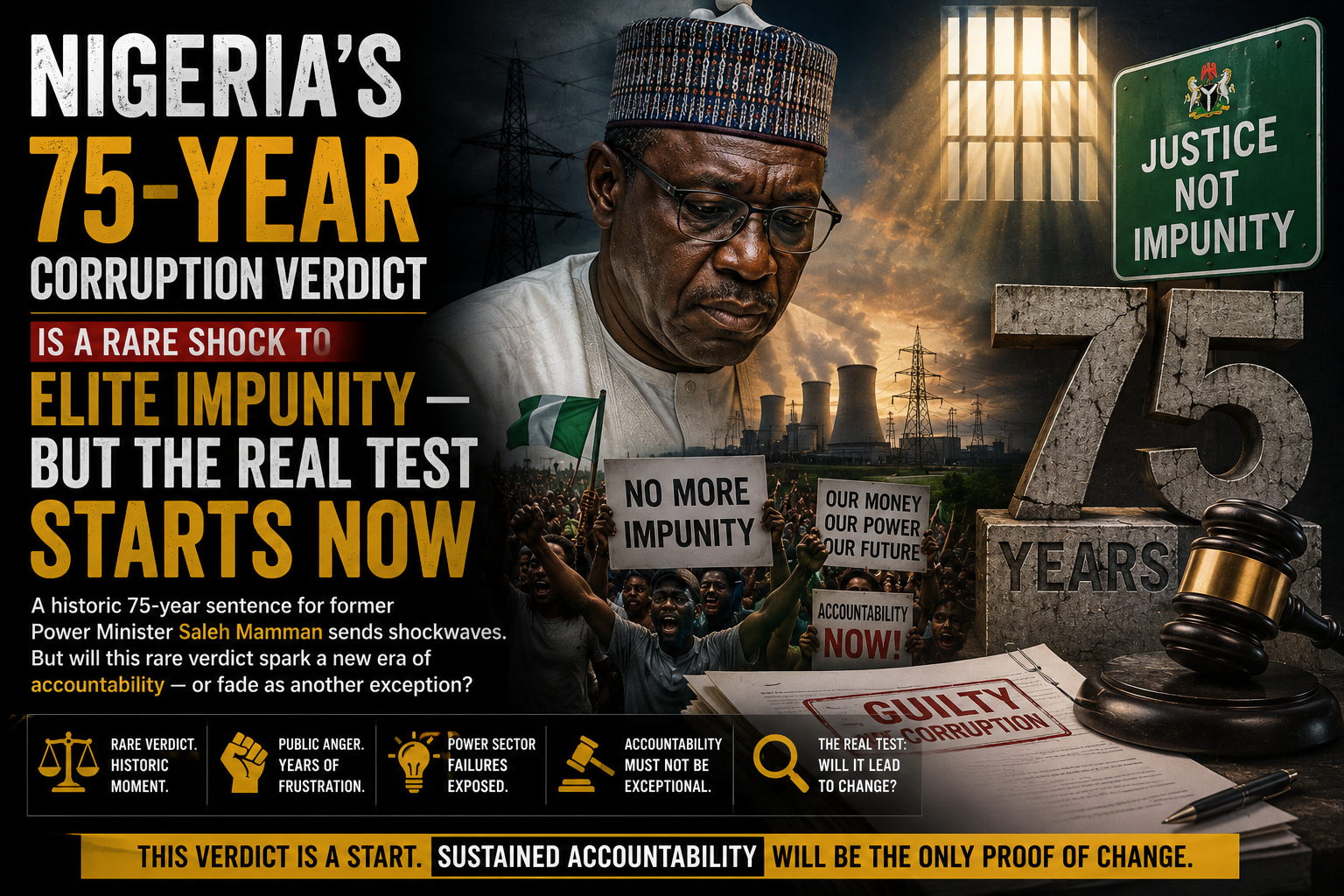
Nigeria’s 75-Year Corruption Verdict Is a Rare Shock to Elite Impunity — but the Real Test Starts Now
Nigeria’s 75-year sentence for former Power Minister Saleh Mamman has landed like a political jolt across the continent. But the bigger issue is not just the punishment itself. It is whether this rare corruption verdict signals a deeper shift in elite accountability — especially in a power sector long tied to public frustration.
The 75-year sentence handed to former Nigerian Power Minister Saleh Mamman has the force of a political thunderclap.
Not because African publics are unfamiliar with corruption allegations. Quite the opposite. Across the continent, citizens have heard so many anti-corruption speeches, watched so many investigations, and sat through so many elite scandals that disbelief has become its own kind of civic reflex. What makes this case feel different is the scale of the punishment and the symbolic weight attached to it.
A court has not merely scolded a former minister or pushed a file a few inches forward. It has delivered a sentence so severe that it immediately raises a bigger question: is Nigeria finally showing that elite accountability can reach the top with real consequences?
That is why this story matters beyond the courtroom.
BBC Africa has framed the ruling as a rare corruption verdict, while Premium Times has treated the case as a major national story tied to power project fraud. Those details matter because they place the case inside two public conversations at once: the credibility of anti-corruption in Africa’s most populous country, and the repeated failures of a power sector that has shaped daily life, business confidence, and development frustration in Nigeria for years.
Why the power-sector angle matters
If this were only a scandal about private greed, it would still matter. But this is also a story about electricity, infrastructure, and the broken promises that ordinary people live with when public money disappears into elite misconduct.
Nigerians do not experience corruption as an abstract ethics debate. They experience it in stalled systems, unstable power, high business costs, and the painful gap between national potential and daily reality. That is what gives this verdict public weight.
It also connects naturally to ADUNAGOW’s wider reporting on how industrial ambition rises or falls with energy and logistics discipline, how elite accountability shapes continental trust, and how mobility, dignity, and opportunity are often blocked by weak systems and unequal power.
Those links are not decorative. They point to the larger truth that corruption in a ministry this central is never only a legal story. It is a development story.
A verdict is not the same thing as a turning point
That is where caution matters.
A historic sentence does not automatically become a historic shift. Reporting that authorities do not yet know Mamman’s whereabouts introduces exactly the kind of tension that could define the next chapter. A strong verdict can electrify headlines, but public trust is not rebuilt by symbolism alone. It is rebuilt by enforcement, follow-through, and visible consistency.
That distinction matters deeply for diaspora readers.
Across Europe, North America, and elsewhere, Africans are often forced into representational work: defending the reality of progress while also carrying fatigue about scandals that repeatedly confirm old stereotypes about elite impunity. So when a case like this breaks through, it creates both hope and hesitation. Hope, because a sentence of this magnitude suggests the system can still produce teeth. Hesitation, because many Africans have seen dramatic moments of accountability before that changed less than they first promised.
The sharper reading, then, is not triumphal. It is serious.
Nigeria may have produced one of the continent’s most arresting accountability headlines of the year. But the deeper value of the verdict will depend on what happens next. Does enforcement hold? Does the case become a reference point for future prosecutions? Do public institutions show that this was not a one-off eruption but part of a more durable standard?
What this means for trust
That final question matters most.
Accountability is not measured only by punishment on paper. It is measured by whether the political class begins to internalize new limits, whether public trust stops draining so fast, and whether sectors like power can be governed as public goods rather than elite feeding grounds.
Nigeria is too important to Africa’s democratic and economic story for this verdict to be treated as mere spectacle. When something this rare happens in one of the continent’s most consequential countries, it becomes a continental signal. It tells other publics what may be possible. It reminds other institutions what seriousness could look like.
The sentence is not powerful only because it is long. It is powerful because it exposes how starved the public has become for visible elite consequence.
If Nigeria can finish what this court has started, the verdict could become more than a moment. It could become a precedent. If not, it risks joining the long archive of dramatic African headlines that briefly raised hopes without changing the deeper machinery of impunity.
For now, the judgment stands as a rare interruption to that machinery.
Whether it becomes something bigger is the real story.
Read Next
- When the Reform President Becomes the Accountability Test
- Dangote Refinery Expansion Could Change Africa — But Will Nigerians Feel the Benefit?
- The Visa Wall: Why Falling African Travel to America Is Really a Diaspora Business Story
Discover more from ADUNAGOW Magazine
Subscribe to get the latest posts sent to your email.