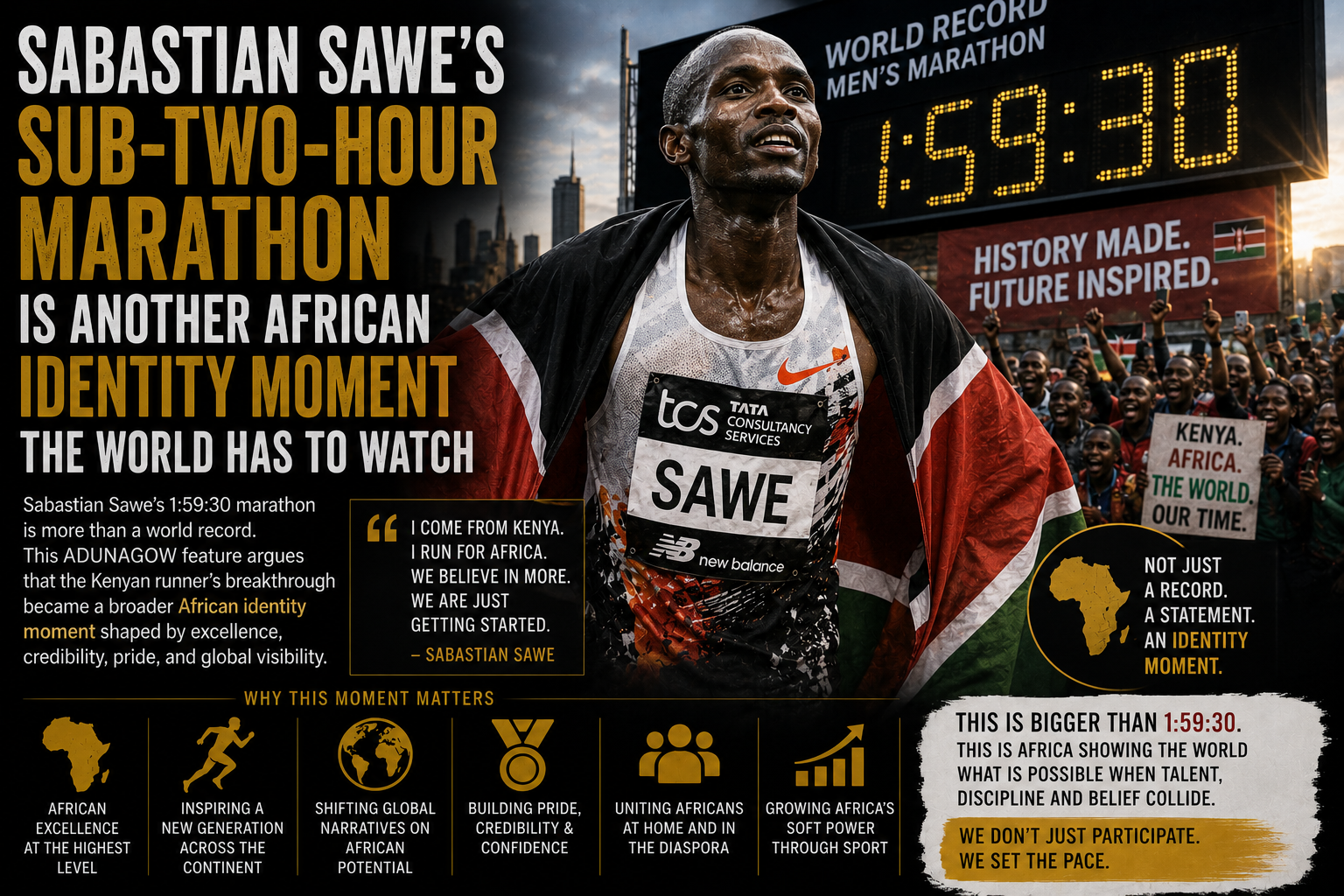
Kenya’s Sabastian Sawe has become the first man to run an official sub-two-hour marathon. The record is historic on its own, but for African audiences it is also something else: a pride story, an image story, and another reminder that the continent’s biggest sports moments rarely stay inside sport.
Excerpt: Sabastian Sawe’s 1:59:30 marathon is more than a world record. This ADUNAGOW feature argues that the Kenyan runner’s breakthrough became a broader African identity moment shaped by excellence, credibility, pride, and global visibility.
The number is so clean it almost feels invented: 1:59:30.
That is the time BBC Sport says Kenya’s Sabastian Sawe ran at the London Marathon to become the first person to break two hours in an official competitive marathon. On its face, that is already enough to guarantee history. But for African audiences, especially for Kenyans and the diaspora, the meaning of this performance does not stop at sport.
It widens.
That is what major African sports moments tend to do.
They become arguments about image, excellence, and belonging. They become opportunities to feel the continent winning in a language the world immediately understands. And they become reminders that Africa’s global identity is not shaped only by the headlines imposed on it, but also by the standards of greatness it creates for itself.
Sawe’s performance fits that pattern perfectly.
BBC reports that even he said afterward that he was not thinking about a world record. He was focused on winning. That detail makes the feat feel even more striking. A man trying to defend a title ends up rearranging the limits of what official marathon running was supposed to allow. The same BBC reporting notes that he broke the previous world record by 65 seconds, a margin large enough to feel emphatic rather than accidental.
This is where ADUNAGOW should resist the lazy sports recap.
Yes, the record matters. Yes, the splits, shoes, fuelling, and preparation all matter. BBC’s profile of Sawe is rich with those details, from the injury concerns that nearly disrupted his build-up to the frequent anti-doping tests he underwent in order to quiet suspicion in a sport where Kenyan excellence is too often forced to carry other people’s doubt. That anti-doping detail is especially important. Sawe has publicly emphasized that he runs clean, and the visibility of those tests matters because African sporting brilliance is too often met with admiration on one hand and suspicion on the other.
That tension is part of the story.
So is the joy.
When BBC showed Sawe returning home to Kenya and being welcomed with dancing and music at Nairobi airport, it captured the part outsiders often miss. For African publics, especially in countries with strong sporting traditions, these victories are never only about the individual. They are collective emotional events. They carry family pride, local pride, national pride, and a broader continental feeling that one of our own has once again forced the world to recalibrate what greatness looks like.
Kenya knows this script well. Distance running has long been one of the country’s most visible contributions to global sport. But familiarity should not reduce amazement. Repeated excellence is not routine. It is culture. It is discipline. It is infrastructure, aspiration, and belief working together so consistently that outsiders sometimes mistake mastery for inevitability.
That is exactly why moments like this still matter so much.
In ADUNAGOW’s editorial lane of sports, culture, and identity, a story like Sawe’s is valuable because it does several jobs at once. It offers a clean, uplifting example of positive African contribution. It gives diaspora readers a pride story with universal readability. And it demonstrates that sport remains one of the clearest places where African excellence travels without translation.
It also says something about narrative power.
The global conversation about Africa often arrives cluttered with qualification. Progress is explained cautiously. Achievement is diluted by stereotype. Even admiration can come packaged with surprise, as if excellence from the continent must always reintroduce itself. A performance like Sawe’s cuts through all of that. It does not need a pity frame, a development frame, or a crisis frame. It demands respect in the bluntest possible terms: time, result, history.
That is why the record matters beyond the finish line.
It belongs in the same broad image conversation as ADUNAGOW’s recent work on African soft power in music, fashion, and film. It also belongs beside wider diaspora discussions about visibility, dignity, and the right to be seen through achievement rather than restriction. In one arena, Africans are still negotiating mobility and image barriers. In another, they are setting the pace for the world.
Sport can hold both truths at once.
Sawe’s sub-two-hour marathon is therefore not only a triumph of physiology or preparation. It is another moment in which African excellence became impossible to soften, question away, or narrate around. The world had to watch. The clock made sure of it.
And for many African readers, that is the deeper beauty of the story.
It was history.
But it was also recognition.
Read Next
- The New African Soft Power Story Is Happening in Music, Fashion, and Film
- Meet the Africans Building the New Diaspora Return Economy
- Why Diaspora Money Is Still One of Africa’s Most Underrated Power Systems
Discover more from ADUNAGOW Magazine
Subscribe to get the latest posts sent to your email.