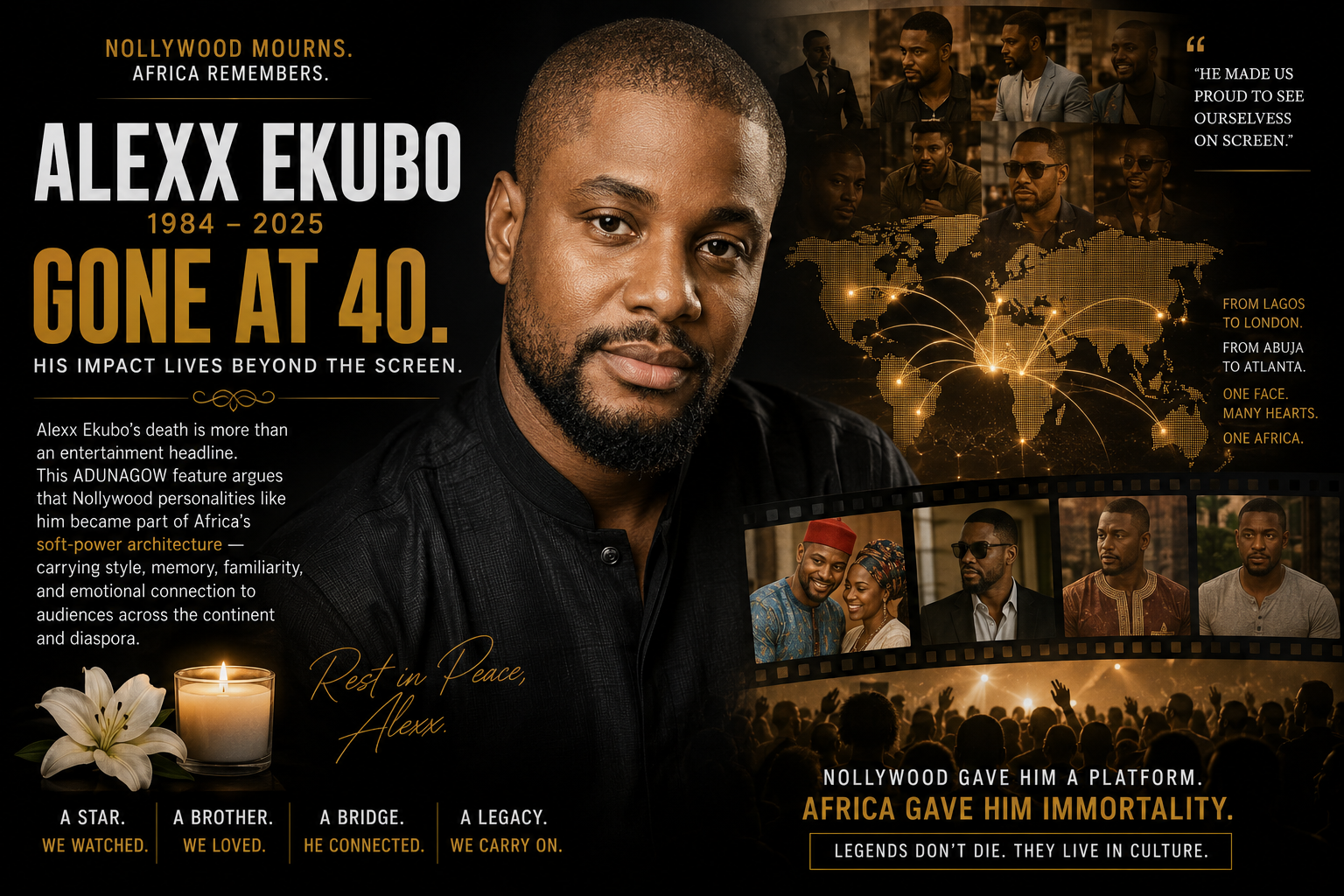
Nigerian actor Alexx Ekubo has died at 40 after a battle with cancer. The deeper story is not only grief inside Nollywood, but how stars like him helped carry African familiarity, aspiration, and cultural influence across borders.
Excerpt: Alexx Ekubo’s death is more than an entertainment headline. This ADUNAGOW feature argues that Nollywood personalities like him became part of Africa’s soft-power architecture — carrying style, memory, familiarity, and emotional connection to audiences across the continent and diaspora.
On one level, this is a deeply human loss. BBC Africa reports that the Nigerian actor died in a Lagos private hospital after complications from advanced metastatic kidney cancer. Tributes from colleagues and fans have carried the shock that always follows when someone who still feels culturally present is suddenly gone. But the stronger ADUNAGOW question is not only who Alexx Ekubo was. It is what figures like him come to represent.
Because Nollywood stars do more than entertain.
They travel with people.
For millions of Africans and diaspora audiences, actors become part of the emotional furniture of home. They appear in films watched in living rooms far from Lagos. They move through music videos, memes, interviews, red carpets, and social feeds. They help carry accent, humor, style, flirtation, masculinity, glamour, and familiarity across borders. In that sense, Alexx Ekubo belonged to a generation of Nollywood personalities who helped make African pop culture feel mobile.
That is why this story deserves more than celebrity mourning language.
BBC notes that Ekubo was known for roles including Weekend Getaway and for appearing in Yemi Alade’s Johnny video, one of those cultural objects that traveled widely enough to feel bigger than its original release moment. He also received recognition for humanitarian efforts, including a special award from Nigeria’s First Lady and later inclusion in the MIPAD under-40 list tied to entertainment and social development. Those details matter because they show that his public image was never limited to screen presence alone. He functioned as a cultural personality, not just an actor-for-hire.
That distinction says something important about Nollywood’s place in African influence.
When ADUNAGOW argued in its recent soft-power analysis that culture becomes serious when it shapes image, aspiration, and economic possibility, Nollywood sat at the center of that case. Film gives Africa faces. It gives audiences recurring personalities they can recognize, follow, admire, debate, and remember. That kind of repetition matters. It turns individual entertainers into vessels of continental familiarity.
Alexx Ekubo’s career fits inside that pattern.
He emerged during a period when Nollywood was becoming not only larger, but more exportable in tone and presentation. The stars of that era did not simply act in stories. They helped project a version of African confidence that felt stylish, urban, humorous, and emotionally legible to audiences far beyond one country. For diaspora viewers especially, that matters. Culture is one of the places where belonging survives distance.
A familiar actor on screen can do quiet identity work. He can make home feel less far away. He can remind viewers that African lives are not only explained through politics, crisis, or development statistics. They are also explained through flirtation, fashion, friendship, ambition, comedy, heartbreak, and all the ordinary textures of social life that entertainment preserves so well.
That is part of what Nollywood has always done at its best.
And it is why a death like this lands differently.
It is not simply about losing a performer. It is about losing one of the recognizable faces through which a cultural ecosystem spoke. The grief feels personal because African entertainment has become one of the continent’s strongest routes into intimacy with its own audience. In homes across Africa and the diaspora, stars become familiar long before they become formally historic.
There is another layer too.
Ekubo’s public recognition for charity and social development hints at how African celebrities increasingly occupy blended roles. They are no longer only artists. They are public symbols, informal ambassadors, aspirational figures, and sometimes bridges between visibility and service. That does not make them saints. It makes them part of a wider soft-power system where image, empathy, influence, and contribution mix together.
ADUNAGOW should care about that system because it is one of the publication’s clearest editorial opportunities. Entertainment coverage wins attention. But when handled well, it also opens a path into deeper questions about who carries African image, who shapes cultural memory, and why familiar faces can matter so much to scattered publics.
Alexx Ekubo’s death is painful because the loss is real.
But it also reminds us of something bigger: Nollywood is not only a film machine. It is one of Africa’s emotional export systems. Its stars help people remember, imagine, and feel the continent in human terms.
That is a serious legacy.
And it is why this is more than a celebrity story.
Read Next
- The New African Soft Power Story Is Happening in Music, Fashion, and Film
- Meet the Africans Building the New Diaspora Return Economy
- Why Diaspora Money Is Still One of Africa’s Most Underrated Power Systems
Discover more from ADUNAGOW Magazine
Subscribe to get the latest posts sent to your email.