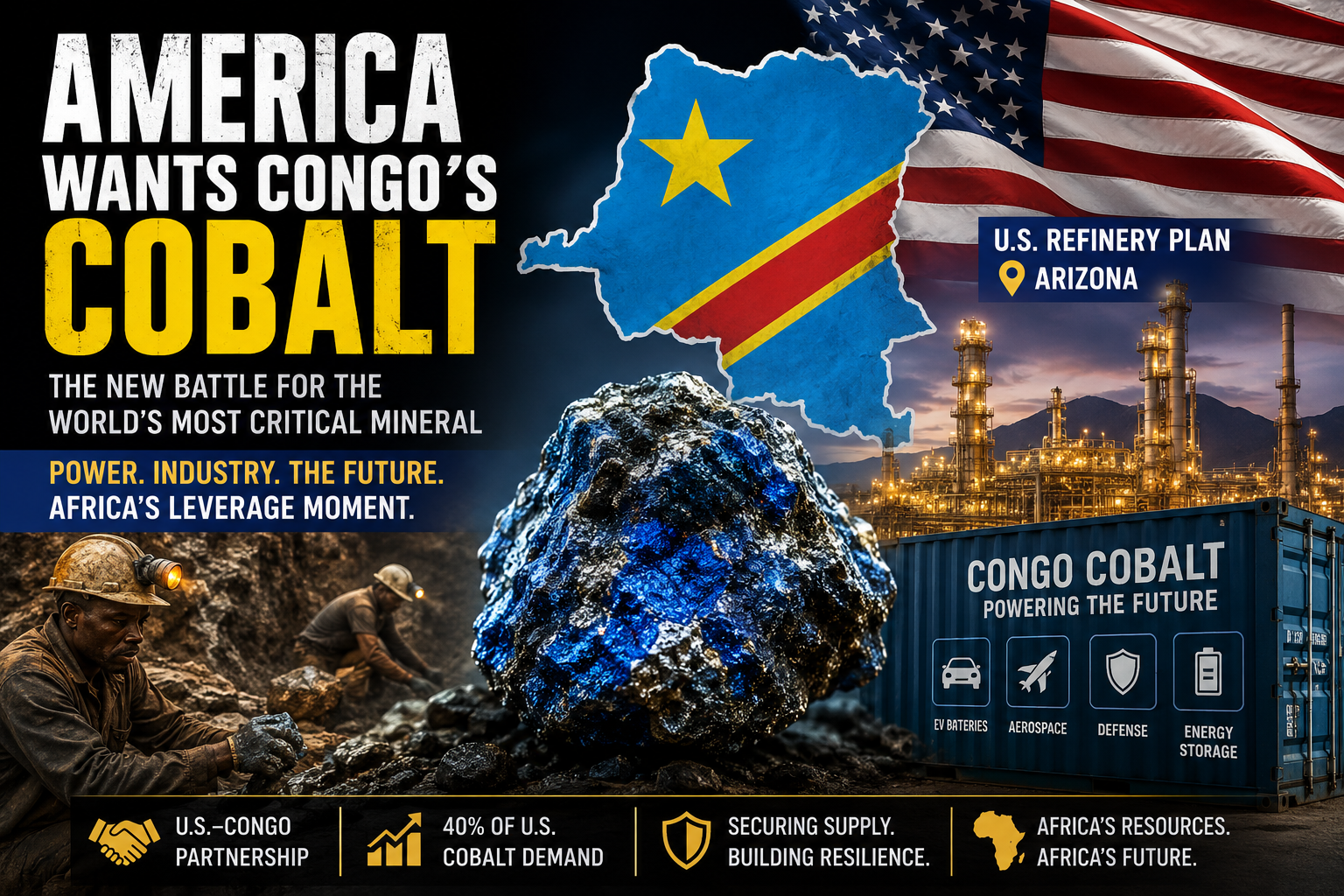
The global race for critical minerals is entering a new and more openly geopolitical phase — and once again, the Democratic Republic of Congo sits at the center of it.
A new long-term cobalt supply agreement involving Congo’s state-backed cobalt company, commodity giant Trafigura, and U.S.-based refinery developer EVelution Energy has reignited global attention on one of Africa’s most strategically important resources. The plan aims to feed Congolese cobalt into a major refining operation in the United States that could eventually provide nearly 40 percent of projected American cobalt demand.
On the surface, this is a business story about electric vehicles, industrial policy, and battery supply chains.
But underneath it, this is really a story about power.
Because cobalt is no longer just a mineral. It is becoming geopolitical infrastructure.
The Democratic Republic of Congo produces roughly 70 percent of the world’s cobalt supply. Without Congo, the global electric vehicle revolution slows down. Defense manufacturing becomes more vulnerable. Advanced battery production becomes more expensive. The energy transition itself becomes less secure.
And the world knows it.
For years, the global system treated African minerals as cheap raw materials that could be extracted, exported, refined elsewhere, and sold back into the global economy with little African control over the higher-value industrial stages.
The Democratic Republic of Congo became one of the clearest examples of that imbalance. The country supplied the world with enormous mineral wealth while struggling with instability, underdevelopment, corruption allegations, and weak industrial transformation.
But global conditions are changing.
The United States is now aggressively trying to reduce its dependence on China for critical mineral refining. China currently dominates much of the world’s cobalt processing infrastructure, even though the raw material itself overwhelmingly comes from Congo.
That imbalance has become a national security concern in Washington.
As a result, the United States is attempting to build alternative supply chains that are politically friendlier, strategically safer, and less dependent on Chinese-controlled processing networks.
That is where this new refinery agreement becomes important.
Under the framework being discussed, Congolese cobalt hydroxide would be shipped to the United States and refined in Arizona into battery-grade cobalt sulfate and cobalt metal. Those materials are essential for electric vehicles, aerospace systems, military technologies, and advanced industrial manufacturing.
The project signals that America no longer sees cobalt as a niche commodity. It now sees it as a strategic necessity.
But the deeper African question is whether this changes anything fundamental for Congo itself.
Because from one perspective, the structure still looks familiar:
Africa extracts. Foreign powers refine. The highest-value industrial profits remain outside the continent.
And that reality continues to frustrate many Africans who believe the continent has spent decades exporting strategic wealth while importing dependency.
However, there are signs that the conversation may be shifting.
Reports surrounding the deal suggest discussions around greater Congolese participation, including possible ownership stakes and more structured state involvement through Entreprise Générale du Cobalt (EGC), the Congolese state-backed entity created to formalize and regulate artisanal cobalt production.
That matters.
Because for decades, African states often negotiated from positions of weakness, fragmentation, or urgent financial pressure. Today, critical minerals are giving some African governments new leverage in global negotiations.
The world’s industrial powers need these resources urgently.
And Africa knows it.
This creates a new strategic environment where countries like Congo may have more bargaining power than they did during previous commodity booms.
The challenge now is whether African leadership can convert mineral importance into long-term national advantage.
That means:
- stronger local processing capacity
- industrial investment
- transparent revenue management
- infrastructure development
- energy expansion
- workforce training
- and ownership participation across the value chain
Without those shifts, Africa risks repeating the old cycle where global powers compete aggressively for African resources while ordinary citizens see limited transformation on the ground.
There is also another uncomfortable reality emerging from this story.
The West’s sudden urgency around African minerals is not purely humanitarian, environmental, or developmental. It is strategic.
The electric future of the global economy requires African resources.
The defense future of advanced military powers increasingly requires African resources.
The technological future of battery storage requires African resources.
That changes Africa’s geopolitical relevance dramatically.
And perhaps for the first time in decades, the continent’s resource leverage is becoming difficult for the world to ignore.
The question now is whether Africa will merely supply the future — or negotiate ownership within it.
Because the real battle is no longer over whether Congo has cobalt.
The real battle is over who captures the power created by it.
Read Next
- Africa’s Trillion-Dollar Mineral Rush: Who Really Owns the Future?
- Dangote’s 1.4 Million BPD Refinery Expansion Could Change Africa — But Will Nigerians Feel the Benefit?
- Ghana Begins Refining Gold Locally at Gold Coast Refinery
Join the Conversation
Africa’s mineral future is being negotiated right now — in boardrooms, governments, refineries, and global power circles. The question is no longer whether Africa matters to the future economy. The question is whether Africans will own enough of that future to shape it.
Do you believe Congo and other African nations should demand local refining, ownership stakes, and stronger industrial participation before exporting strategic minerals?
Share your thoughts in the comments and follow ADUNAGOW Magazine for more sharp analysis on Africa, global power, business, technology, and the future of the diaspora.
Discover more from ADUNAGOW Magazine
Subscribe to get the latest posts sent to your email.