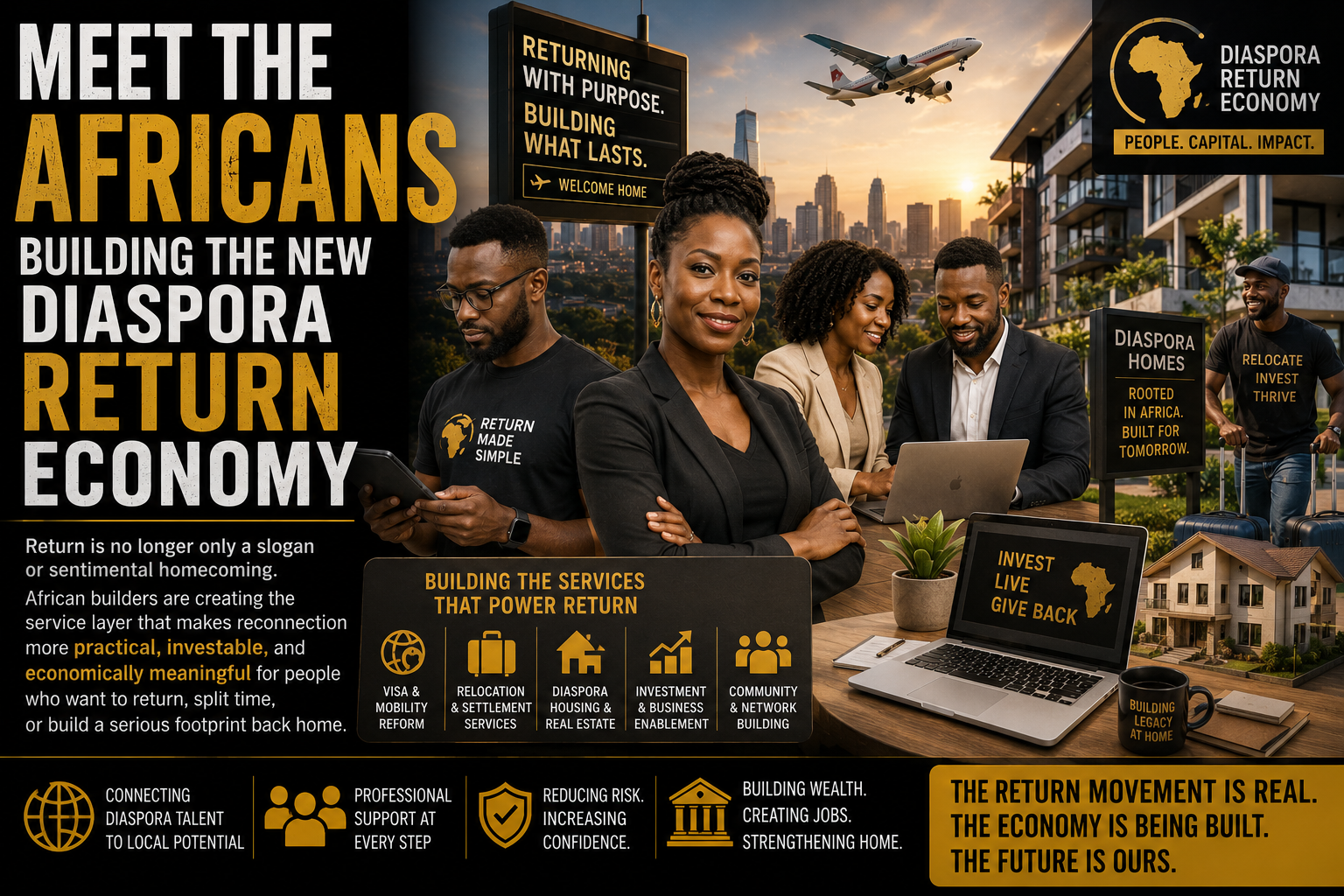
The return-to-Africa story is no longer only emotional. Across policy, housing, relocation, and business services, a new class of African builders is turning reconnection into real infrastructure.
For years, the return-to-Africa story was told mainly in emotional language.
It was about ancestry, healing, homecoming, and the spiritual pull of reconnecting with a continent that many in the diaspora had been taught to imagine from a distance. That emotional core still matters. But it is no longer the whole story.
A new economy is taking shape around return, and the people building it are doing something more practical than selling nostalgia. They are reducing friction.
That is the shift worth paying attention to.
The African Development Bank and the International Organization for Migration have already argued that diaspora engagement is a development tool, not just a cultural project. Their joint framing is clear: diaspora ties can help reverse brain drain while accelerating flows of skills, knowledge, and capital back into African economies. The UN’s latest migrant stock data also reminds us that the audience for this shift is enormous. The pool is not symbolic. It is global and durable.
Now the service layer is catching up.
In Ghana, Foreign Affairs Minister Samuel Okudzeto Ablakwa has announced visa-free entry for diaspora visitors during this year’s Black Star Experience, arguing that people of African descent should not be treated like foreigners when they come to reconnect. That is more than a nice gesture. It is policy as infrastructure. It says governments increasingly understand that if they want diaspora presence, spending, and long-term commitment, they have to lower the entry friction.
The Black Star Experience itself is explicit about the ambition. Its mission is to attract people, investments, and businesses into the Ghanaian economy through culture, tourism, and creative engagement. In other words, return is being packaged not only as identity, but as economic strategy.
But policy alone does not complete the journey. Someone still has to help people land.
That is where builders like Monalisa Effah come in. Effah, the founder and CEO of Lusso Casona, has built one of Ghana’s better-known luxury real estate and expatriate relocation firms. According to MyJoyOnline, she has spent more than a decade guiding diasporans, families, and corporations through the practical realities of cross-border movement and investment in Ghana. Her recent appointment as ambassador for the Ghana-Jamaica Homecoming is significant because it captures what the return economy now requires: not vibes, but trusted operators.
Homecoming sounds beautiful in a speech. In real life, it depends on housing, legal clarity, local navigation, vetted property options, and someone who knows how to translate aspiration into an address.
Michael Kyei-Ayensu represents another part of the same system. The founder and CEO of Jacob West Limited relocated from the United Kingdom to build in Ghana and has spoken publicly about how difficult that transition was, even with prior business success abroad. His company is now associated with mortgage brokerage, property advisory, and diaspora-focused housing solutions. That matters because one of the biggest psychological gaps in the return conversation is the distance between wanting to come back and knowing how to do it without making expensive mistakes.
Builders like Kyei-Ayensu work inside that gap.
They turn “I want to do something back home” into something more concrete: a financing plan, a property decision, an investment structure, a business pathway, a realistic timeline.
And the competition is not limited to Ghana. Kenya’s immigration system now offers a Class N digital nomad permit valid for one or two years for remote workers employed by foreign firms or serving foreign clients. That tells us return no longer has to mean one dramatic permanent move. It can mean staged re-entry, split-location living, long stays, remote work, soft landing, then deeper commitment later.
That is one reason the term “return economy” matters so much. It is broader than migration. It includes relocation support, cultural tourism, investment guidance, community building, business advisory, remote-work policy, and the emotional intelligence required to help people rebuild identity as well as logistics.
The smartest African builders in this space understand something powerful: the diaspora does not need only invitation. It needs systems.
That does not mean the return economy is simple. It can still be overhyped. Some operators are serious; others are selling fantasy. Some returnees arrive idealistic and then collide with bureaucracy, pricing pressure, or local complexity. Even Michael Kyei-Ayensu has warned that technical expertise from abroad does not automatically translate into local success. Global experience helps, but local intelligence remains indispensable.
That caution actually strengthens the story. It makes the builders more necessary, not less.
The new diaspora return economy is not about pretending the move home is easy. It is about creating better rails for people who want to reconnect on serious terms—whether that means moving forever, splitting time, investing, hiring, building, or simply becoming less absent from the continent’s future.
That is why this trend deserves more than sentimental coverage. It is one of the clearest signs that diaspora identity is being converted into development infrastructure.
The next era of return will not be built by slogans alone.
It will be built by the Africans who know how to turn longing into systems.
Read Next
- From Year of Return to the 17th Region: Is Ghana Finally Giving the Diaspora Real Power?
- The Visa Wall: Why Falling African Travel to America Is Really a Diaspora Business Story
- The Diaspora Money Paradox: Africa Depends on Remittances, but Sending Money Home Still Costs Too Much
Discover more from ADUNAGOW Magazine
Subscribe to get the latest posts sent to your email.