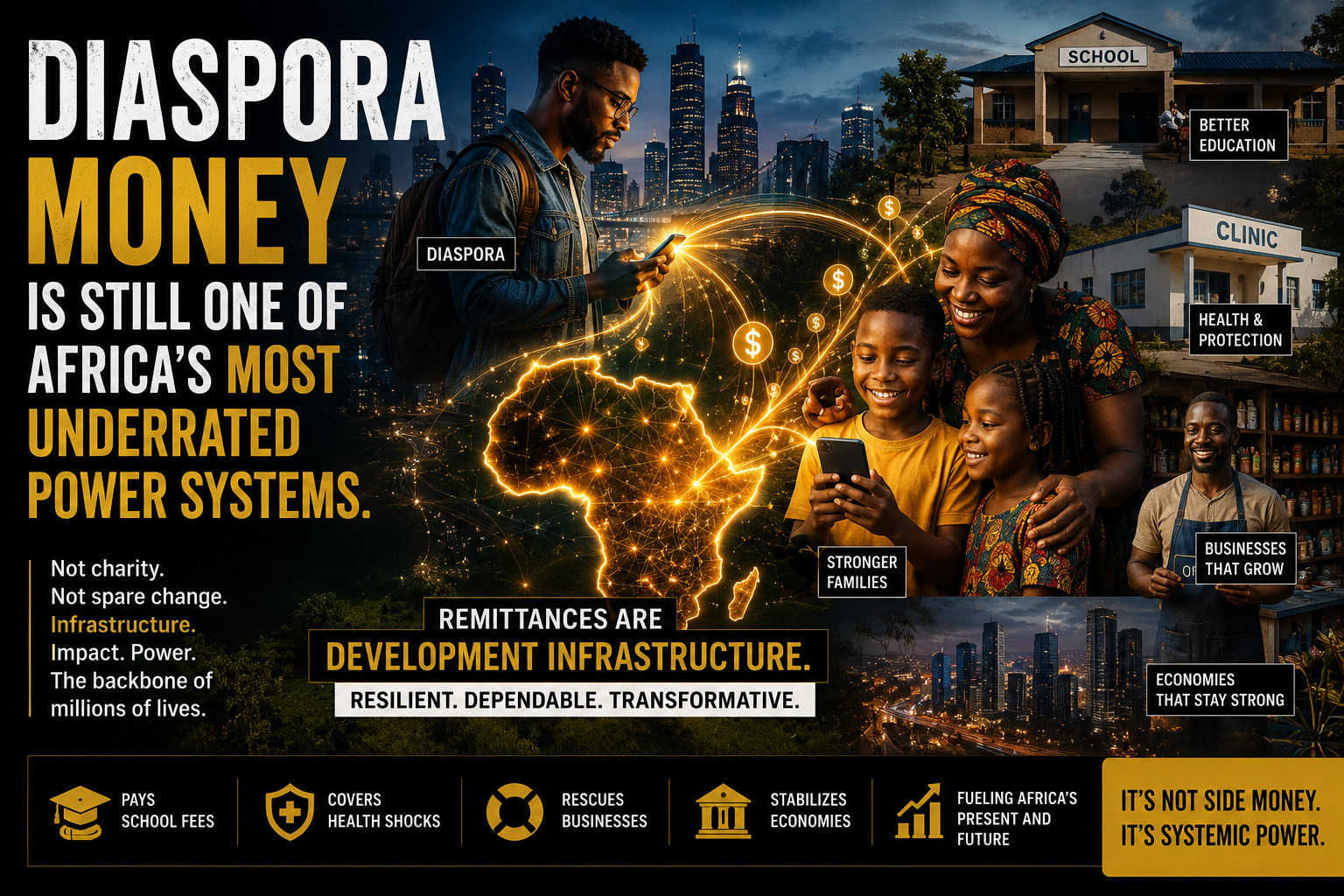
Remittances are often treated like private family sacrifice. In reality, diaspora money is one of Africa’s most reliable development systems—keeping households stable, businesses alive, and entire economies breathing.
Across Africa, there is a quiet budget line that does not appear in most national speeches with the respect it deserves.
It is the money sent home by Africans abroad.
Not the dramatic investment announcement. Not the aid package with cameras around it. Not the high-level summit language about transformation. Just the recurring transfer from a nurse in London, a driver in New York, a student in Toronto, an engineer in Berlin, a care worker in Milan, a founder in Atlanta. Month after month, crisis after crisis, diaspora money keeps systems alive.
This is why remittances should be discussed with more seriousness than they usually are.
The World Bank projected that remittance flows to low- and middle-income countries would reach 685 billion dollars in 2024, larger than foreign direct investment and official development assistance combined. Sub-Saharan Africa alone was expected to receive about 56 billion dollars. Those are not sentimental numbers. They describe one of the most resilient financial systems connected to the continent.
But the real meaning of diaspora money is easier to understand at household level first.
It is school fees paid on time. It is hospital bills handled before they become tragedy. It is rent covered during a family emergency. It is the capital that helps a small shop restock, the cushion that keeps a young graduate moving, the rescue money that arrives when inflation, illness, unemployment, or state weakness leaves families exposed.
That is why the phrase “sending money home” is too casual for what is often happening.
In many families, diaspora money is not extra. It is structure.
And in some economies, that structure is even more visible. World Bank and KNOMAD data have flagged countries such as The Gambia, Lesotho, Comoros, Liberia, and Cabo Verde as especially dependent on remittances. In those contexts, the money Africans send home is not peripheral to national survival. It is part of the bloodstream.
Yet the system is still treated in a strangely private way. Governments are happy to count the inflows, but slower to treat senders like stakeholders. Public language often frames the diaspora as generous relatives rather than as economic actors helping hold up education, health, consumption, business continuity, and foreign exchange resilience.
That framing is too weak.
Diaspora money is one of Africa’s most underrated power systems because it combines scale with consistency. It shows up even when investors get nervous. It keeps moving even when aid politics change. It often flows fastest when families are under pressure. It is not perfect, and it should not be romanticized. But it is durable.
The insult is that the system remains expensive to use.
According to the same KNOMAD brief, sending 200 dollars to Sub-Saharan Africa cost an average of 7.9 percent, nearly unchanged from a year earlier. That means diaspora households are paying twice: first through sacrifice, then through friction. They are carrying the emotional burden of transnational responsibility while also subsidizing the transaction layer that sits between need and support.
That cost matters morally, but it also matters strategically. If remittances are already functioning as development infrastructure, then reducing the price of sending money should be treated as a development priority. This is where policymakers, banks, fintech firms, and regional institutions should be far more ambitious.
There is also a second conversation that deserves attention. The African Development Bank and IOM have stressed that diaspora engagement is not just about cash transfers. Skills, networks, knowledge, and resilience move through diaspora channels too. In other words, diaspora money is the most visible part of a broader power system, but not the only part.
Still, the money itself tells a profound story.
It tells us that millions of Africans abroad are already participating in development, whether or not official narratives know how to honor them properly. They are not waiting for perfect systems to exist before acting. They are filling gaps now.
That should deepen gratitude, but it should also sharpen accountability.
How long can states rely on diaspora sacrifice without designing better rails around it? How long can remittance corridors remain expensive while everyone publicly praises the diaspora? How long can policymakers talk about inclusion without treating senders as people whose transfers are helping stabilize the social contract?
ADUNAGOW’s audience does not need to be convinced that this money is real. Many readers are the ones sending it.
What they may need is stronger language for what they are already doing.
They are not only helping relatives.
They are helping power Africa through one of its most dependable informal systems.
Read Next
- The Diaspora Money Paradox: Africa Depends on Remittances, but Sending Money Home Still Costs Too Much
- The Secret Economy of the Diaspora: Why Everyone Is Sending Money Home Now
- From Year of Return to the 17th Region: Is Ghana Finally Giving the Diaspora Real Power?
Discover more from ADUNAGOW Magazine
Subscribe to get the latest posts sent to your email.