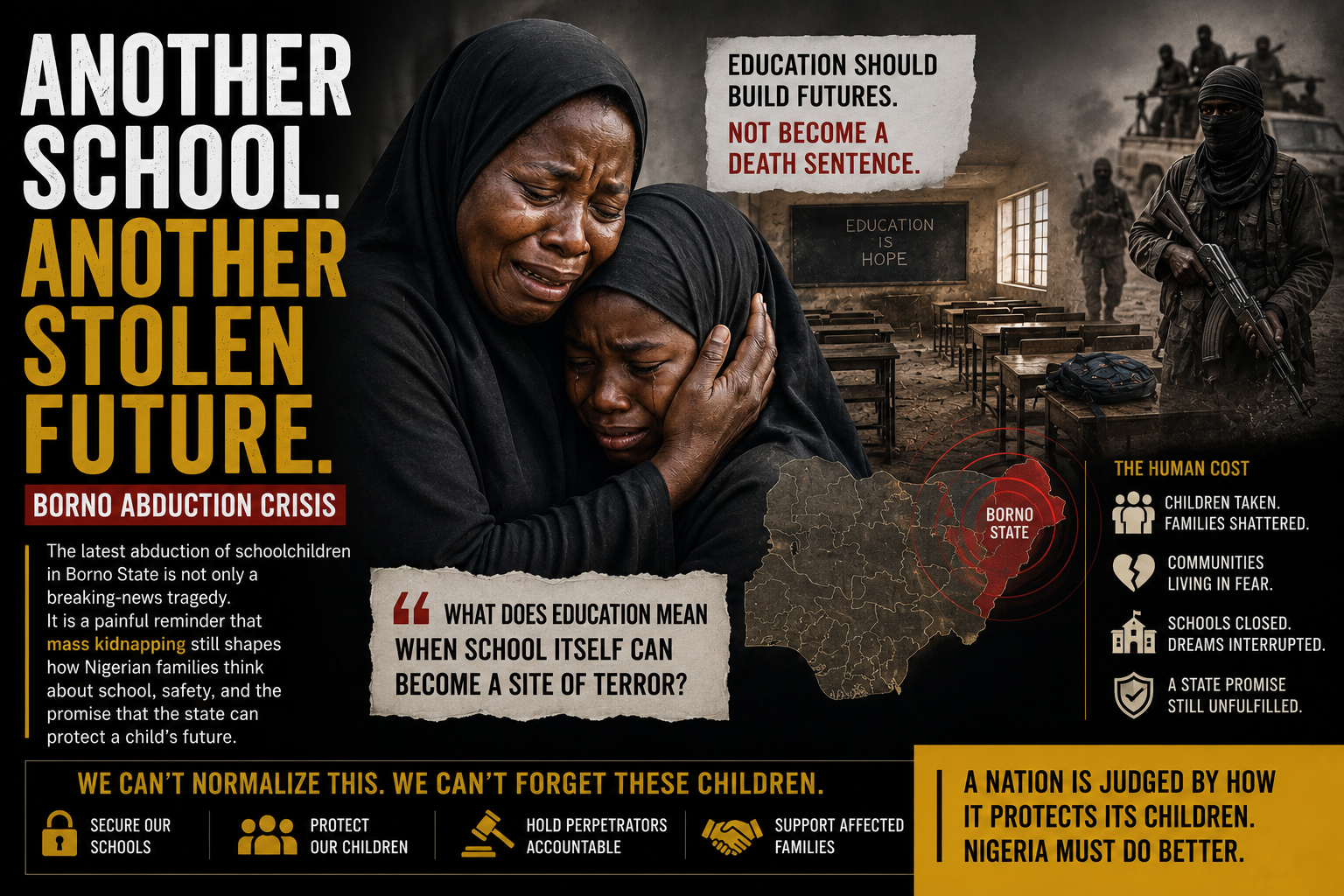
The latest abduction of schoolchildren in Borno State is not only a breaking-news tragedy. It is a painful reminder that mass kidnapping still shapes how Nigerian families think about school, safety, and the promise that the state can protect a child’s future.
The latest abduction of schoolchildren in Borno State has reopened one of Nigeria’s most painful national questions: what does education mean when school itself can become a site of terror?
Reuters reports that suspected militants abducted an unspecified number of students from a primary and junior secondary school in insurgency-ravaged Borno on 15 May. BBC Africa reports that more than 50 schoolchildren were kidnapped in Mussa town and that no group had yet claimed responsibility. Premium Times placed the story high in Nigeria’s news cycle and framed it clearly as a terrorism-linked abduction. Those verified facts are already devastating enough. They do not need embellishment.
The stronger and more responsible reading of the story is not sensational. It is human.
Another school abduction is not simply another security headline in a country exhausted by insecurity. It is a direct assault on one of the few promises families still try to hold onto: that education can be the route to dignity, mobility, and a safer future. When children are taken from school, the damage does not end with the incident. It spreads through homes, classrooms, and entire communities. It teaches parents to fear the very institution they are told to trust.
That is why this moment matters far beyond Borno.
A School Attack Changes More Than a News Cycle
Nigeria has lived through enough school kidnapping trauma for the pattern to feel both horrifying and familiar. That familiarity is part of the tragedy. A society should never become accustomed to stories like this. Yet repetition changes how families make decisions. It changes whether children are sent to school at all. It changes how communities interpret official reassurances. And it changes what citizens mean when they talk about the state.
A government may still exist in formal terms, but state legitimacy is felt most clearly in the ordinary places where people test whether protection is real. A school is one of those places. If parents cannot believe their children are safe there, trust erodes at the most intimate level.
That erosion connects naturally to ADUNAGOW’s wider conversations about how mobility and belonging are shaped by trust in institutions, how elite accountability debates affect public belief in national seriousness, and how young Africans are asked to imagine opportunity in systems that often feel unstable.
The point is not to force unrelated stories together. It is to recognize that insecurity, governance, and future-building are not separate subjects for most families. They are experienced as one reality.
When a child is abducted from school, a family does not process it as a policy category. It is felt as a collapse in protection, a rupture in routine, and a blow to belief itself. Parents begin asking whether education is still worth the risk. Communities start calculating survival instead of planning futures. The national conversation narrows from aspiration to fear.
Diaspora Readers Know This Story Travels Beyond Nigeria
For diaspora readers, stories like this carry an extra burden. There is grief for the families directly affected, but there is also a familiar frustration with what such incidents do to Africa’s image abroad. Too often, tragedy becomes the only lens through which the continent is discussed. But resisting caricature does not mean minimizing reality. It means telling the truth with seriousness.
And the truth here is that repeated school abductions create long-term damage to trust. They make it harder for citizens to believe official security claims. They make it harder for young people to feel that the future is being protected. They make it harder for diaspora communities to speak of home only in the language of potential when fear keeps interrupting the basic foundations of family life.
This is why the story should not be handled as a brief episode of outrage before the cycle moves on. The larger issue is whether Nigeria can break a pattern that has already scarred a generation. If mass kidnapping remains a recurring feature of public life, then every new incident becomes more than an emergency. It becomes evidence in a wider argument about whether the state can still provide safety where it matters most.
That argument will not be settled by rhetoric alone. It will be settled by whether families see real protection, whether schools can function without terror hanging over them, and whether government response feels timely, credible, and equal to the scale of the wound.
For now, what Borno’s latest tragedy reveals is painfully simple: the school-kidnapping nightmare is not a memory Nigeria has fully escaped. It is still alive enough to shape parenting, education, and public trust in the present.
That is what makes this story so serious.
Not only that children were taken, but that the future they were trying to reach through school was made to feel fragile again.
Read Next
- Meet the Africans Building the New Diaspora Return Economy
- When the Reform President Becomes the Accountability Test
- Why Diaspora Money Is Still One of Africa’s Most Underrated Power Systems
Discover more from ADUNAGOW Magazine
Subscribe to get the latest posts sent to your email.