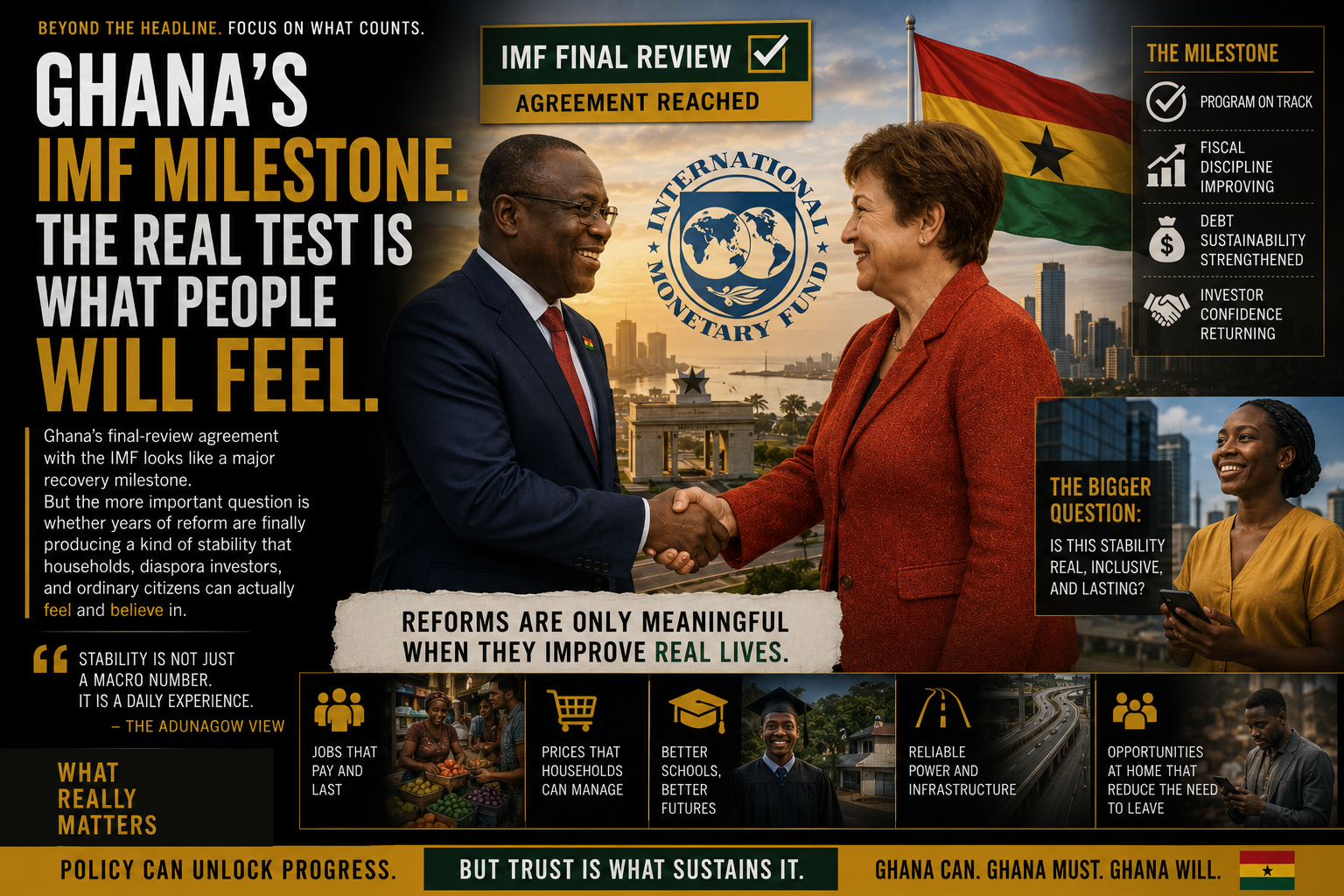
Ghana’s final-review agreement with the IMF looks like a major recovery milestone. But the more important question is whether years of reform are finally producing a kind of stability that households, diaspora investors, and ordinary citizens can actually feel and believe in.
Ghana’s agreement with the IMF on the final review of its $3 billion support programme is the kind of policy milestone that can sound impressive and distant at the same time.
Impressive, because Reuters reports that the final-review agreement marks a significant step in the reform programme that has helped Ghana emerge from its worst economic crisis in a generation. Distant, because many people have learned to distrust recovery language that feels clean in official briefings but uneven in daily life.
That is why the most important question now is not whether Ghana has cleared another technical checkpoint. It is whether recovery is becoming real enough for ordinary people to feel.
That question gives the story its full value.
Ghana’s Ministry of Finance has described the country’s reform journey since the 2022 crisis as transformative and has insisted the gains are “not cosmetic.” It has pointed to structural reform, debt-restructuring progress, reserve accumulation, investor town halls, and public-finance-management efforts as evidence that the turnaround is deeper than short-term stabilization. Reuters has added an external layer of significance by reporting a staff-level agreement on the sixth and final review, framing the moment as the closing stretch of a major recovery effort.
Those facts matter. But public confidence is not built by milestones alone.
Recovery Becomes Believable Only When It Reaches Daily Life
For most households, macroeconomic repair is meaningful only when it begins to change the texture of ordinary living. That can mean slower inflation pressure, greater predictability, a more stable currency environment, improved business confidence, or the sense that tomorrow is easier to plan for than yesterday. Until then, reform can remain technically important but emotionally unconvincing.
That is the tension at the heart of Ghana’s current moment. The country may be earning back credibility with lenders and policy observers, but the deeper political and social test is whether it can also rebuild credibility with citizens who lived through the crisis in far more intimate ways.
This is where the story connects to ADUNAGOW’s wider reporting on how diaspora money follows confidence as much as sentiment, how return-economy dreams depend on stable systems rather than branding alone, and how industrial and development ambition needs believable economic foundations.
Ghana matters in this conversation because it holds unusual symbolic weight. For many diaspora readers, it is more than a country under IMF review. It is a place associated with return imagination, business possibility, cultural magnetism, and relative democratic steadiness. When Ghana struggles, that symbolism takes a hit. When Ghana begins to recover, the significance reaches beyond bond markets and policy circles.
The Real Audience for Recovery Is Not the IMF Alone
That is why this story should not be written as a bureaucratic success memo. The IMF review matters, but not because outside approval alone defines national progress. It matters because it can signal that the hardest stretch of emergency stabilization may be giving way to a more durable phase of rebuilding.
The challenge is that countries do not truly exit crisis in the abstract. They exit crisis when confidence broadens. Investors may need evidence in spreadsheets. Citizens need evidence in lived conditions. Diaspora audiences need evidence that opportunity is becoming sturdier, not just more marketable.
That means Ghana’s next chapter will be judged by translation: can macro repair become social confidence? Can policy discipline become a wider sense of governability? Can official claims of transformation become believable enough that households stop treating stability as temporary?
Those are serious questions, not cynical ones. In fact, they offer Ghana more respect than either easy cheerleading or reflex dismissal. A country that has endured a difficult crisis and worked through a major reform programme deserves to be read carefully. The point is not to deny progress. It is to ask whether progress is crossing the line from institutionally visible to publicly felt.
If it is, Ghana’s recovery story could become one of the more meaningful West African confidence signals of the year. Not because it impressed lenders, but because it begins to restore something harder to win back: belief.
And belief matters in economics more than official language often admits.
It shapes spending, planning, investment, return decisions, hiring, and the emotional willingness to imagine the future without bracing for the next shock. If Ghana can rebuild that kind of belief, then the IMF milestone will deserve to be remembered as more than a procedural success.
It will mark the point where recovery started becoming credible again.
Read Next
- Why Diaspora Money Is Still One of Africa’s Most Underrated Power Systems
- Meet the Africans Building the New Diaspora Return Economy
- Dangote’s Mega-Refinery Expansion Is Africa’s Biggest Industrial Bet — and a Test of Who Really Benefits
Discover more from ADUNAGOW Magazine
Subscribe to get the latest posts sent to your email.