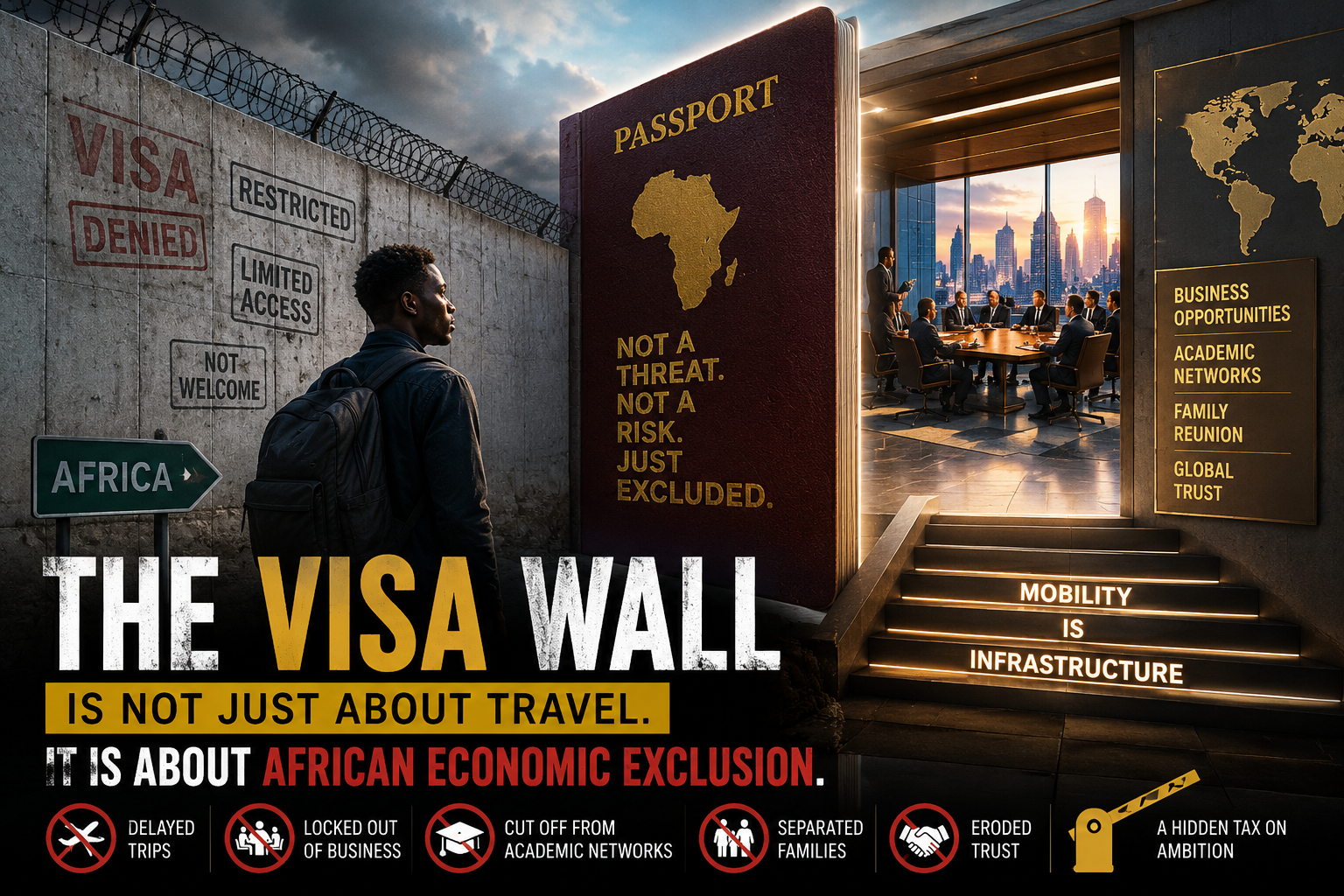
For millions of Africans, visa friction is not a side inconvenience. It is a hidden tax on access to markets, meetings, education, family life, and global economic participation.
For many Africans, a trip to the United States begins with paperwork before it begins with possibility.
It begins with invitation letters, interview dates, account statements, employment records, and the quiet emotional labor of trying to prove that your movement is legitimate before your journey has even started. You may be traveling for a business meeting, a graduation, a funeral, a trade event, a conference, or a family reunion. But the trip is never just the trip. It is a test.
That is why the visa conversation deserves to be taken more seriously than it usually is.
Too often, African mobility is discussed as if it belongs only in the soft category of travel inconvenience. The language gets reduced to delays, frustrations, embassy queues, and diplomatic irritation. But that framing is too small for what is really happening. When Africans face higher movement barriers than others, the loss is not only emotional. It is economic.
The U.S. State Department openly notes that visa wait times vary by post and that routine business, conference, and academic travel do not qualify for expedited processing. That detail matters because it tells us something blunt: the kinds of trips that help people build careers, close deals, maintain networks, and stay globally relevant are often forced to wait like everything else.
That waiting is not neutral.
It shapes who gets to show up in the room and who does not. It shapes whether a founder makes the investor meeting, whether a student visits a campus, whether a professional attends the conference where future opportunities are built, and whether a family can remain connected across borders without humiliation becoming part of the price.
The larger numbers point in the same direction. FurtherAfrica recently reported steep declines in travel from several African countries to the United States, including sharp drops from Sudan, Libya, Zimbabwe, Nigeria, and Senegal. Meanwhile, Henley & Partners says the gap between the world’s strongest and weakest passports has widened to 168 destinations, turning passport power into a practical measure of unequal access.
That is the real story.
Mobility is infrastructure.
A visa is not only permission to board a plane. In practice, it is permission to participate. It determines who can move quickly enough to build trust in person, inspect an opportunity, join a commercial conversation, sit in a graduation hall, or remain present inside a transnational family network. When one group faces more friction than another, that group is paying a participation tax.
Africans know this tax intimately. The emotional side of it is easy to recognize: the missed wedding, the postponed funeral, the panic over interview slots, the ritual of over-documenting your own legitimacy. But the economic side deserves more attention. Every delayed trip can mean a delayed partnership. Every abandoned trip can mean a weaker network. Every humiliating process can push talent, events, and commercial energy toward easier corridors.
And that rerouting matters.
The U.S. National Travel and Tourism Office treats international arrivals as part of a measurable export system because travel has economic value. If inbound movement matters enough to count when it benefits major economies, then African exclusion from that movement should matter enough to name clearly when it harms African participation.
This is where the visa wall becomes more than a border story. It becomes a market story.
If America is harder to access, then Gulf hubs gain. European hubs gain. Other meeting grounds gain. In some cases, African cities can gain too, if institutions and entrepreneurs invest seriously in building stronger regional and diaspora-facing corridors of their own. But that only happens if the problem is understood correctly. If the conversation stays trapped at the level of inconvenience, the strategic response stays weak.
ADUNAGOW readers already know the feeling of border suspicion. What this moment requires is a sharper political and economic reading of that feeling. Mobility inequality is one of the hidden ways the global system sorts whose ambition moves quickly and whose ambition must first defend itself.
That is why this issue belongs inside any serious conversation about African development, diaspora power, and global competitiveness.
The question is no longer whether visa friction is painful. It is. The question is whether African institutions, businesses, and diaspora networks will keep absorbing that cost quietly, or begin treating mobility as a core development issue.
Because when Africans cannot move easily, they do not only lose trips.
They lose time, leverage, access, trust, and room.
Read Next
- The Visa Wall: Why Falling African Travel to America Is Really a Diaspora Business Story
- The Diaspora Money Paradox: Africa Depends on Remittances, but Sending Money Home Still Costs Too Much
- From Year of Return to the 17th Region: Is Ghana Finally Giving the Diaspora Real Power?
Discover more from ADUNAGOW Magazine
Subscribe to get the latest posts sent to your email.