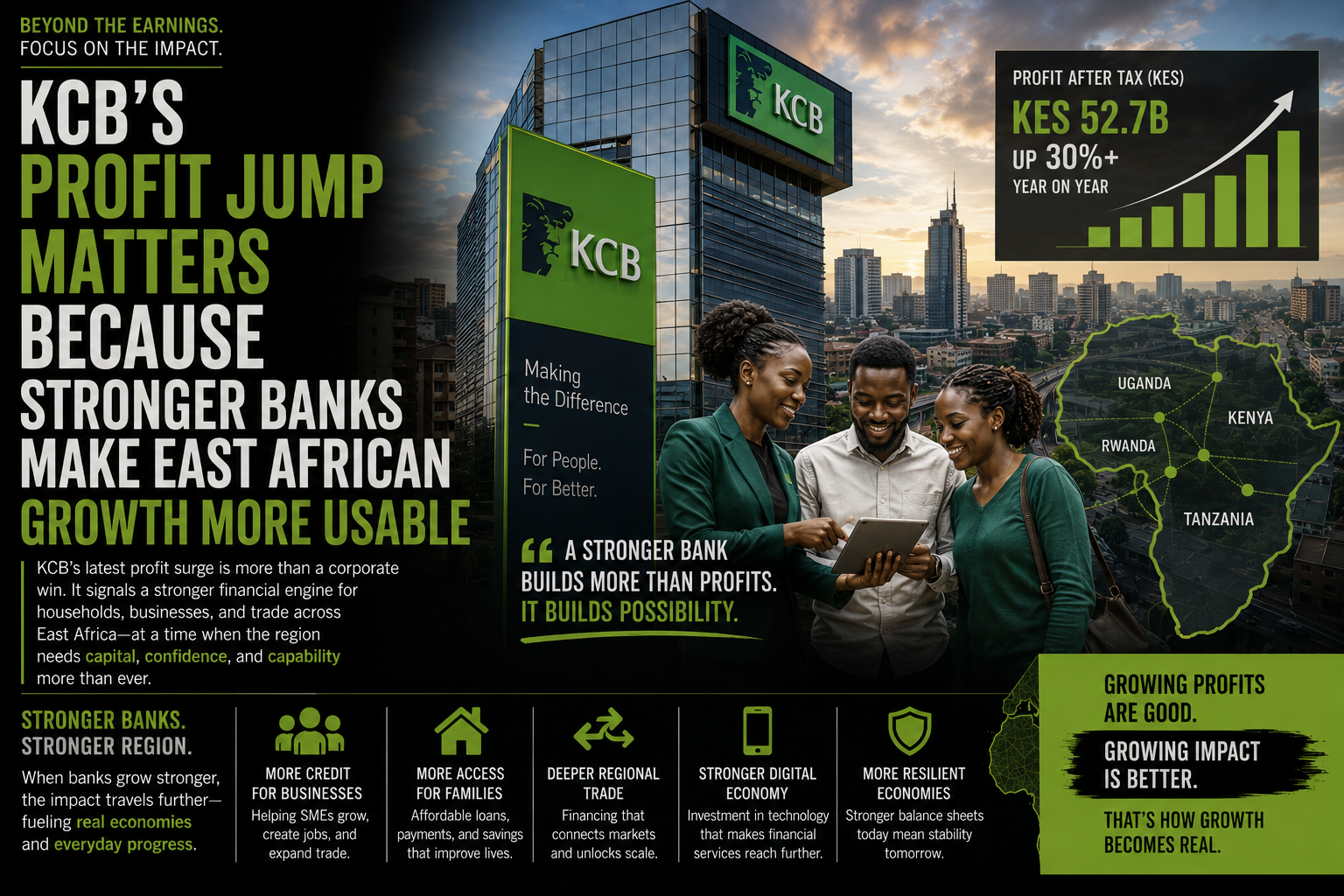
A bank’s profit increase rarely sounds like a public-interest story at first glance. But in East Africa, a large regional bank’s performance can reveal something much bigger than a balance-sheet win.
Reuters reports that KCB Group’s pretax profit rose 15 percent in the first quarter to 24.4 billion shillings, helped by higher interest income. On its own, that is a clear business headline. But KCB is not just any lender. The group describes itself as a regional holding company spanning Kenya and multiple East African subsidiaries, with a vast branch network, ATM footprint, and merchant-agent reach. That scale matters because it makes the bank less a narrow corporate actor and more a window into how people actually move through the region’s financial life.
That is where the stronger ADUNAGOW story begins.
When a regional bank grows, the important question is not only what shareholders see. It is what the result suggests about financial confidence, access to services, and whether the systems people use to save, borrow, transfer money, and build small businesses are becoming more dependable.
Banking Strength Matters Most When It Feels Usable in Daily Life
For many African households, banking is not primarily about investment jargon. It is about whether wages can be stored safely, whether fees are manageable, whether credit is accessible, whether remittances move smoothly, and whether a business owner can plan with less uncertainty. A regional bank’s health matters because these everyday interactions shape how opportunity feels on the ground.
That is why KCB’s scale deserves attention beyond finance pages. A bank with that kind of reach sits at the intersection of household resilience, business activity, digital payments, and regional integration. If such an institution is expanding from a position of strength, it can suggest that parts of East Africa’s economic architecture are becoming more stable and more usable.
That connects directly to ADUNAGOW’s wider coverage of African remittance rails as infrastructure of trust, the return economy and cross-border mobility, and why industrial ambition depends on systems people can actually rely on.
The point is not that one bank’s quarterly result proves the whole region is thriving. It does not. But it can offer a useful indicator of where resilience is being built. Financial systems are one of the clearest places where confidence either becomes practical or remains abstract.
Diaspora Readers Care About Banks When Banks Make Life More Possible
This is especially true for diaspora audiences.
People living abroad do not watch African banking stories simply out of curiosity. They care when those stories affect remittances, enterprise, property decisions, family support, and the basic usability of local economies. A strong regional bank can mean smoother money movement, wider access points, more credible lending channels, and a stronger base for entrepreneurship. In other words, it can make economic connection to home less friction-heavy.
That is why KCB’s result can be read as a proxy story. Not a perfect one, but a meaningful one. It asks whether East Africa’s financial backbone is deepening in ways that support broader growth rather than only elite finance narratives.
Of course, profit alone is not the same as inclusion. A bank can grow without becoming more equitable or more affordable. Strong earnings do not automatically tell us whether underserved communities are gaining easier access to credit or whether digital expansion is reducing exclusion. That is why serious business reporting should resist easy celebration.
But it should also resist the opposite mistake of treating every positive institutional signal as irrelevant unless it instantly solves structural inequality. Development often becomes visible through systems that work a little better, reach a little further, and inspire a little more confidence than before. A regional bank with scale, reach, and rising performance is one of those signals worth reading carefully.
For ADUNAGOW, the value of this story lies in that balance. It offers a constructive African business narrative without empty boosterism. It highlights institutional capacity without pretending growth is evenly distributed. And it gives readers a practical way to think about economic resilience: not as a slogan, but as the strength of the systems people touch every day.
If East African banking is becoming more robust, more connected, and more usable, that matters far beyond quarterly profit. It matters for small businesses trying to expand, for families trying to transfer money safely, for diaspora readers evaluating where opportunity feels credible, and for a region still proving that growth can be built on functioning institutions.
That is why KCB’s numbers are worth more than a passing market note.
They offer a glimpse of whether financial confidence in East Africa is becoming something people can actually use.
Read Next
- The Diaspora Money Paradox: Africa Depends on Remittances, but Sending Money Home Still Costs Too Much
- Meet the Africans Building the New Diaspora Return Economy
- Dangote’s 1.4 Million BPD Refinery Expansion Could Change Africa — But Will Nigerians Feel the Benefit?
Discover more from ADUNAGOW Magazine
Subscribe to get the latest posts sent to your email.