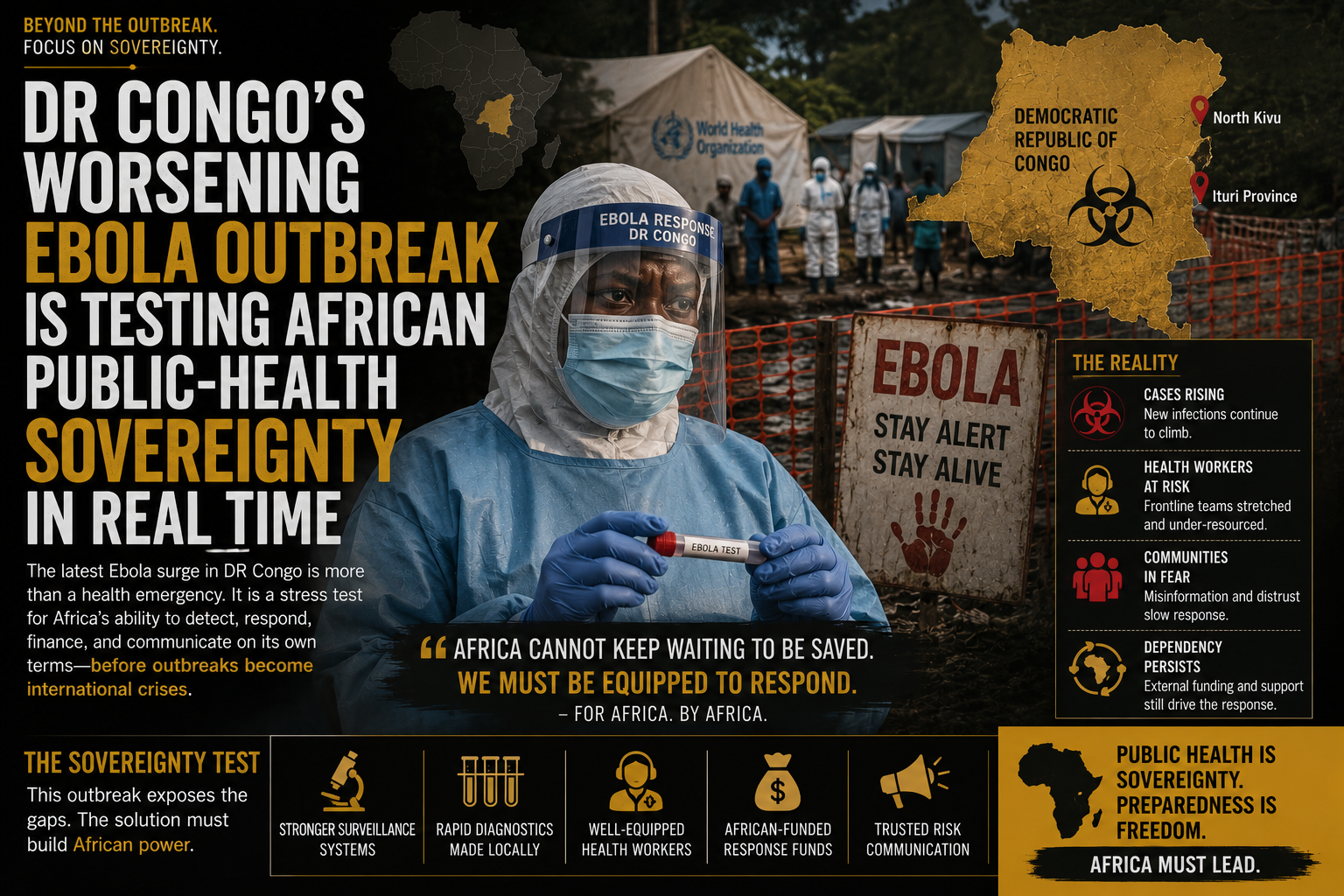
DR Congo’s worsening Ebola outbreak is forcing a familiar but uncomfortable question back onto the African agenda: when a dangerous health crisis accelerates, can public institutions move faster than fear?
That is the deeper significance of the current moment. BBC Africa reports that the World Health Organization has warned a vaccine for the current Ebola outbreak could take nine months, even as the suspected death toll and case count rise sharply. Reuters reports that the outbreak involves the rare Bundibugyo strain, for which there is no vaccine. WHO Africa says the response is unfolding in Ituri Province under difficult conditions shaped by insecurity, mobile populations, cross-border trade, and refugee movement. Africa CDC has also called for urgent regional coordination after Uganda reported an imported case.
Those facts alone make this a serious public-interest story. But the stronger ADUNAGOW reading is not built on fear-click urgency. It is built on institutional meaning.
This is not only a test of whether doctors, laboratories, and emergency teams can respond under pressure. It is also a test of whether African systems can communicate clearly enough, coordinate regionally enough, and act credibly enough to stop a medical emergency from becoming a wider trust breakdown.
The Real Threat Is Not Only the Virus, but the Trust Gap Around It
Ebola outbreaks carry a unique psychological weight. They move through communities not only as diseases, but as events that quickly shape movement, rumour, trade, schooling, and the emotional temperature of daily life. Once uncertainty deepens, people do not wait for formal policy language before adjusting behaviour. Families become more cautious. Travel plans shift. Border anxiety rises. Informal economies tense up. And if public messaging appears slow, confusing, or fragmented, fear fills the vacuum.
That is why this outbreak matters far beyond DR Congo alone.
Readers who have followed ADUNAGOW’s reporting on Africa visa openness and the return economy, why African remittance systems are also trust systems, and how industrial and development ambition depends on durable public infrastructure will recognize the wider pattern: health crises do not stay neatly inside the health lane. They spill into mobility, commerce, investment confidence, and the broader question of whether systems feel governable under pressure.
That spillover matters because the outbreak is unfolding against exactly the kind of regional complexity that exposes weak coordination quickly. Ituri is not an isolated bubble. It sits inside wider human movement patterns shaped by trade, insecurity, and displacement. When WHO Africa and Africa CDC emphasize regional coordination, they are effectively acknowledging that public-health response in Africa now has to work across borders, not simply within them.
Public-Health Sovereignty Means More Than Waiting for Outside Rescue
That is the most important frame for diaspora readers.
Too often, African outbreak stories are presented globally as scenes of helplessness awaiting international intervention. That framing flattens the continent and strips institutions of agency. The sharper question is not whether external support matters — of course it does. The sharper question is whether African public-health bodies are building enough coordination, surveillance, and response capacity to shape outcomes rather than merely react to them.
This is where the idea of public-health sovereignty becomes real. It is not rhetoric. It is the practical ability to detect threats early, share information fast, manage border risk intelligently, mobilize trust, and respond with enough credibility that people believe guidance before panic starts reorganizing daily life.
That does not mean pretending the situation is under easy control. In fact, the seriousness of this outbreak is exactly why clear-eyed reporting matters. The lack of a vaccine for this strain raises the stakes. The growing suspected death toll raises the urgency. The imported case in Uganda raises the regional consequence. But none of that justifies collapse into alarmism. The public deserves something better than either minimization or panic.
It deserves honesty about the danger and seriousness about the response.
For ADUNAGOW, that means treating this outbreak as a test of African institutional maturity under pressure. Can authorities protect lives while preserving trust? Can they manage cross-border risk without feeding chaos? Can they show that response capacity is deepening, even when circumstances are difficult? Those are the questions that matter now.
Because the longer-term stakes are larger than one outbreak. Every serious health emergency becomes part of a continental memory about what institutions can or cannot do when lives, movement, and confidence are on the line.
If African public-health systems respond with speed, coherence, and regional discipline, this moment can reinforce trust in their growing capacity. If they do not, the damage will be measured not only in cases and deaths, but in the further hardening of public doubt.
That is why the story is so important.
Ebola is the immediate emergency. But the wider test is whether African institutions can contain fear, protect movement, and prove that public-health sovereignty is becoming more than an aspiration.
Read Next
- Nigeria’s 75-Year Corruption Verdict Is a Rare Shock to Elite Impunity — but the Real Test Starts Now
- When the Reform President Becomes the Accountability Test
- The Visa Wall Is Not Just About Travel. It Is About African Economic Exclusion.
Discover more from ADUNAGOW Magazine
Subscribe to get the latest posts sent to your email.