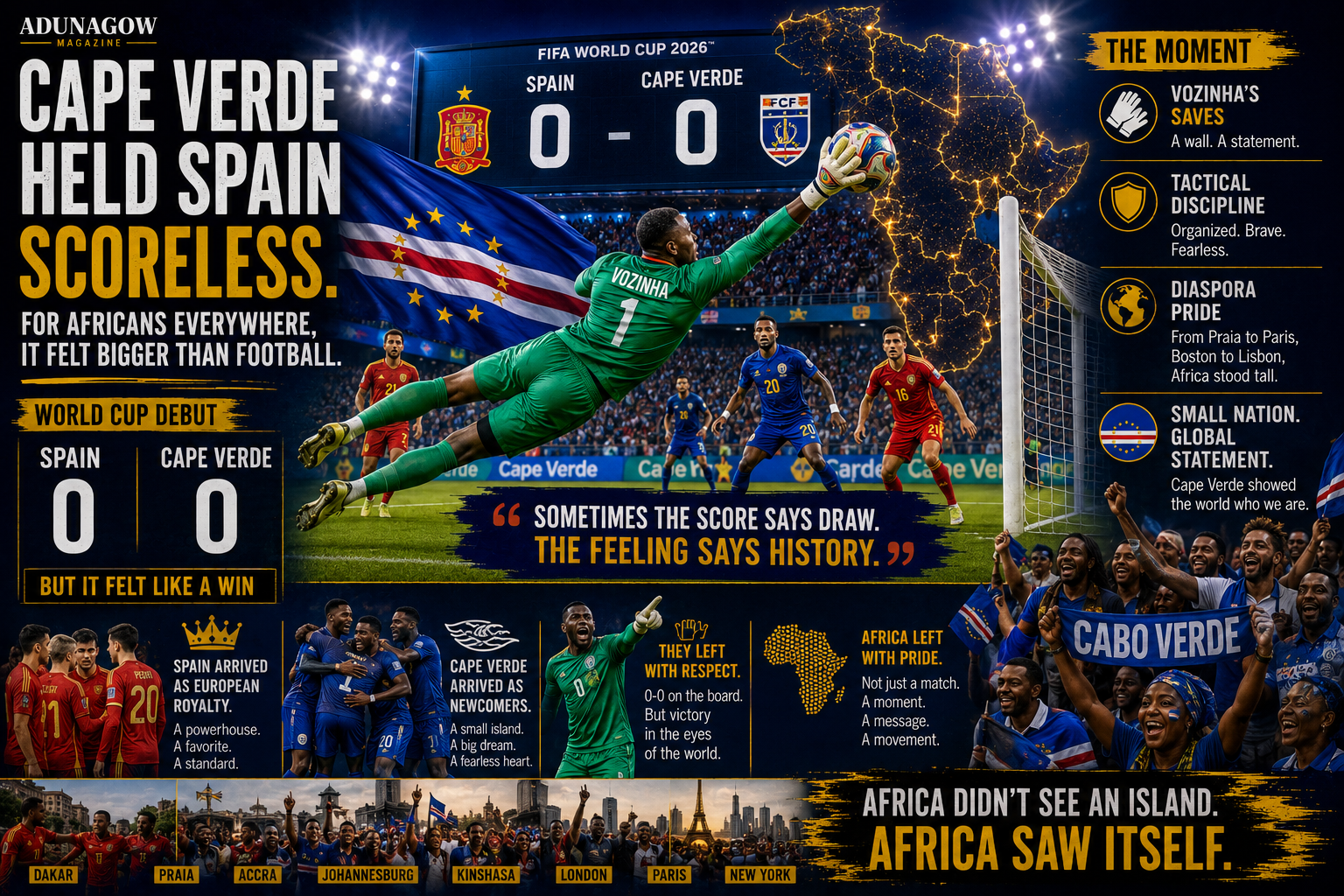
Cape Verde's first World Cup match ended 0-0 against European champions Spain, but for a small island nation and its global diaspora, the result carried the weight of recognition, resilience, and African pride.
Cape Verde's first World Cup match did not end with a goal. It ended with something almost as powerful: recognition.
On June 15, 2026, in Atlanta, Cape Verde held Spain to a 0-0 draw in its first-ever men's FIFA World Cup finals match. Spain arrived as European champions and one of the tournament favorites. Cape Verde arrived as a debutant, one of the smallest nations ever to qualify for the competition, carrying the hopes of an island country of just over half a million people and a much larger global diaspora.
By the final whistle, the football world had learned the name Vozinha.
The 40-year-old goalkeeper, formally Josimar Jose Evora Dias, became the face of the match after a string of saves kept Spain out. FIFA and multiple match reports credited him as player of the match after seven saves, a performance that turned Cape Verde's disciplined defensive stand into one of the early defining images of the 2026 World Cup.
A Draw That Felt Like A Statement
The scoreboard said 0-0. The meaning was bigger.
For Cape Verde, this was not simply about stopping Spain for 90 minutes. It was about entering the world's most visible sporting stage and refusing to be treated as a ceremonial opponent. Spain had the possession, the pressure, and the reputation. Cape Verde had structure, patience, belief, and a goalkeeper playing like a man carrying more than a team sheet.
That is why the result traveled so quickly beyond football circles. In Cape Verdean communities, across African football spaces, and among diaspora fans watching from host cities like Atlanta, the draw became a shared pride story. It was a reminder that African excellence is not always announced with spectacle. Sometimes it arrives as discipline, endurance, and collective refusal.
Vozinha's Human Moment
Every World Cup needs a human story. Cape Verde found one immediately.
At 40, Vozinha is older than many of the stars whose shots he stopped. His performance carried the emotion of a late-career dream finally realized, and reports around the match added another layer: his mother was not able to be present because of visa and cost barriers. That detail should be handled carefully, but it matters because it connects the World Cup's glamour to the real movement challenges many African families still face.
For the diaspora, that detail lands with force. Migration, documentation, cost, distance, and longing are not side stories in African global life. They are part of the emotional architecture. Cape Verde's draw against Spain became powerful because it was both a sporting result and a family story, both a national milestone and a diaspora mirror.
Cape Verde Was Not A Miracle. Cape Verde Was Prepared.
The easy version of this story is to call Cape Verde a miracle team. That framing is too small.
Cape Verde did not survive Spain by accident. Under coach Pedro "Bubista" Brito, the Blue Sharks played with compact shape, clear assignments, and emotional discipline. They absorbed pressure without collapsing into panic. They defended as a unit, trusted their goalkeeper, and made Spain work for every opening.
That distinction matters for how African teams are covered. Too often, African success is framed as surprise, passion, or chaos. Cape Verde's performance deserves a more serious reading. It was organization. It was preparation. It was a small football nation showing that scale does not decide dignity.
Why This Matters For ADUNAGOW Readers
This story belongs in ADUNAGOW's sports-culture-identity lane because it is about what African achievement means once it enters global view.
Cape Verde's World Cup moment can strengthen national branding, tourism visibility, and cultural recognition. It can reconnect younger diaspora audiences to a country they may know through family, music, language, or memory. It can also widen the way global audiences think about African football, beyond the familiar giants of Nigeria, Senegal, Morocco, Ghana, Cameroon, Egypt, and South Africa.
The 2026 World Cup is being played across North America, where African and Caribbean communities are not just spectators. They are part of the host-city story. Atlanta's African and Caribbean diaspora context makes Cape Verde's performance there even more resonant. A small island nation's debut became a public reminder that diaspora identity is not hidden in the margins of global events. It is in the stadiums, the watch parties, the flags, the chants, and the family calls after the whistle.
Africa's World Cup Has Started With A Signal
Cape Verde's draw does not guarantee a deep tournament run. It does not turn a group-stage point into a trophy. Spain may still recover, and Cape Verde still has work ahead.
But some results become meaningful before the table is finished.
Cape Verde did not need to defeat Spain to make a statement. Holding one of football's powerhouses scoreless on debut was enough to force respect. It gave Africans and the diaspora a story of composure under pressure, a story of a small nation refusing to shrink, and a story of what representation can feel like when it is earned in front of the world.
For Cape Verde, it was a first World Cup point.
For many Africans watching, it was a reminder: the world stage is not reserved for the biggest countries. Sometimes, it belongs to those who arrive prepared, united, and impossible to ignore.
Read Next
- Africa Has a Record World Cup Moment. Will Africans Be Allowed Into the Room?
- How Senegal Turned Diaspora Identity Into World Cup Power
- Africa’s World Cup Moment
Discover more from ADUNAGOW Magazine
Subscribe to get the latest posts sent to your email.