Nigeria-Morocco Gas Pipeline: West Africa's $27 Billion Test Of Regional Power
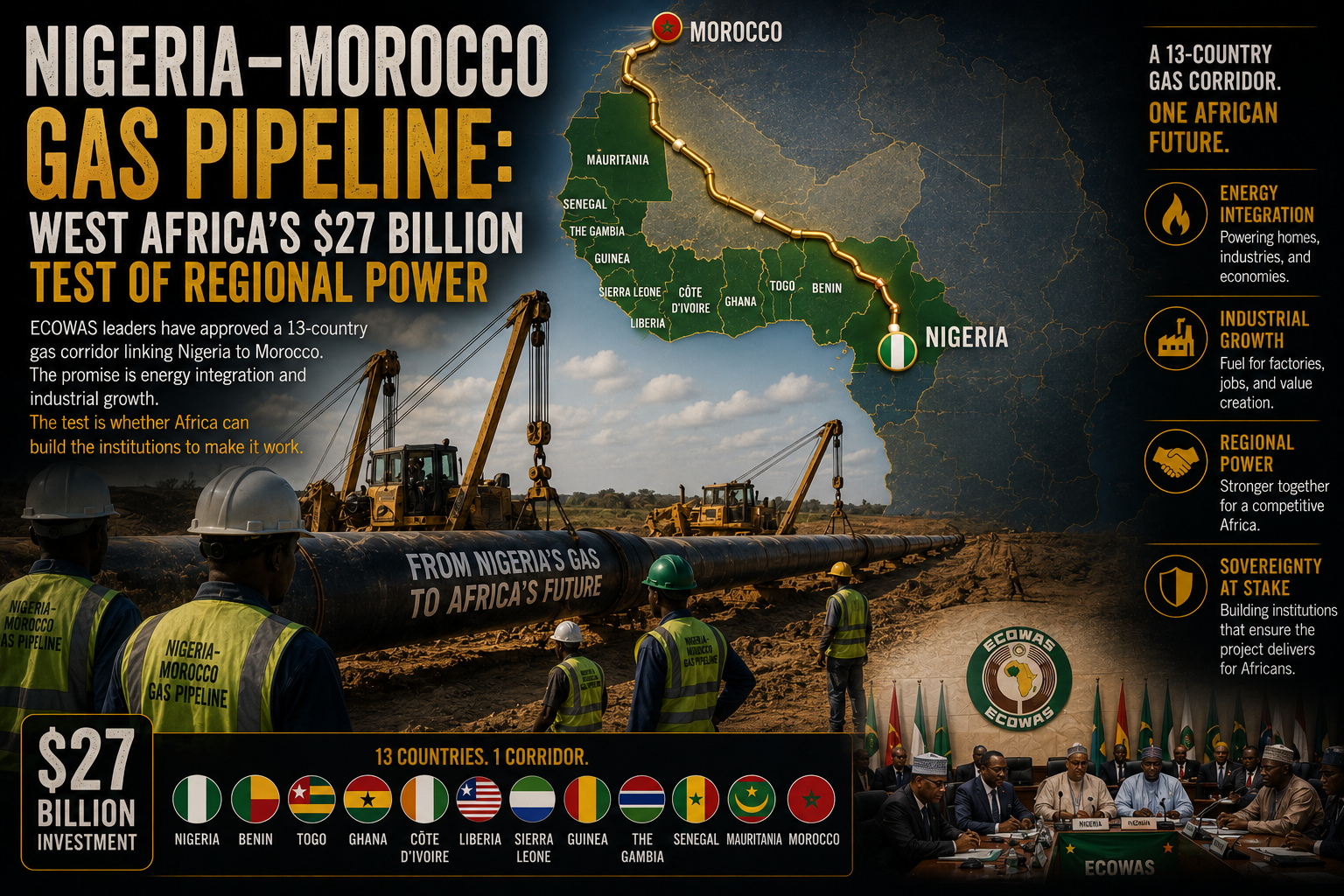
ECOWAS leaders have approved a 13-country gas corridor linking Nigeria to Morocco. The promise is energy integration and industrial growth. The test is whether Africa can build the institutions to make it work.
West African leaders have given fresh political backing to one of the continent's most ambitious infrastructure ideas: a gas pipeline stretching from Nigeria to Morocco along Africa's Atlantic coast.
At an ECOWAS summit in Freetown, leaders signed an agreement approving the Nigeria-Morocco Gas Pipeline, a project expected to cross 13 countries and run roughly 6,000 kilometres before connecting Nigerian gas to Morocco and, potentially, to the Maghreb-Europe pipeline. Africanews, citing AFP, reported that the project is estimated at about $27 billion, with construction expected to begin in 2028 and first gas deliveries targeted for 2031.
That timeline is ambitious. So is the political vision behind it.
The pipeline is being sold as more than a tube carrying gas. Morocco's state hydrocarbons agency ONHYM and Nigeria's NNPC say the project is meant to connect West Africa's gas resources to regional markets, strengthen African energy-market integration, and create a new development corridor linking West Africa, the Sahel, Morocco, and Europe.
That last phrase matters: development corridor.
For decades, African resource stories have too often followed the same pattern. The continent supplies raw materials, outside markets capture most of the value, and local communities are left arguing over pollution, revenue leaks, and broken promises. The Nigeria-Morocco pipeline will be judged by whether it breaks that pattern or simply redraws it across a larger map.
The opportunity is real. A reliable regional energy corridor could support power generation, fertilizer production, logistics, industrial parks, and cross-border trade. For countries along the Atlantic coast, it could make energy cooperation practical rather than rhetorical. For Nigeria, it offers another route to monetize gas beyond its existing export structures. For Morocco, it reinforces the country's role as a gateway between Africa and Europe. For ECOWAS, it is a chance to prove that regional integration can become physical infrastructure, not just communiques.
The timing is also important. UNCTAD's World Investment Report 2026 says Africa attracted about $70 billion in foreign direct investment in 2025, the third-highest level since 1990 and roughly one-third above the continent's long-term average. But UNCTAD also warns that energy, infrastructure, critical minerals, and technology investment is still concentrated in limited sectors and countries. In other words, money is interested in Africa. The harder question is whether African institutions can turn that interest into broad industrial development.
That is where the pipeline's next steps become more important than the announcement itself.
According to Africanews, ONHYM and NNPC said the project still needs a Casablanca-based project company, an Abuja-based governing authority, investor onboarding, and a final investment decision. Each of those steps will test coordination across governments, national oil companies, regulators, financiers, and communities.
The project will also carry risk. A 13-country infrastructure corridor is exposed to politics, security concerns, financing delays, environmental scrutiny, local compensation disputes, and changing global energy markets. By 2031, Europe may still want African gas, but the energy transition will be moving faster. That means the strongest case for the pipeline cannot be only export revenue. It has to include African access, African industry, African jobs, and transparent African governance.
For the diaspora, this is exactly the kind of story worth watching closely. It sits at the intersection of investment, engineering, regional politics, and development. It is not just about whether gas reaches Europe. It is about whether African countries can coordinate at continental scale and keep enough value at home to matter.
The Nigeria-Morocco Gas Pipeline could become one of West Africa's defining infrastructure projects of the next decade. But the approval is only the opening chapter. The real story begins now: financing, governance, accountability, and whether the communities along the route see development rather than just another promise passing through.
Sources:
- Africanews/AFP: https://www.africanews.com/2026/07/20/west-african-leaders-approve-nigeria-morocco-gas-pipeline/
- UNCTAD: https://unctad.org/news/africa-attracting-investment-strategic-industries-challenge-turning-it-broader-industrial
Read Next
- AfCFTA Has A Local Business Problem. Solving It Could Change African Trade
- Gabon's Manganese Deal Tests Africa's New Value-Add Ambition
- Airtel Money's IPO Push Shows African Mobile Money Has Become Global Infrastructure
Discover more from ADUNAGOW Magazine
Subscribe to get the latest posts sent to your email.