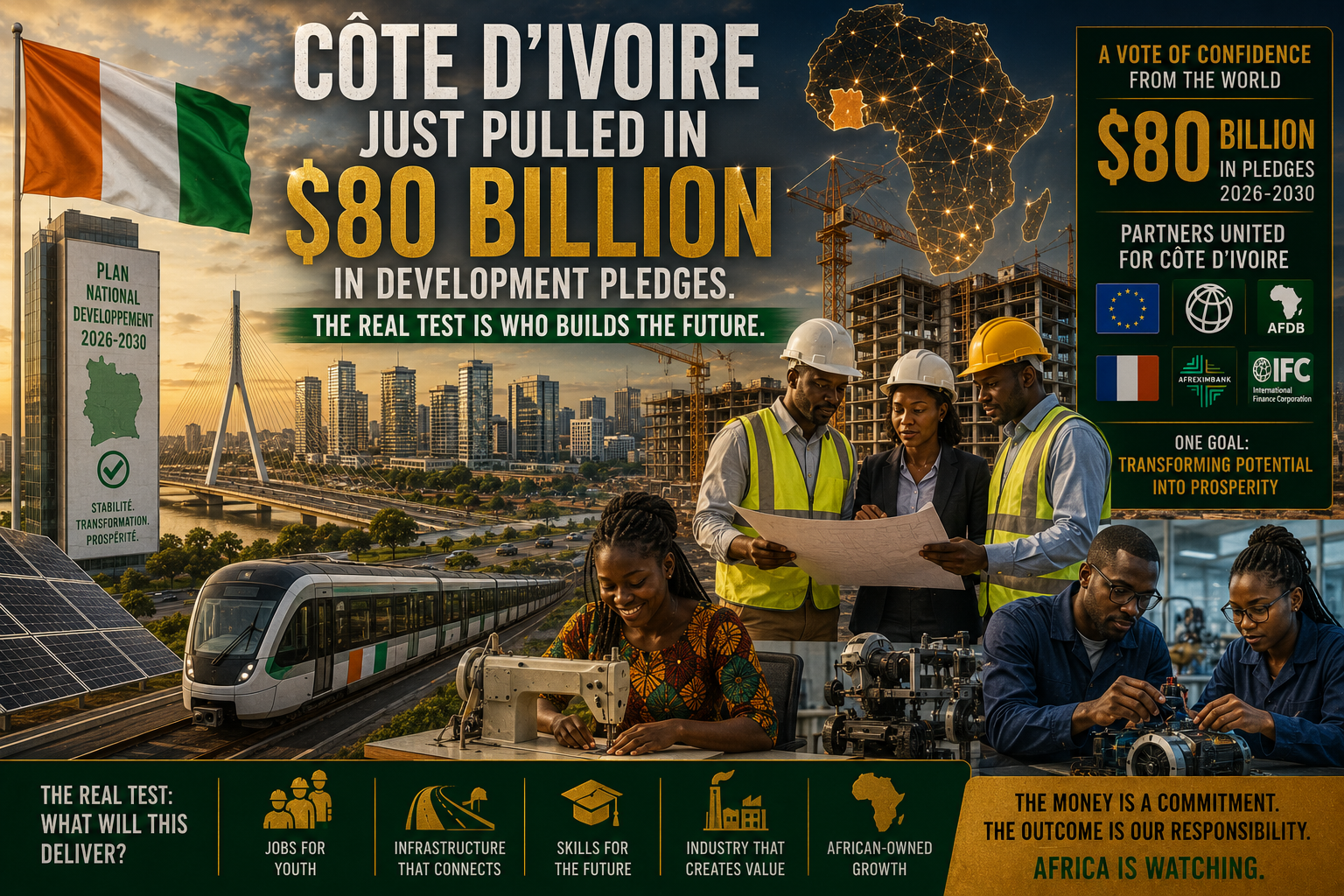
Côte d'Ivoire Just Pulled In $80 Billion in Development Pledges. The Real Test Is Who Builds the Future
Côte d'Ivoire's new 2026-2030 development plan has attracted a huge vote of confidence from global partners. For African and diaspora readers, the question is not only how much money was pledged, but whether the value turns into jobs, infrastructure, skills, and African-owned growth.
Côte d'Ivoire is having the kind of development-finance moment African countries are often told to wait for.
At a consultative group meeting in Abidjan on July 8 and 9, the country presented its 2026-2030 National Development Plan to international partners. According to the Embassy of Italy in Abidjan, the event drew more than 3,000 delegates from 49 countries, including governments, international organizations, financial institutions, civil society, and private-sector players. The result was a headline number that deserves attention: about $80 billion in pledges.
That figure is large enough to travel quickly. But the number alone is not the story.
The real story is what Côte d'Ivoire is trying to become, and whether this new wave of confidence can be converted into African-owned value.
The plan is organized around six priorities: peace and stability, stronger agricultural value chains, more private investment, human capital and decent jobs, strategic infrastructure and regional economic hubs, and modern governance. It is not framed as a charity appeal. It is framed as an economic transformation plan, with the private sector expected to carry roughly 70% of planned investments.
That matters because Africa's development debate is too often trapped between two shallow narratives. One says the continent is only a crisis zone. The other sells every major investment announcement as automatic progress. Neither is enough.
Côte d'Ivoire's moment should be read with both optimism and discipline.
On the optimistic side, the country has become one of West Africa's stronger economic performers. Africanews reports that since the 2011 post-election crisis, Côte d'Ivoire has maintained average annual growth of about 6.5%, helped by infrastructure investment and an improving business environment. For a country working to turn political recovery into economic momentum, that track record helps explain why international partners showed up in force.
For diaspora readers, this is also a reminder that Africa's growth story is not only about remittances sent home after emergencies. It is also about capital, skills, institutions, logistics, agriculture, technology, and the power to participate in building markets before others define them.
The agriculture pillar is especially important. Côte d'Ivoire is already central to global cocoa supply, but the old model of exporting raw value while others capture the higher-margin processing, branding, and retail profits has not served African economies well enough. If a development plan talks about strengthening value chains, the measure of success should be clear: more processing, more skilled jobs, more local enterprise, and more bargaining power inside global markets.
The same applies to infrastructure and regional economic hubs. Roads, ports, power, digital systems, and industrial zones are not glamorous on their own. They matter when they reduce the cost of doing business, connect farmers and manufacturers to markets, and make it easier for young Africans to build companies that can compete beyond their borders.
But big pledges also demand big questions.
Who will win the contracts? How much procurement will go to Ivorian and African firms? Will financing terms protect public interest? Will projects reach communities outside the capital and economic elite? Will skills transfer be real, or will African workers remain at the bottom of the value chain while foreign contractors capture the most profitable layers?
Those questions are not anti-investment. They are pro-development.
For ADUNAGOW's audience, this is where the diaspora lens becomes useful. African professionals, investors, engineers, builders, academics, and entrepreneurs abroad should not see a story like this as distant government news. It is a signal to watch sectors where expertise and capital may be needed: agribusiness, logistics, renewable energy, skills training, digital infrastructure, construction, public-sector modernization, and creative industries around a growing consumer economy.
The best version of this story is not simply "$80 billion for Côte d'Ivoire." It is Côte d'Ivoire testing whether an African economy can move from being an investment destination to being a value-creation platform.
That is the difference between growth that impresses conference rooms and growth that changes lives.
If the pledges turn into durable infrastructure, competitive African firms, stronger schools, better jobs, and more value kept inside the country, Côte d'Ivoire's development plan could become a West African case study. If the money mainly circulates through imported expertise, elite contracts, and debt-heavy projects with limited local ownership, the headline will fade like many others.
The promise is real. So is the accountability test.
For Africa and its diaspora, the message is simple: celebrate the confidence, follow the money, and measure the future by who gets to build it.
Read Next
- AfCFTA Has A Local Business Problem. Solving It Could Change African Trade
- Gabon's Manganese Deal Tests Africa's New Value-Add Ambition
- When Senegal Turns an Old Rival Into Africa's UN Candidate
Discover more from ADUNAGOW Magazine
Subscribe to get the latest posts sent to your email.