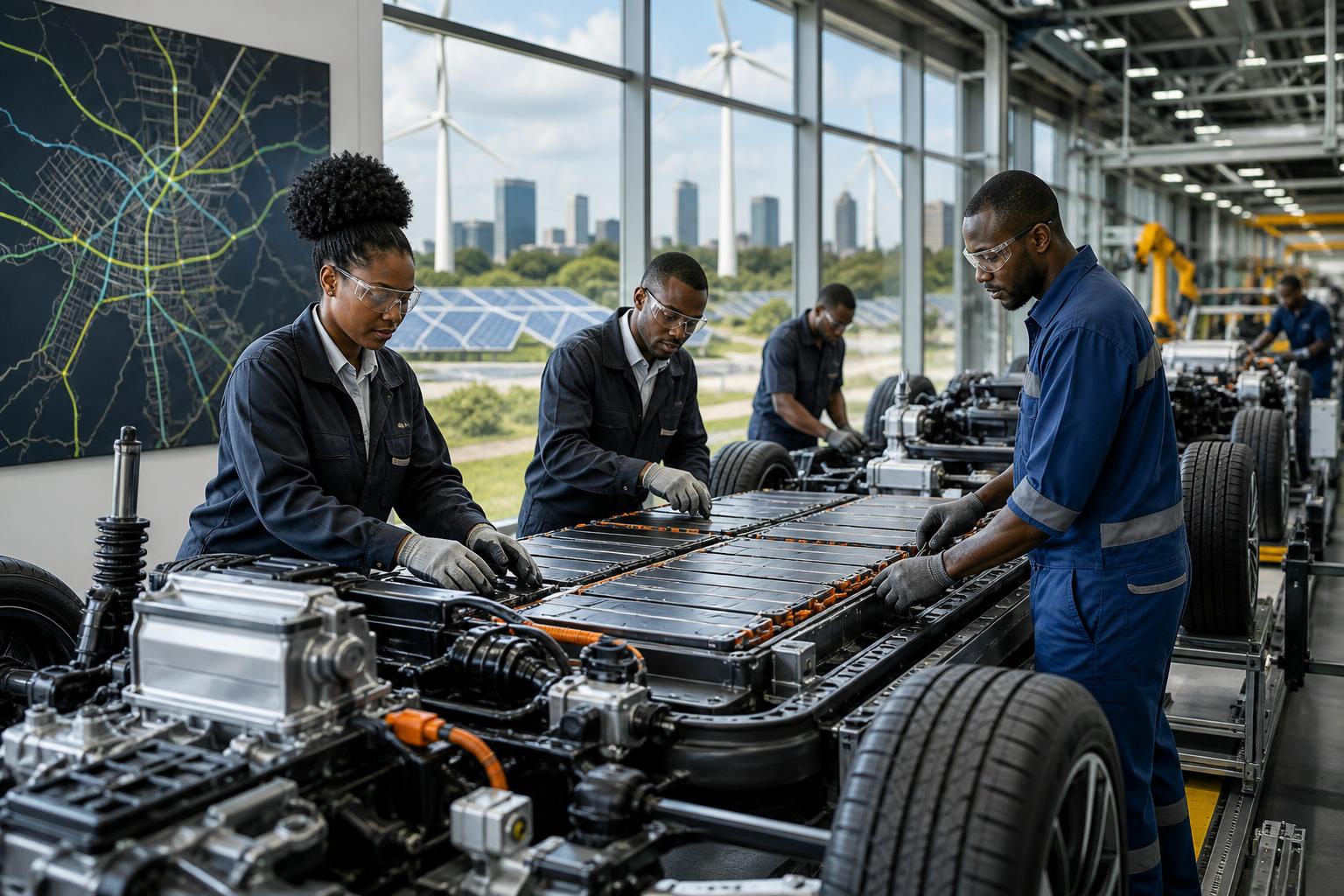
Chinese automakers are shifting from exports to African assembly. For African governments, the opportunity is bigger than cheaper cars: it is jobs, batteries, charging networks, skilled work, and bargaining power.
Africa's electric-vehicle moment is no longer a distant prediction. It is beginning to show up in factories, policy choices, mining strategies, and boardroom decisions about where the next generation of affordable vehicles will be built.
The Associated Press reported on August 12 that Chinese automakers are increasingly moving from exporting vehicles to building them in Africa. The logic is clear: demand inside China is slowing, trade barriers are rising in Europe and North America, and African cities are growing into some of the world's most important future transport markets.
But for Africa, the question is not simply whether more electric vehicles arrive on the continent. The real question is who captures the value.
In July, Chery, China's largest auto exporter, acquired Nissan's former Rosslyn plant near Pretoria, South Africa. The company plans to produce plug-in hybrids, battery-electric vehicles, and models under its Jetour brand. AP also pointed to South Africa, Morocco, Kenya, Ethiopia, and Ghana as countries well positioned to attract Chinese EV investment because of industrial capacity, policy support, or stronger electricity infrastructure.
That list matters. It suggests the EV race in Africa will not be decided by consumer demand alone. It will be shaped by policy discipline, electricity reliability, mineral strategy, worker training, charging infrastructure, and whether governments can turn market access into local production.
For decades, many African markets have depended heavily on imported vehicles, including used cars from Europe, Asia, and North America. Chinese brands changed part of that story by offering more affordable new models. Now the next shift may be more consequential: building closer to African consumers instead of only selling to them.
If handled well, local EV assembly could reduce some import costs, create factory jobs, support component manufacturing, and encourage investment in charging networks. It could also connect with Africa's mineral advantage. Zimbabwe has lithium. Morocco is moving toward battery production. The African Union's Green Minerals Strategy aims to increase domestic processing of critical minerals rather than leaving African countries locked into raw-material export roles.
That is the strategic opening. Africa can either become a sales market for other people's energy transition, or it can become a manufacturing base inside that transition.
Ethiopia has taken one of the boldest policy routes by banning imports of fossil-fuel-powered vehicles and encouraging local EV production through lower duties on vehicles assembled domestically. South Africa is using industrial incentives, duty rebates, production-linked credits, direct cash investment, and tax breaks to attract electric- and hydrogen-vehicle manufacturing.
Those policies show two different paths toward the same goal: making transport electrification part of national industrial strategy.
Still, the obstacles are serious. EV assembly cannot thrive without reliable electricity, affordable charging, stable tax rules, and roads that support regional distribution. A factory announcement is not the same as an industrial ecosystem. African governments must ask harder questions before celebrating the headlines: How many skilled jobs will be created? How much local sourcing will be required? Will battery processing happen locally? Will African suppliers be built into the chain? Will charging infrastructure reach beyond elite urban corridors?
The answers will determine whether this becomes another import story with better branding, or a real development story.
For the African diaspora, this is where the story becomes personal. Engineers, investors, logistics experts, climate professionals, and entrepreneurs across the diaspora should see the EV transition as a field where African participation cannot stop at consumption. The continent needs finance, policy literacy, technical training, maintenance networks, grid investment, battery recycling, software, design, and regional trade systems.
Africa's growing cities need cleaner transport. African economies need industrial jobs. African countries with minerals need more than extraction. Those three pressures are now meeting in the same place.
Chinese automakers are making a rational bet: Africa's future transport market is too large to ignore. The responsibility of African governments is to make an equally rational demand: if global companies want access to African growth, they must help build African capacity.
The EV race is not only about who sells the car. It is about who builds the parts, trains the workers, owns the infrastructure, processes the minerals, finances the fleets, and writes the rules.
Africa should welcome investment. But it should not confuse assembly with transformation.
The continent's strongest position is not as the final destination for imported ambition. It is as a negotiating bloc of fast-growing markets with minerals, young talent, urban demand, and regional trade potential. If that leverage is used well, the next chapter of African mobility can create more than cleaner roads. It can create a deeper industrial base.
That is the real story behind Chinese EV makers moving into Africa: the cars matter, but the value chain matters more.
Sources
Read Next
- Kenya’s Cotton Comeback Is Really a Fight to Keep African Value at Home
- South Sudan’s Next Business Story Is Being Built Through Mobile Money
- Nigeria’s Crypto Shift Could Turn Diaspora Remittances Into Investment Capital
Discover more from ADUNAGOW Magazine
Subscribe to get the latest posts sent to your email.

One thought on “Chinese EV Makers Are Moving Into Africa. Who Gets the Real Value?”
Comments are closed.