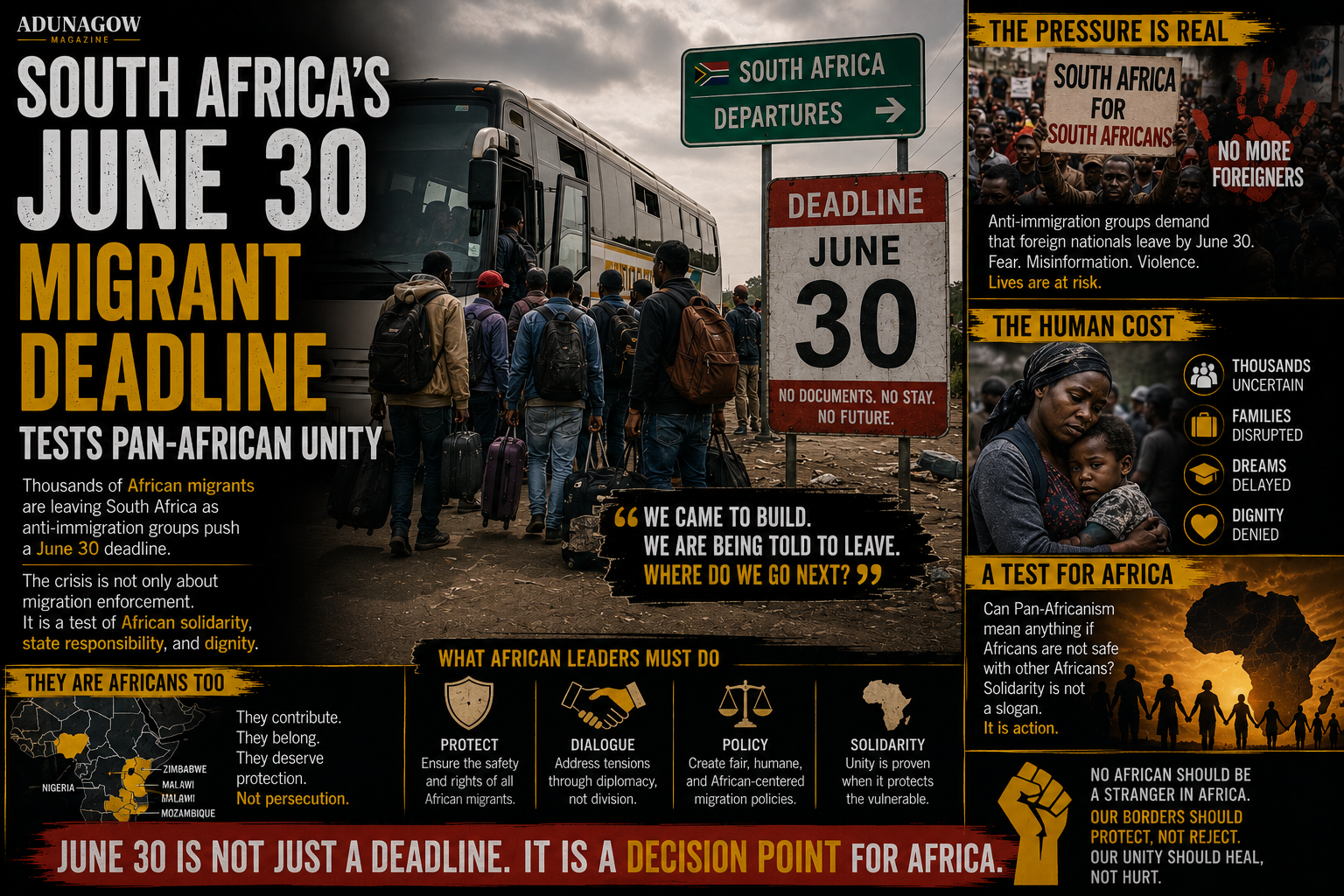
South Africa's June 30 Migrant Deadline Tests Pan-African Unity
Thousands of African migrants are leaving South Africa as anti-immigration groups push a June 30 deadline. The crisis is not only about migration enforcement. It is a test of African solidarity, state responsibility, and dignity.
South Africa is facing a dangerous migrant crisis ahead of a June 30 deadline declared by anti-immigration groups, and the story now stretches far beyond one country's internal politics.
According to the Associated Press, thousands of African immigrants have left South Africa or gathered in temporary shelters, near embassies, and at deportation sites because of fear of attacks. The pressure follows months of anti-immigration protests in several major cities. Some groups are demanding that undocumented migrants leave the country by June 30 and have threatened a national shutdown if the government does not respond.
The deadline is not an official government order. That distinction matters. But it has already created a climate serious enough for South African police to go on high alert and for several African countries to begin helping citizens return home.
Nigeria and Ghana have repatriated nearly 2,000 people on government-sponsored flights, AP reported. Malawi had around 10,000 people gathered at a temporary shelter in Durban last week, with more than 8,000 later leaving on buses. Zimbabwe and Mozambique have also repatriated smaller numbers of citizens.
This is the kind of African story that should not be reduced to a simple headline. It is about migration, yes. It is also about unemployment, public frustration, weak border systems, political mobilization, and the recurring danger of blaming vulnerable foreigners for problems that are much larger than them.
South Africa has real governance challenges around migration. President Cyril Ramaphosa has acknowledged failures in border control. His government says more than 100,000 undocumented people have been deported in the last two years, while around 500,000 others have been stopped at the border from entering without documents.
But legal enforcement is not the same as mob pressure. A state can debate immigration rules. A society can demand better administration. What it cannot do is allow fear, harassment, and violence to become unofficial policy.
Ramaphosa warned earlier this month that only authorized government officials can act against violations of the law. He also said illegal immigration is not the cause of South Africa's social and economic difficulties. That warning goes to the center of the crisis.
South Africa has one of the continent's most powerful economies, but it also carries deep inequality, unemployment, and public anger over services and crime. Migrants are often the easiest target for frustrations that were not created by migrants alone.
The numbers complicate the political rhetoric. The 2022 census counted 2.4 million foreign nationals in South Africa's population of about 62 million, less than 4 percent. Critics argue undocumented migration is undercounted, but the basic reality remains: blaming Africans from elsewhere for South Africa's full economic burden turns a complex governance problem into a dangerous identity conflict.
The human cost is already visible. Police are investigating recent attacks, including the killing of two Mozambicans in unrest that also saw more than 50 homes set alight in an immigrant neighborhood, according to AP. A Malawian man was allegedly stoned to death during anti-immigration protests in another part of the country. Other attacks have been reported.
The United Nations secretary-general's spokesperson has said Antonio Guterres is deeply concerned by reports of xenophobic attacks, harassment, and intimidation against migrants and foreign nationals in parts of South Africa.
For Africans across the continent and in the diaspora, this crisis cuts especially deep because it exposes a contradiction at the heart of the pan-African project.
African leaders speak often about integration, free movement, regional trade, and continental unity. The African Continental Free Trade Area imagines a continent where goods, services, investment, and people can move with greater purpose. Diaspora communities are routinely invited to reconnect, invest, visit, and help build the continent's future.
But those ambitions become fragile when Africans seeking safety or opportunity can be treated as threats inside another African country.
South Africa's history makes the moment even heavier. In 2008, more than 60 people, both South Africans and foreign nationals, were killed in a wave of anti-immigrant violence that spread from Johannesburg. Since then, xenophobic violence has returned in waves, often during periods of economic and political stress.
That history should make the current moment impossible to ignore.
The issue is not whether countries have the right to manage their borders. They do. The issue is whether border enforcement can be separated from public scapegoating, whether political actors can resist using migrants as emotional fuel, and whether African governments can protect their citizens abroad with the same urgency they use in diplomatic speeches about unity.
The repatriations now underway show that other African governments are watching closely. Nigeria, Ghana, Malawi, Mozambique, and Zimbabwe are not abstract names in this story. Their citizens are affected. Their families are worried. Their diplomatic relationships with South Africa are being tested.
For the diaspora, the question is just as direct: what does African solidarity mean if Africans can be made foreign, disposable, or unsafe on African soil?
South Africa's June 30 deadline crisis should be treated as an alarm. It is an alarm for the South African state to protect lives while addressing migration law. It is an alarm for African governments to coordinate better on labor mobility and citizen protection. It is an alarm for the African Union to move pan-African language closer to practical guarantees.
Most of all, it is a reminder that unity cannot live only in slogans.
If Africa wants to build a future of shared markets, shared culture, shared influence, and shared dignity, then the safety of African migrants must be part of that future. Otherwise, the continent risks asking the world to respect African lives while failing to protect African lives from each other.
June 30 may pass as a date on the calendar. The deeper test will remain.
Discover more from ADUNAGOW Magazine
Subscribe to get the latest posts sent to your email.