Africa's Lions Are Running Out of Space. Communities Cannot Be Asked to Pay the Price Alone
On World Lion Day, Kenya's coexistence crisis shows that the future of African conservation depends as much on livelihoods, compensation, and local ownership as it does on protecting wildlife.
Africa's lions still carry a global image of power. They appear on flags, tourism posters, sports crests, luxury branding, and the imagination of millions of people who have never stood near a savannah.
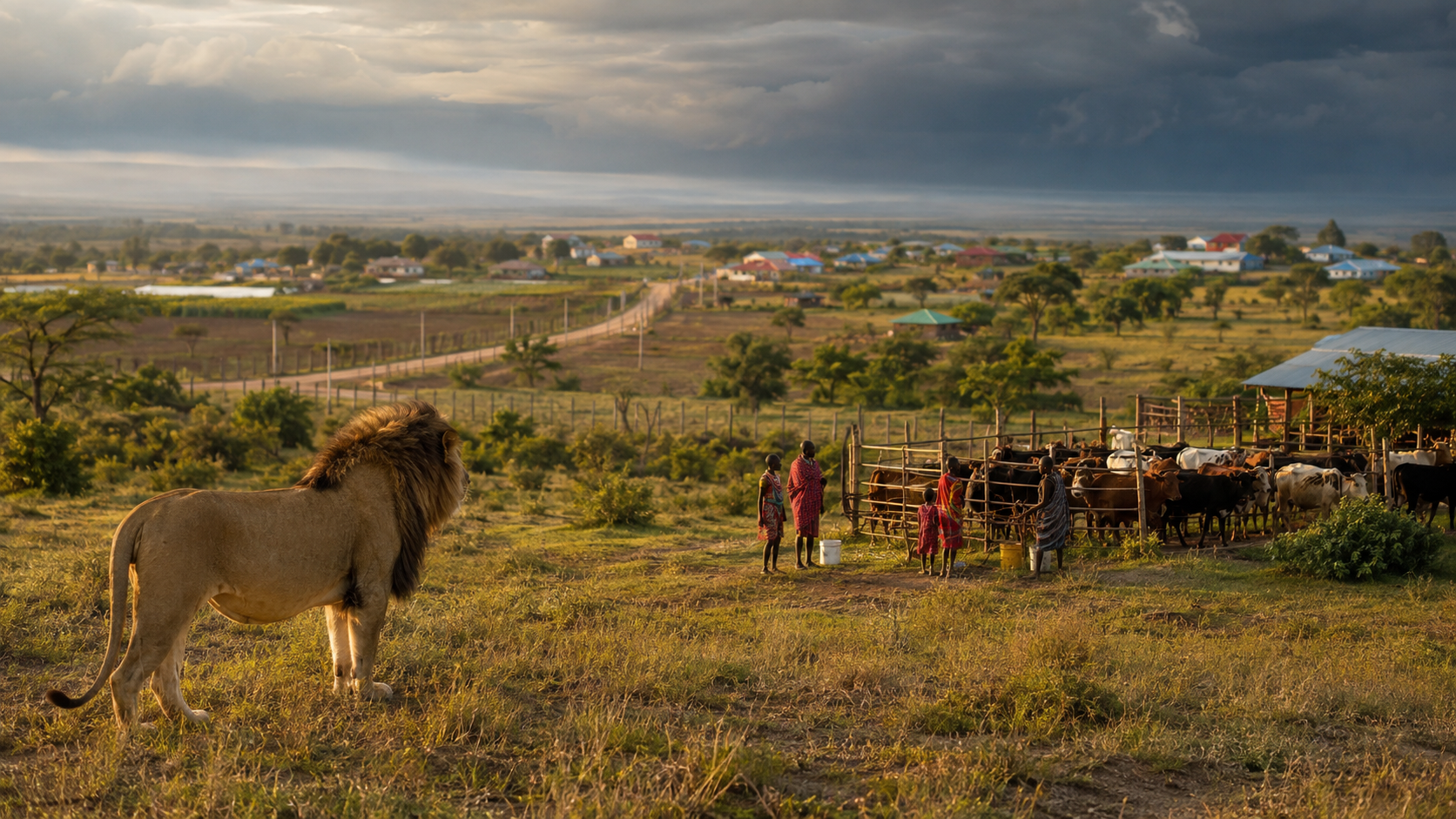
But on the ground, the future of the lion is being decided in a more practical place: the boundary between protected wildlife areas and the communities whose livestock, land, safety, and income are affected when predators run out of room.
That is the harder message behind this year's World Lion Day. A new Africanews/AP report from Kenya warns that lions across Africa are under pressure from habitat loss, shrinking prey populations, expanding settlement, livestock conflict, retaliatory killings, and poisoning. The African Wildlife Foundation estimates that only about 20,000 to 23,000 lions remain on the continent, after a decline of roughly 43 percent over two decades.
Kenya, one of Africa's best-known wildlife destinations, has an estimated 2,500 to 2,600 lions left. That number is not just a wildlife statistic. It is a development question.
Lions help power a tourism economy. They attract photographers, safari operators, conservation donors, documentary crews, and international attention. They also play a crucial ecological role as apex predators. But communities living near protected areas often experience the costs first: lost livestock, damaged livelihoods, fear, and sometimes danger to human life.
When a lion kills livestock, the loss is not symbolic. For many households, cattle, goats, and sheep are savings, food security, income, status, and survival. If people feel that conservation protects animals while leaving families exposed, retaliation becomes more likely.
The danger is not limited to lions. Africanews reported that earlier this year, six lions and dozens of vultures were poisoned in Kenya's Amboseli area. Poisoning can turn one livestock conflict into a wider ecological crisis. A treated carcass may kill the predator that ate the animal, then hyenas, vultures, and other scavengers that arrive afterward.
This is why the most important conservation conversation is not only about fencing off more land. It is about making coexistence workable.
Conservationists quoted in the Africanews/AP report argue that communities need practical reasons to protect wildlife. That means jobs, conservation enterprises, education, better livestock management, faster response systems, and fairer compensation when losses happen. It also means recognizing that people living closest to wildlife cannot be treated as background characters in a tourism story written for outsiders.
Kenya already offers models worth watching. Conservancies can connect wildlife protection to local livelihoods through employment, tourism revenue, land agreements, and community participation. Groups working in landscapes such as Tsavo and Ol Pejeta are using tools including GPS collars, real-time monitoring, research, and community partnerships to reduce conflict and strengthen predator protection.
The lesson is bigger than Kenya. Across Africa, wildlife is part of identity, heritage, ecology, and economic opportunity. But conservation cannot survive on symbolism alone. If the lion is treated as an African icon, then the people sharing land with lions must be treated as partners, not obstacles.
For the diaspora, this story carries a familiar tension. Africa's images travel globally. Its natural beauty sells experiences, brands, films, and dreams. Yet the people closest to that beauty often have to fight for a fair share of the value it creates.
World Lion Day should therefore be more than a celebration of a majestic animal. It should be a test of whether Africa's conservation future can become more just, more local, and more economically honest.
The lion may be a symbol of strength. But its survival now depends on whether the systems around it become strong enough to protect both wildlife and the communities asked to live beside it.
Read Next
- Ghana's Cocoa Protection Bill Puts Farmers At The Center Of A Global Chocolate Fight
- Comoros Just Won Its First UNESCO World Heritage Listing. Now Comes The Real Work.
- Africa’s Solar Power Shift Is Becoming a Finance Story
Discover more from ADUNAGOW Magazine
Subscribe to get the latest posts sent to your email.