As the world races for cobalt, lithium, manganese, and rare earths, African governments are asking a bigger question: why should the future economy be built from African minerals while most of the value is captured somewhere else?
The world wants Africa's minerals. Africa is starting to ask for more than applause.
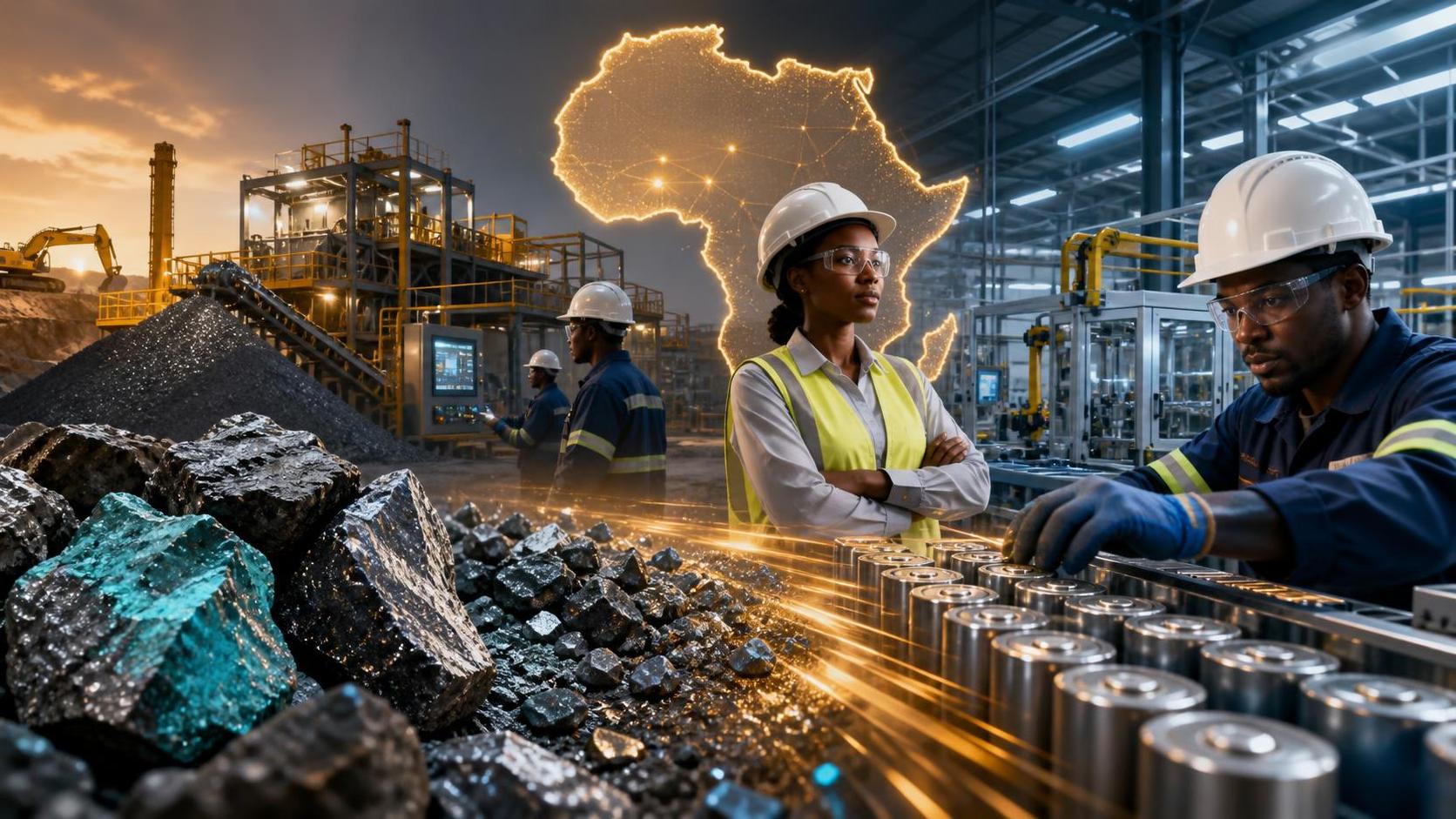
Cobalt, lithium, manganese, graphite, rare earths, and platinum-group metals sit at the center of the clean-energy economy. They are needed for electric vehicles, grid storage, electronics, defense systems, and the industrial hardware of a low-carbon future. For years, that fact has been described mainly as a global supply-chain problem for wealthy economies. The African question is sharper: if the future is being built with African minerals, how much of that future will be built in Africa?
That question is moving from speeches into policy. Across the continent, governments are trying to shift from raw extraction toward local processing, beneficiation, and regional value chains. The African Development Bank says Africa holds about 30% of the world's critical mineral deposits. The African Union's African Green Minerals Strategy sets a continental ambition to move beyond exporting raw materials and toward value addition, industrialization, job creation, and climate resilience.
This is the old African resource story meeting a new global economy.
For generations, the pattern has been familiar: minerals leave the continent as raw or lightly processed commodities, then return as expensive finished goods, foreign debt, imported technology, or geopolitical pressure. The names change, but the structure often stays the same. The clean-energy transition now creates a rare opening. Global demand is rising. Supply security has become a strategic concern. China dominates many refining and processing routes. The United States, Europe, Gulf powers, and Asian economies all want reliable access.
That gives African countries leverage, but leverage is only useful if it is organized.
Zimbabwe's lithium policy has become one example. The country has moved to restrict exports of raw minerals and lithium concentrates, pushing companies toward domestic processing. The Democratic Republic of Congo has also used export controls and quotas around cobalt. Other African producers are studying similar moves. The message is clear: the continent does not want to remain only the mine at the beginning of someone else's value chain.
The ambition is easy to understand. Processing minerals locally can create skilled jobs, deepen tax revenue, support energy and logistics infrastructure, and help African economies build industrial capability around batteries, components, chemicals, and manufacturing. If done well, it can also give young African engineers, technicians, financiers, lawyers, and entrepreneurs a bigger role in the industries shaping the next century.
For diaspora readers, this is not a distant mining-policy story. It is a wealth and power story. Diaspora capital often looks for credible ways to participate in Africa's growth without being limited to real estate, remittances, small retail ventures, or symbolic return projects. A serious minerals value-chain agenda could open space for investment in logistics, technical services, environmental monitoring, industrial parks, training, legal compliance, data systems, and supplier networks.
But the opportunity should not be romanticized. Export bans alone do not build factories. Processing plants need reliable electricity, water, transport corridors, financing, technical skills, predictable regulation, and governance people can trust. Without those, restrictions can create smuggling, investor uncertainty, elite capture, or stalled projects. Communities near mines also need a stronger bargain than "national development" promised from far away while local land, health, and livelihoods carry the cost.
That is why the better question is not whether Africa should demand more value. It should. The better question is how.
A stronger African minerals strategy would connect national policies to regional infrastructure. One country may have cobalt. Another may have ports, power potential, manufacturing capacity, or financing depth. AfCFTA-era thinking matters here because mineral value chains do not have to stop at colonial borders. Battery inputs, chemical processing, rail corridors, industrial zones, research centers, and export platforms can be planned regionally if governments and private investors treat African integration as a production strategy, not just a slogan.
This is also where accountability matters. Resource nationalism can become a powerful development tool, but it can also become a cover for closed deals. African citizens and diaspora observers should ask who owns the processing facilities, where profits go, how contracts are disclosed, what environmental protections are enforced, and whether local workers are moving into skilled positions or only providing cheap labor around foreign-controlled assets.
Still, the shift itself is important. Africa is not just waiting to be discovered by clean-energy investors. African institutions are naming the problem and pushing toward a new deal. The African Development Bank has called for critical minerals to become a lever for industrial transformation. The African Union has framed green minerals as part of a broader development strategy. Analysts from policy institutions have argued that Africa's challenge is turning mineral demand into broad prosperity rather than another extraction cycle.
The stakes are bigger than batteries. They are about whether Africa can enter the next industrial era as a supplier of dirt, a supplier of materials, or a builder of systems.
The diaspora should watch this closely because this may become one of the defining African economic stories of the next decade. Not because every export ban will work. Not because every government will negotiate wisely. Not because foreign competition will suddenly become fair. But because the bargaining table has changed.
The world needs what Africa has. The next move is making sure Africa gets more of what it needs too: jobs, infrastructure, ownership, technology, and the power to shape the future built from its own ground.
Read Next
- Kenya's Cotton Comeback Is Really a Fight to Keep African Value at Home
- West Africa's Development Bank Just Got a Credibility Upgrade
- Chinese EV Makers Are Building in Africa. The Bigger Question Is Who Owns the Value Chain
Sources
- https://www.lemonde.fr/en/le-monde-africa/article/2026/08/24/how-africa-is-using-critical-minerals-to-rebalance-geopolitical-power_6756807_124.html
- https://www.afdb.org/en/news-and-events/africa-wants-make-its-critical-minerals-lever-industrialisation-and-economic-transformation-95515
- https://au.int/en/documents/20250318/africas-green-minerals-strategy-agms
- https://www.climatechangenews.com/2026/03/11/africa-needs-more-than-export-bans-to-cash-in-on-critical-minerals-experts-say/
- https://www.brookings.edu/articles/how-africa-can-benefit-from-the-global-mineral-rush/
Discover more from ADUNAGOW Magazine
Subscribe to get the latest posts sent to your email.