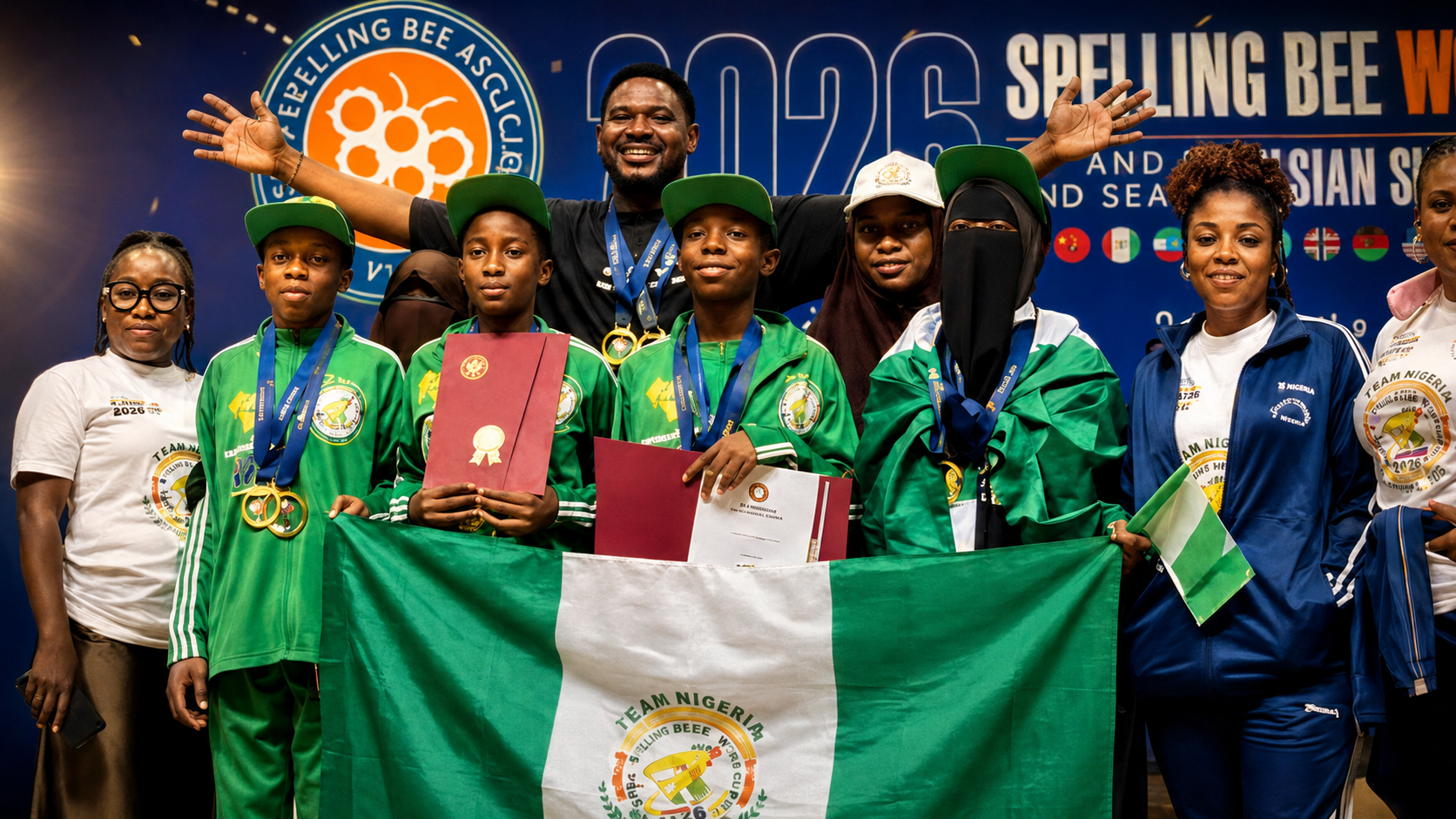
Four young Nigerian scholars claimed the Gold Award in the Middle School Group category, turning the country’s first appearance at the global competition into a historic victory.
Nigeria has made an emphatic entrance onto the global spelling stage.
Team Nigeria won the Gold Award in the Middle School Group category at the 2026 Spelling Bee World Cup in Shanghai, China, completing a remarkable journey that began in national classrooms and continued through continental competition.
The tournament, held from July 14 to 19, brought together young spellers from Africa, Asia, China, Canada, the United States and other parts of the world. Nigeria’s victory was especially significant because it marked the country’s first appearance at the international event.
The four students representing Nigeria were:
- Adeolu Oluwadamilola Oreofe of St. Lawrence Metropolitan College, Ado-Ekiti
- Abdurrahman Yusuf of Ar-Raheem International College, Ilorin
- Great Chinedu Okediachi of Madonna International School, Asaba
- Maryam Yusuf of Ar-Raheem International College, Ilorin
“Team Nigeria has won the Gold Award in the Middle School Group Category at the Spelling Bee World Cup in Shanghai, China,” the Nigeria Spelling Bee announced after the competition.
It was a short announcement carrying a much larger message: when African talent receives preparation, exposure and an opportunity to compete, it can succeed on the world stage.
From Nigeria to Zimbabwe—and then Shanghai
The students did not arrive in China by accident.
Their path began at the Nigeria Spelling Bee, where they distinguished themselves against other young competitors from across the country. They then advanced through the African Spelling Bee Championship in Harare, Zimbabwe, before earning the opportunity to represent Nigeria in Shanghai.
Oluwadamilola emerged as the junior champion at the African championship, reportedly outperforming competitors from across the continent. Abdurrahman finished among the leading junior contestants, while Maryam had an impressive run in the senior division despite still being a junior secondary school student.
Maryam, 14, reportedly spelled 17 of 20 words correctly during a one-minute speed round in Harare, helping Nigeria secure second place in the continental team competition. Her performance in Zimbabwe established her as one of the delegation’s standout talents before the journey to China.
Ahead of the World Cup, Oluwadamilola said she was looking forward to competing, meeting spellers from other countries and building her vocabulary and confidence.
She also expressed a more ambitious objective: bringing the trophy home.
Team Nigeria accomplished exactly that.
A victory built across several Nigerian communities
Nigeria’s winning team reflected a broad national effort rather than the success of a single school or city.
The four students came from schools in Ado-Ekiti, Ilorin and Asaba, bringing together young talent from Ekiti, Kwara and Delta states. Their achievement also demonstrated what can happen when families, schools, national organizers and continental institutions create a pathway through which exceptional students can advance.
Ar-Raheem International College celebrated the performances of Maryam and Abdurrahman, confirming that its two students won medals during the World Cup finals.
In Delta State, Great Chinedu Okediachi’s achievement received major official recognition. Governor Sheriff Oborevwori presented the young scholar with a ₦20 million reward after receiving him at Government House in Asaba. The Asagba of Asaba, Professor Epiphany Azinge, also reportedly awarded Chinedu a scholarship covering his university education.
Such recognition matters. African students frequently receive widespread public attention for their academic accomplishments only after winning abroad. The greater challenge is building systems that identify and support them long before they step onto an international stage.
More than a spelling competition
A spelling bee may appear to test only a contestant’s ability to arrange letters correctly, but succeeding at this level demands much more.
Competitors must develop a large vocabulary, understand word origins, recognize language patterns and recall difficult spellings while performing under pressure. They also need confidence, concentration, discipline and the ability to recover quickly from uncertainty.
Those skills extend far beyond spelling. They are valuable in literature, public speaking, science, law, technology and nearly every profession in which precise communication matters.
The Shanghai competition also gave the Nigerian students something their classrooms alone could not provide: direct exposure to peers from different countries and educational cultures.
Other African nations represented at the event reportedly included Ethiopia, Côte d’Ivoire, Malawi, South Africa and Zimbabwe. Their participation demonstrated that Africa is becoming more visible within international academic competitions traditionally associated with contestants from North America and Asia.
Africa’s talent is not the problem
Nigeria’s victory arrives amid persistent concerns about the state of education across the continent. Overcrowded classrooms, insufficient instructional materials, disruptions to schooling and unequal access to quality education continue to limit millions of African children.
But Team Nigeria’s achievement challenges any suggestion that African students lack the intellectual ability to compete globally.
The talent exists.
What remains uneven is the infrastructure surrounding it: strong schools, trained teachers, competitive programs, sponsorship, travel funding, mentoring and consistent institutional support.
For every student who reaches Shanghai, there may be thousands of equally promising children who never encounter a program capable of discovering and developing their abilities.
That is why Nigeria’s gold should be treated as more than a celebratory headline. It should become an argument for sustained investment in academic competitions and enrichment programs—not only in elite private institutions but also in public and underserved schools.
Corporate sponsors, diaspora organizations and education-focused foundations could play an important role by funding regional competitions, training programs and international travel. The objective should be to create a reliable talent pipeline rather than depending on isolated success stories.
A debut that changes expectations
Team Nigeria traveled to Shanghai as a first-time participant. It returned as a Gold Award winner.
That transformation matters because international competitions are partly about confidence. Once young people see someone from their country or community succeed, the world stage begins to feel less distant.
Oluwadamilola Adeolu, Abdurrahman Yusuf, Great Chinedu Okediachi and Maryam Yusuf have now created that example for the next generation of Nigerian spellers.
Their victory belongs to the students who studied the words, the teachers who prepared them, the families who supported them and the organizations that helped move them from local competition to the African championship and finally to China.
But it also belongs to every African child who needs evidence that global excellence is not reserved for someone else.
On its first trip to the Spelling Bee World Cup, Nigeria did not merely participate.
Nigeria spelled out its arrival—and brought home gold.
Read Next
- Airtel Money's IPO Push Shows African Mobile Money Has Become Global Infrastructure
- Nairobi Becomes Africa's Tech Deal Room as Africa Technology Show Opens
- WAFCON 2026 Is More Than a Tournament. It Is Africa’s Next Football Talent Market
Discover more from ADUNAGOW Magazine
Subscribe to get the latest posts sent to your email.