Macron’s $27bn Africa Push Is Really a Test of Whether African States Can Bargain From Strength
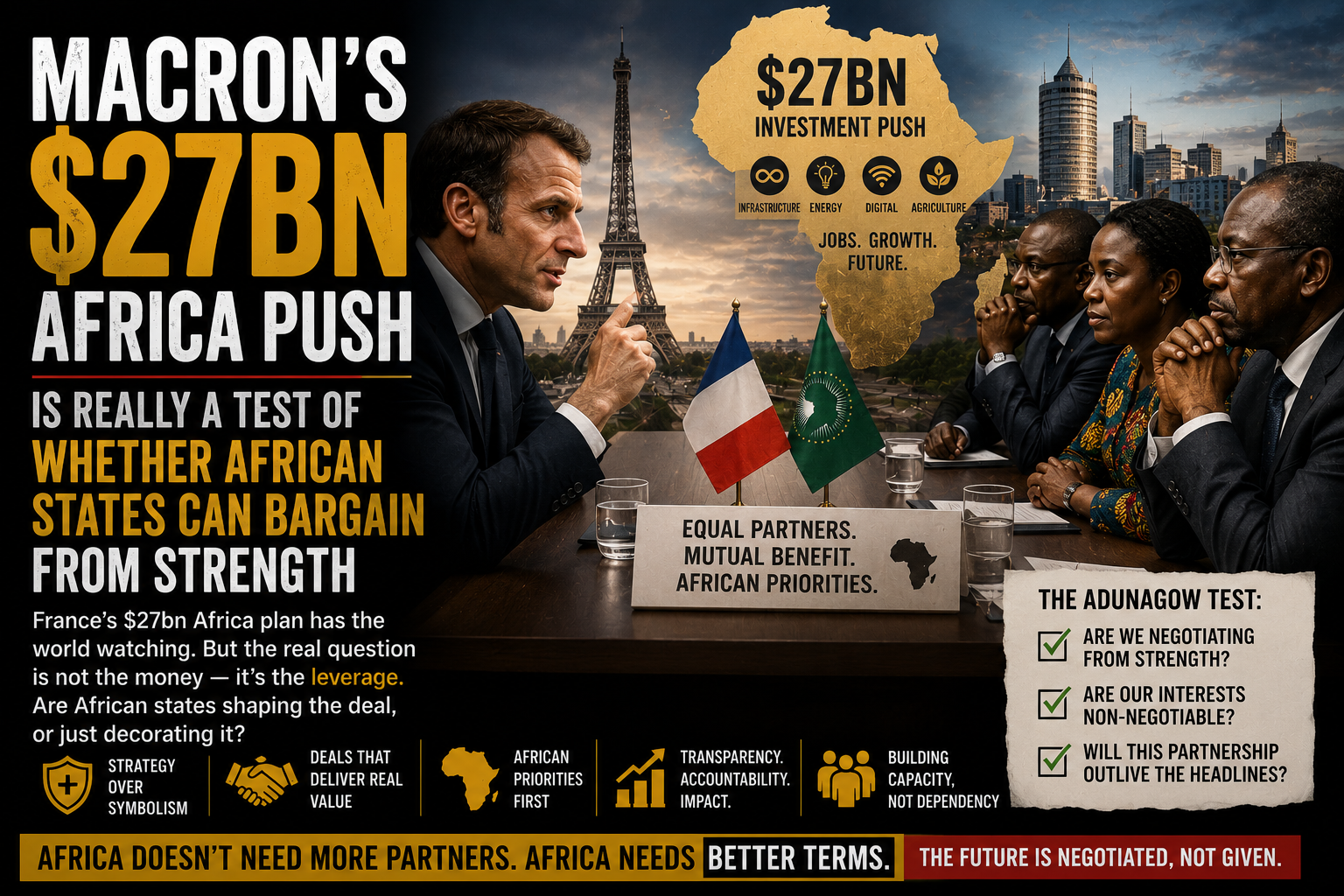
France’s $27bn Africa investment push has produced a headline built for global attention. But the sharper ADUNAGOW question is whether Kenya and other African states are finally negotiating from a position of strategy and leverage — or simply hosting a polished new version of old influence politics.
When Emmanuel Macron announces a $27bn Africa investment push at a summit in Kenya, the easiest version of the story is also the weakest one.
That version says France is bringing money, Africa is receiving attention, and another diplomatic stage has been built around promises of partnership. It is simple, familiar, and incomplete.
The more useful question is harder: when global powers come courting Africa with fresh language, large figures, and summit choreography, who is actually shaping the terms?
That is why the Africa Forward summit matters.
Al Jazeera has reported that Macron used the Kenya-hosted gathering to announce the $27bn push, while BBC Africa has framed the summit as part of France’s effort to move beyond old colonial ties and rethink how it engages African leaders. The Africa Report has added another important detail: more than half of Africa’s presidents were in Nairobi, giving the summit real continental gravity rather than the feel of a side event. Kenya’s presidency has meanwhile presented the moment as a win-win partnership grounded in mutual respect, with 11 agreements signed across strategic sectors.
These are not small signals. They show that Africa is not only being discussed in absentia. It is negotiating in the room.
Why Kenya matters here
Kenya is not functioning as a passive venue. It is presenting itself as a gateway — a logistics node, diplomatic convening point, and policy actor that can broker serious investment conversations on terms increasingly defined by African ambition.
The Africa Report’s note that CMA CGM unveiled an $800m Kenya logistics deal reinforces that point. This is not just about speeches or symbolic resets. It is about ports, corridors, trade routes, and the infrastructure language through which influence becomes concrete.
That naturally connects to ADUNAGOW’s wider reporting on diaspora mobility and the politics of access, industrial scale and African value capture, and the hidden economic architecture of diaspora finance.
The deeper pattern is the same: the future is often decided not only by who offers capital, but by who controls the systems through which trade, movement, and value flow.
This is really a leverage story
France’s role on the continent is impossible to separate from history. Any attempt by Paris to relaunch or reposition its influence in Africa will be read through the long shadow of colonial power, military entanglement, and credibility loss in parts of its former sphere.
That makes the optics delicate. But it also makes the strategic opening more interesting. If old habits of deference are weakening, then African states have more room to negotiate from calculation instead of inherited hierarchy.
This is where diaspora readers have reason to care.
Too often, Africa is framed abroad as a market to enter, a frontier to unlock, or a geopolitical theatre in which outside powers compete for access. That language flattens the continent into an object. The stronger frame is to ask what African governments can extract, build, and retain when global interest intensifies.
Can they demand local value? Can they shape financing terms? Can they secure infrastructure that strengthens continental trade rather than deepening dependency on external priorities? Can they use outside capital without surrendering narrative or control?
Those are not academic questions. They sit at the heart of whether partnerships like this become transformative or merely photogenic.
The fine print matters more than the headline number
Ruto’s language about mutual respect and shared responsibility sounds right. But the real test will not be in summit speeches. It will be in implementation, visibility, and leverage.
Do these deals create jobs and logistics capacity that endure? Do they widen African room to maneuver in trade and manufacturing? Do they strengthen regional integration? Or do they simply modernize the packaging around influence politics that remains fundamentally external in direction?
Africa does not need to reject outside capital to answer those questions seriously. It needs to negotiate from clarity.
That means understanding that the headline number — $27bn — is only the beginning of the story, not the conclusion. Big figures attract attention, but development credibility is built in project quality, execution discipline, ownership structures, infrastructure logic, and whether gains are distributed in ways ordinary people can actually feel.
For ADUNAGOW, this is exactly the kind of story that matters now. It lets us cover growth without naivete, diplomacy without passivity, and Africa’s global relevance without surrendering African agency. The point is not to ask whether France is back. The point is to ask whether African states are writing a harder, smarter script for what partnership must mean in the next era.
If Kenya can help define that script, the summit will matter for reasons far deeper than Macron’s announcement. It will matter because it shows an African country using convening power, strategic geography, and diplomatic confidence to influence how global capital arrives.
That would be a more important story than French generosity.
It would be a story about African leverage.
Read Next
- From Year of Return to the 17th Region: Is Ghana Finally Giving the Diaspora Real Power?
- Dangote Refinery Expansion Could Change Africa — But Will Nigerians Feel the Benefit?
- The Diaspora Money Paradox: Africa Depends on Remittances, but Sending Money Home Still Costs Too Much
Discover more from ADUNAGOW Magazine
Subscribe to get the latest posts sent to your email.