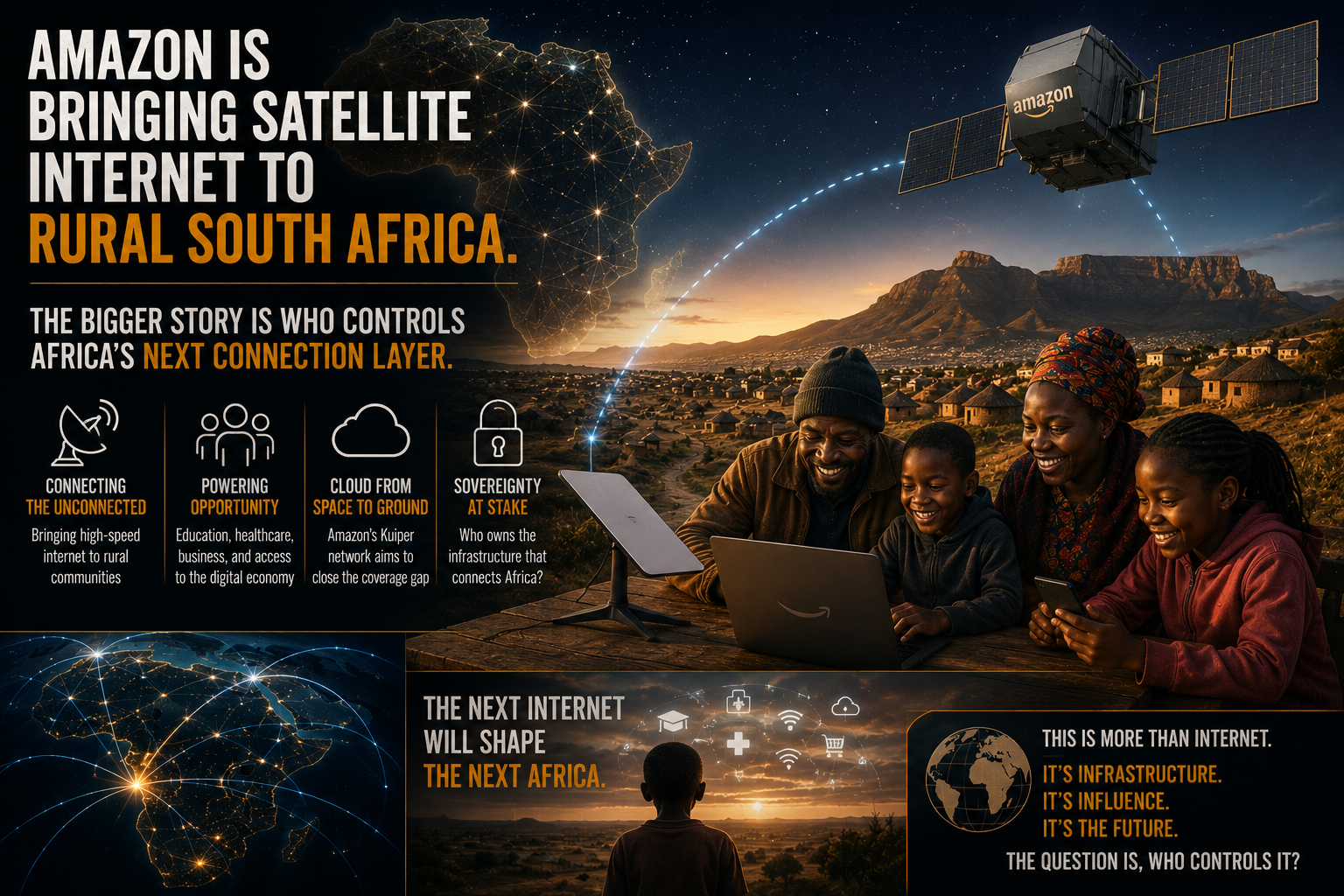
Amazon Is Bringing Satellite Internet to Rural South Africa. The Bigger Story Is Who Controls Africa's Next Connection Layer
Amazon Leo's Herotel deal could connect farms, small towns, and rural households that fiber cannot reach. For Africa and its diaspora, the real question is whether better access becomes local power or another imported dependency.
Amazon's satellite internet venture, Amazon Leo, has signed a deal with South African internet provider Herotel to bring satellite broadband to the country through a new service called evry. The commercial launch is expected in 2027, and Amazon says it is the first Amazon Leo agreement of its kind on the African continent.
On the surface, the story is easy to frame as a billionaire space race. Amazon is moving into the home country of Elon Musk while Starlink remains delayed by South Africa's communications licensing and empowerment rules. That angle will travel online. But for ADUNAGOW readers, the deeper story is bigger than one rivalry: rural Africa is becoming the next frontier of global internet infrastructure.
Amazon says the service is designed for homes and small businesses beyond the reach of fiber and fixed wireless networks. That matters because millions of South Africans still live in farms, small towns, and rural communities where traditional broadband is expensive, slow to deploy, or simply unavailable. Herotel already has a national field footprint, with hundreds of thousands of customers and local offices across more than 550 towns, giving Amazon a practical path into communities that are often left out of digital expansion.
If the rollout works, the benefits could be real. Better rural internet can support online learning, remote work, telehealth, small business payments, creator income, public services, and diaspora connection. A young founder outside Johannesburg should not need to move to a major city just to upload a product demo. A family in the diaspora should not need to treat reliable video calls with relatives in rural towns as a luxury. A farmer, teacher, clinic, or local shop should not be excluded from the digital economy because geography made fiber unattractive.
But access alone is not the same as power.
The arrival of Amazon Leo raises a strategic question Africa cannot avoid: who owns the next connection layer? Satellite broadband can narrow infrastructure gaps, but the economics, data flows, pricing, hardware, and service rules may still be shaped by companies headquartered far from the communities they serve. If African governments and operators negotiate well, satellite internet can complement local networks and expand opportunity. If they do not, rural customers may gain access while African markets lose leverage over the systems that connect them.
South Africa's regulatory debate sits inside that tension. AP reports that Starlink has not launched there in part because foreign communications companies must meet local ownership and empowerment requirements designed to address apartheid-era exclusion. Critics call the rules restrictive; supporters see them as a necessary guardrail against a market where foreign capital captures value without local participation. Amazon's Herotel route suggests one path forward: partner through local operators that already understand the communities, terrain, and service realities.
That does not make the story simple. Amazon and Herotel will still need to prove affordability, reliability, customer support, and real usefulness when the service launches. A satellite connection that is technically available but priced beyond ordinary households will not close the digital divide. A rural broadband solution that depends entirely on imported hardware and foreign platform economics will not automatically build African digital sovereignty.
Still, this is a meaningful signal. Global technology companies are no longer treating African connectivity as a charitable side project. They see a market, a growth frontier, and a strategic battleground. Africa should see the same thing and negotiate accordingly.
For the diaspora, the lesson is direct. Connectivity is now part of development power. The next wave of African opportunity will not only be built in capitals, tech hubs, and financial centers. It will be built where internet access finally reaches the towns and families that have been waiting for the network to arrive.
Amazon Leo may be bringing the satellites. The real test is whether Africa turns the signal into sovereignty, jobs, knowledge, and local wealth.
Read Next
- Nairobi Becomes Africa's Tech Deal Room as Africa Technology Show Opens
- Airtel Money's IPO Push Shows African Mobile Money Has Become Global Infrastructure
- AfCFTA Has A Local Business Problem. Solving It Could Change African Trade
Discover more from ADUNAGOW Magazine
Subscribe to get the latest posts sent to your email.