After Accra, Reparations Are No Longer Just A Moral Demand
Ghana's reparatory justice conference turned a landmark UN resolution into a working global agenda, linking apology, restitution, debt relief, cultural return, and diaspora power.
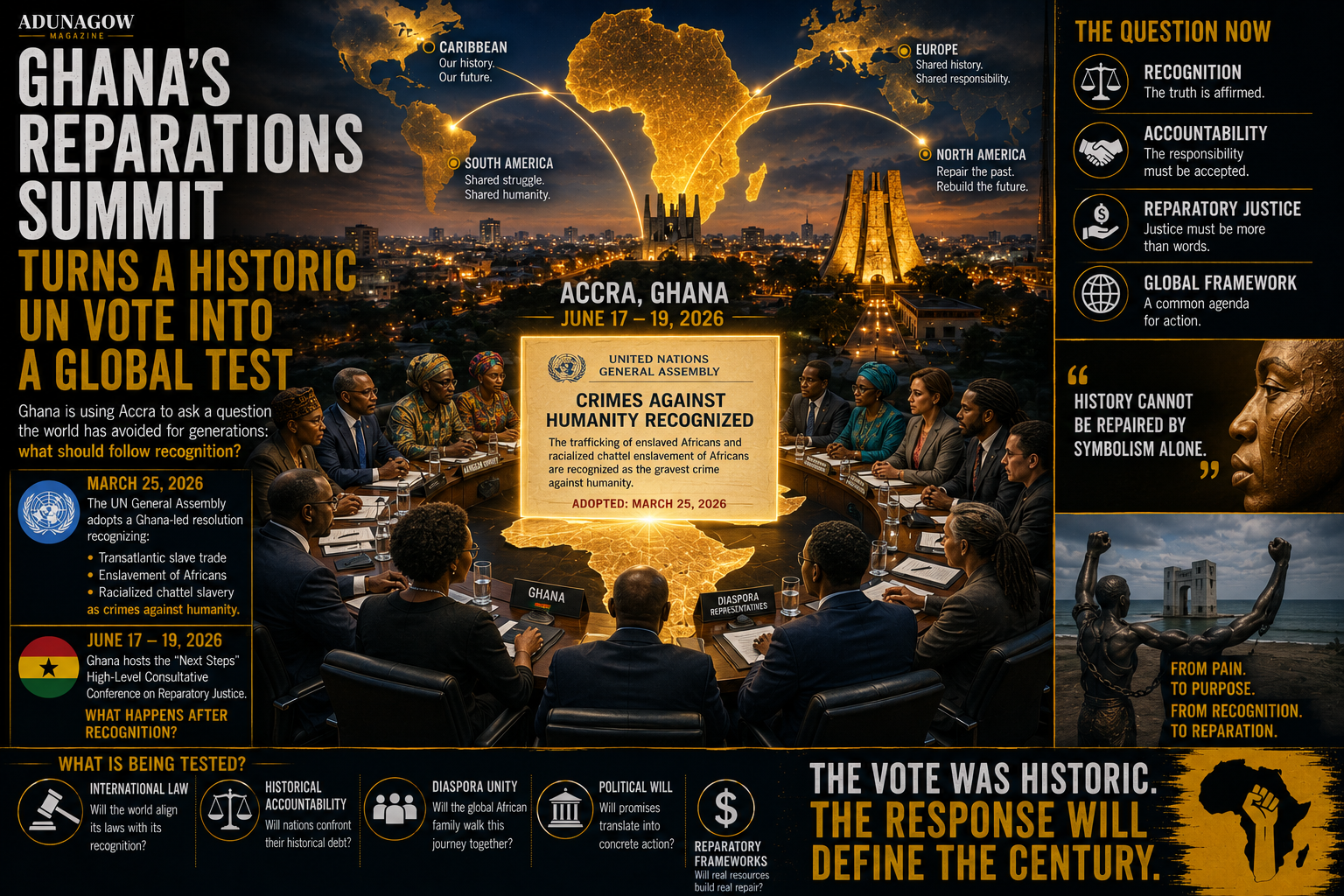
When Ghana brought leaders, legal experts, civil society organizers, and diaspora voices to Accra for the "Next Steps" conference on reparatory justice, the message was clear: recognition alone is no longer enough.
The conference followed the March 25, 2026 United Nations General Assembly resolution recognizing the transatlantic trade in enslaved Africans and racialized chattel enslavement as the gravest crime against humanity. That vote gave the reparations movement a historic diplomatic marker. Accra was about the harder question that comes next: how does the world move from acknowledgement to action?
By the close of the June 17-19 gathering, African, Caribbean, and allied leaders had adopted a 19-point global framework for reparatory justice. The framework calls for formal and unconditional apologies from countries and institutions that benefited from the transatlantic slave trade. It also pushes for compensation, debt relief, cultural restitution, and the return of stolen artifacts and human remains.
For ADUNAGOW readers, this story matters because it is not only about the past. It is about the global systems that the past helped build, and the future Africans and people of African descent are demanding a role in shaping.
Ghana's leadership is central. President John Dramani Mahama has positioned the country as a diplomatic engine for reparatory justice, working through the African Union and alongside Caribbean partners. The Accra conference also built on the long-standing CARICOM reparations agenda, which has helped keep apology, restitution, development support, and institutional accountability in the global conversation.
The diaspora dimension is especially important. Reparatory justice is often reduced to a debate about individual payments, but the Accra framework is broader. It links memory to development. It links stolen labor to debt. It links looted culture to identity. It links historical violence to the modern inequalities that still shape education, health, land, migration, finance, and global power.
That broader frame is why the conference matters beyond Ghana. Former slave-trading nations and institutions are being asked not only to express regret, but to confront the systems that profited from African dispossession. Museums and universities face questions about stolen artifacts and human remains. Churches, banks, and states face questions about wealth built through slavery and colonial extraction. International institutions face questions about whether development and debt rules can be separated from history.
The political resistance is real. The UN resolution is non-binding. Many Western governments remain cautious or openly opposed. The United States, Israel, and Argentina voted against the March resolution. A large bloc of countries, including European Union members, abstained. Those positions show why implementation will be difficult.
But Accra changed the conversation in one important way: it treated reparatory justice as a governance agenda, not a symbolic gesture.
That shift matters. Apologies may be morally necessary, but they are only a beginning. If reparatory justice is to become meaningful, it will need institutions, legal strategy, financing models, cultural return processes, and measurable commitments. The Accra framework does not settle those questions. It makes them harder to ignore.
For Africa and the global diaspora, the moment is both emotional and strategic. It asks descendants of the enslaved and colonized to see memory not as a burden, but as evidence. It asks African governments and Caribbean states to coordinate rather than speak alone. It asks diaspora communities to understand reparations as a development issue, a cultural issue, and a question of global power.
The real test begins now. The world has heard the moral case many times. Accra's challenge is whether that moral case can become machinery: panels, legal claims, diplomatic pressure, cultural restitution, debt negotiations, and public accountability.
If that happens, Ghana's conference may be remembered as more than another summit. It may be remembered as the moment reparations moved from recognition to architecture.
Discover more from ADUNAGOW Magazine
Subscribe to get the latest posts sent to your email.