| Exclusive Interview | November 2026

For Dr. Adeolu Adeboye, the journey from Nigeria to a medical career in the United States was never simply a story of personal achievement.
It was also the beginning of a question that would eventually reshape his understanding of success.
What responsibility comes with gaining knowledge, opportunity and resources that others may never have the chance to access?
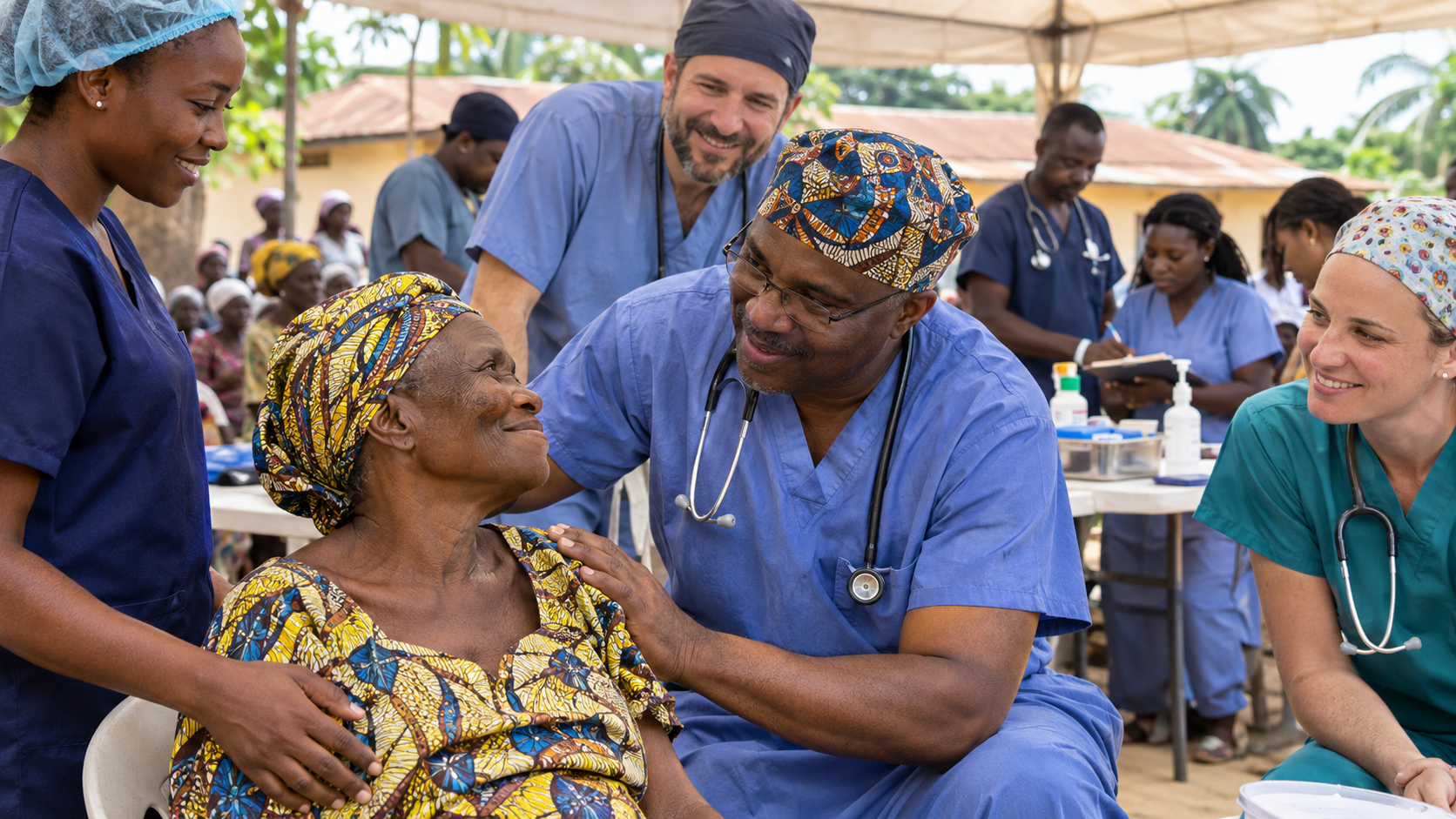
Today, that question is at the heart of Shekinah Global Healthcare Foundation, a U.S.-based nonprofit working with Nigerian healthcare professionals and organizations to deliver free medical and surgical care to underserved communities.
Between February 2024 and January 2026, the foundation and its collaborating partners reported reaching more than 8,500 people, delivering over 20,000 medical interventions and supporting more than 580 surgical procedures across four documented missions in Nigeria.
But for Adeboye, the numbers tell only part of the story.
In an exclusive written interview with ADUNAGOW Magazine, the trauma and general surgeon reflects on the responsibility he feels toward his country of birth, the realities of organizing medical missions across continents, and his belief that meaningful diaspora engagement must be built on partnership rather than dependency.
A Calling Rooted in Two Worlds
Born and raised in Nigeria, Adeboye eventually pursued his medical training and professional career in the United States. He now practices as a trauma surgeon at HCA Florida Bayonet Point Hospital.
His medical career exposed him to a troubling contrast.
Conditions routinely treated in well-resourced hospitals can become debilitating or life-threatening in communities where surgery is unaffordable, specialists are difficult to reach, or essential medical resources are unavailable.
For Adeboye, recognizing that disparity became increasingly personal.
"If God has given me this skill, training, relationships, and access to resources, what am I supposed to do with them?"
The question, he explained, ultimately led to the creation of Shekinah Global Healthcare Foundation.
But his vision was never limited to organizing occasional trips abroad.
He wanted to build a collaborative network bringing together physicians, surgeons, nurses, pharmacists, volunteers, donors and Nigerian healthcare institutions to serve patients who might otherwise go without necessary treatment.
More importantly, he wanted the foundation's contributions to endure.
"The long-term vision is not for communities to remain dependent on visiting medical teams," he told ADUNAGOW Magazine.
Instead, the objective is to use resources and relationships developed abroad to reinforce existing Nigerian healthcare systems and strengthen their ability to serve patients independently.
The Patient Behind the Numbers
Ask Adeboye which experience has stayed with him most, and he does not begin with an operating-room statistic.
He remembers a man whose untreated hernia had gradually made everyday life unbearable.
The patient arrived at an outreach with a large inguinal hernia. The condition had become painful enough to interfere with his ability to work and support his family.
For a surgeon accustomed to performing such procedures, the medical solution was straightforward.
For the patient, however, access to surgery had become an almost insurmountable obstacle.
Adeboye and the medical team repaired the hernia, and he reports that the patient recovered well.
The experience reinforced a lesson that continues to shape his approach to healthcare.
A successful operation is not merely a clinical achievement. It can also change a household's financial security, restore someone's independence and relieve the anxiety of family members who depend on that person.
"The real story is the person behind each number, the family connected to that person, and what becomes possible in their lives when a barrier to care is finally removed."
For Adeboye, this is why the foundation's work cannot be understood solely through numbers of consultations, procedures or beneficiaries.
Its significance lies in the lives affected by access to treatment.
Four Missions, Thousands Reached
 The foundation's documented mission history illustrates how its work has developed through collaborations with Nigerian organizations, medical institutions and volunteer teams.
Its first recorded mission took place in Lagos in February 2024, in partnership with Dominion Healing Wings.
The outreach focused on hemodialysis access for people requiring life-sustaining kidney treatment. More than 60 patients received free surgical procedures, including tunneled dialysis catheter placements and arteriovenous fistula creation.
In October 2024, Shekinah participated in the Ubomi Medical and Surgical Outreach in Lagos, organized through partnerships involving Pistis Foundation and Pro-Health International.
According to the foundation's mission records, the collaborative outreach reached 3,396 beneficiaries and delivered 8,894 interventions, including 229 surgical procedures.
A subsequent July 2025 mission in Lagos, supported by the Onome Omobolaji Obada Foundation and Pro-Health International, reported reaching 2,556 individuals and delivering more than 4,500 medical interventions.
The fourth documented mission took place in Sodeke, Abeokuta, Ogun State, in January 2026.
Working with Pro-Health International and other partners, the outreach reported serving 2,587 beneficiaries through 6,661 interventions over five days, including 189 surgical procedures.
These figures represent collaborative mission outcomes reported by the foundation, rather than services delivered solely by Shekinah.
Together, the initiatives demonstrate a model built around shared expertise, donated resources and coordinated medical services.
They also demonstrate the scale of unmet healthcare needs that individual outreach programs are attempting to address.
Building Capacity, Not Dependency
“What remains after the mission team leaves?”
On long-term healthcare sustainability
One of the most compelling aspects of Adeboye's vision is his insistence that temporary missions cannot, by themselves, solve structural healthcare challenges.
He returns repeatedly to a fundamental question:
"What remains after the mission team leaves?"
His answer begins with recognizing the expertise already present in Nigeria.
Rather than presenting visiting professionals as the sole source of medical knowledge, Adeboye emphasizes collaboration between Nigerian and international healthcare workers.
Surgeons, physicians, nurses and pharmacists work together, exchange techniques and share practical experience.
He is particularly careful to challenge the assumption that professional knowledge flows in only one direction.
Nigerian healthcare professionals, he explained, regularly achieve remarkable outcomes despite considerable limitations in resources and infrastructure.
"There is tremendous expertise already present locally," he said.
For Shekinah, strengthening healthcare therefore means building on those existing capabilities.
The foundation has begun donating medications and supplies to a local clinic to support continued patient care after its outreach activities conclude.
Adeboye hopes to develop more consistent support alongside expanded training, surgical education, mentorship, equipment assistance and partnerships between missions.
His long-term ambition is striking.
He would consider it a major success if a hospital or community eventually no longer required visiting teams for particular services because local professionals had acquired the necessary training, equipment and infrastructure.
The measure of success, in other words, is not how indispensable the foundation becomes.
It is how much stronger local healthcare becomes without it.
The Hidden Work Behind Free Healthcare
Providing medical services without charging patients requires significant planning, funding and coordination.
Adeboye describes months of preparation involving professionals, medication supplies, surgical equipment, transportation, local healthcare facilities and regulatory considerations.
Operating-room capacity is limited. Medical needs are extensive. Decisions must be made about how to allocate finite resources among patients requiring care.
Local organizations are essential to navigating those challenges.
Adeboye identifies Pro-Health International as a particularly important partner because of its familiarity with Nigerian communities, medical facilities, healthcare professionals and operating conditions.
Other organizations, including Pistis Foundation, have played substantial roles in making collaborative outreach possible.
Funding remains another persistent challenge.
Although patients receive treatment free of charge, the procedures themselves require costly resources.
Volunteer time, donated supplies, institutional support and financial contributions all contribute to making the missions possible.
For Adeboye, this collective effort demonstrates that meaningful change rarely depends on one individual or organization.
It depends on people with different capabilities choosing to work toward a shared purpose.
Ibadan 2026: A New Chapter in Collaborative Care
The foundation's work continued in Ibadan, Oyo State, where Pro-Health International Africa and Pistis Foundation organized the UBOMI 2026 Medical and Surgical Outreach from September 21 to 25.
Shekinah Global Healthcare Foundation served as a surgical partner and co-sponsor.
According to a post-mission report published by Pro-Health International on October 17, the five-day outreach reached 3,611 beneficiaries and delivered 10,292 free medical interventions.
Services included general medical consultations, surgical procedures, eye care, dental care, laboratory investigations, pharmacy support and health education.
The outreach also reported 100 cataract surgeries performed with support from the University College Hospital Ophthalmology Department and its alumni partners.
For Adeboye, the value of such missions extends beyond the immediate provision of treatment.
In his interview responses, prepared while planning was underway, he explained that the hoped-for outcomes included healthier patients, relief for families, stronger professional relationships and opportunities for continued education and collaboration.
Those goals remain central to the foundation's broader mission.
The Ibadan results also underscore the importance of recognizing the contributions of Nigerian-led partner organizations, local medical professionals and institutional teams alongside diaspora volunteers.
A Different Definition of Giving Back
Adeboye's message to Africans living abroad is not that everyone must become a philanthropist or establish a nonprofit organization.
It is that everyone has something potentially valuable to contribute.
For some, that contribution may be money.
For others, it may be expertise in medicine, technology, engineering, business, education, law or another profession.
Sometimes, the most useful contribution is a professional connection that makes new opportunities possible.
He also challenges an assumption that can undermine diaspora-led development initiatives: the belief that experience gained abroad automatically makes someone better equipped to solve local problems.
"The better model is partnership. Listen first and understand what is needed."
Africa, he emphasizes, already has talented people, established organizations and professionals doing significant work.
The role of diaspora communities should be to identify credible partners, understand their needs and contribute resources that strengthen existing efforts.
This philosophy places collaboration above recognition and shared progress above individual accomplishment.
For Adeboye, giving back is not a separate chapter that begins after someone has achieved financial or professional success.
It is part of the purpose of that success.
Beyond the Operating Room
The story of Shekinah Global Healthcare Foundation is ultimately about more than medical missions.
It is about what happens when professional knowledge, personal responsibility and local partnerships come together around practical needs.
For the patients served, access to medical care can mean relief from pain, restoration of sight, the possibility of returning to work or the chance to regain independence.
For participating healthcare professionals, it can mean new relationships, shared experience and opportunities to strengthen services within their own communities.
And for the African diaspora, Adeboye's journey offers a broader challenge.
The value of opportunities gained abroad may be measured not only by what individuals accomplish for themselves, but also by how those opportunities can benefit others.
As he concluded in his conversation with ADUNAGOW Magazine:
"So the question is not simply, How far have we gone? It is also, Who else can benefit from what we have gained?"
It is a question that reaches far beyond healthcare.
And for Adeboye, it is the question that continues to give his work meaning.
About Dr. Adeolu Adeboye
Dr. Adeolu Adebayo Adeboye is a Nigerian-born, U.S.-based board-certified trauma and general surgeon and the founder and president of Shekinah Global Healthcare Foundation. He practices at HCA Florida Bayonet Point Hospital and leads the foundation's efforts to provide free medical and surgical care in Nigeria through collaborative outreach and local healthcare partnerships.
About Shekinah Global Healthcare Foundation
 Shekinah Global Healthcare Foundation is a U.S.-registered nonprofit dedicated to improving healthcare access in underserved Nigerian communities through free medical services, surgery, health education and partnerships that support local healthcare capacity.
Website: https://shekinahglobalfoundation.org
Editor's note: This exclusive feature incorporates written interview responses provided to ADUNAGOW Magazine by Dr. Adeolu Adeboye, the foundation's mission reports covering February 2024–January 2026, and an October 17, 2026 post-mission report from Pro-Health International documenting the collaborative Ibadan outreach. Mission statistics are organization-reported; the historical totals and Ibadan results cover different reporting periods.
Discover more from ADUNAGOW Magazine
Subscribe to get the latest posts sent to your email.