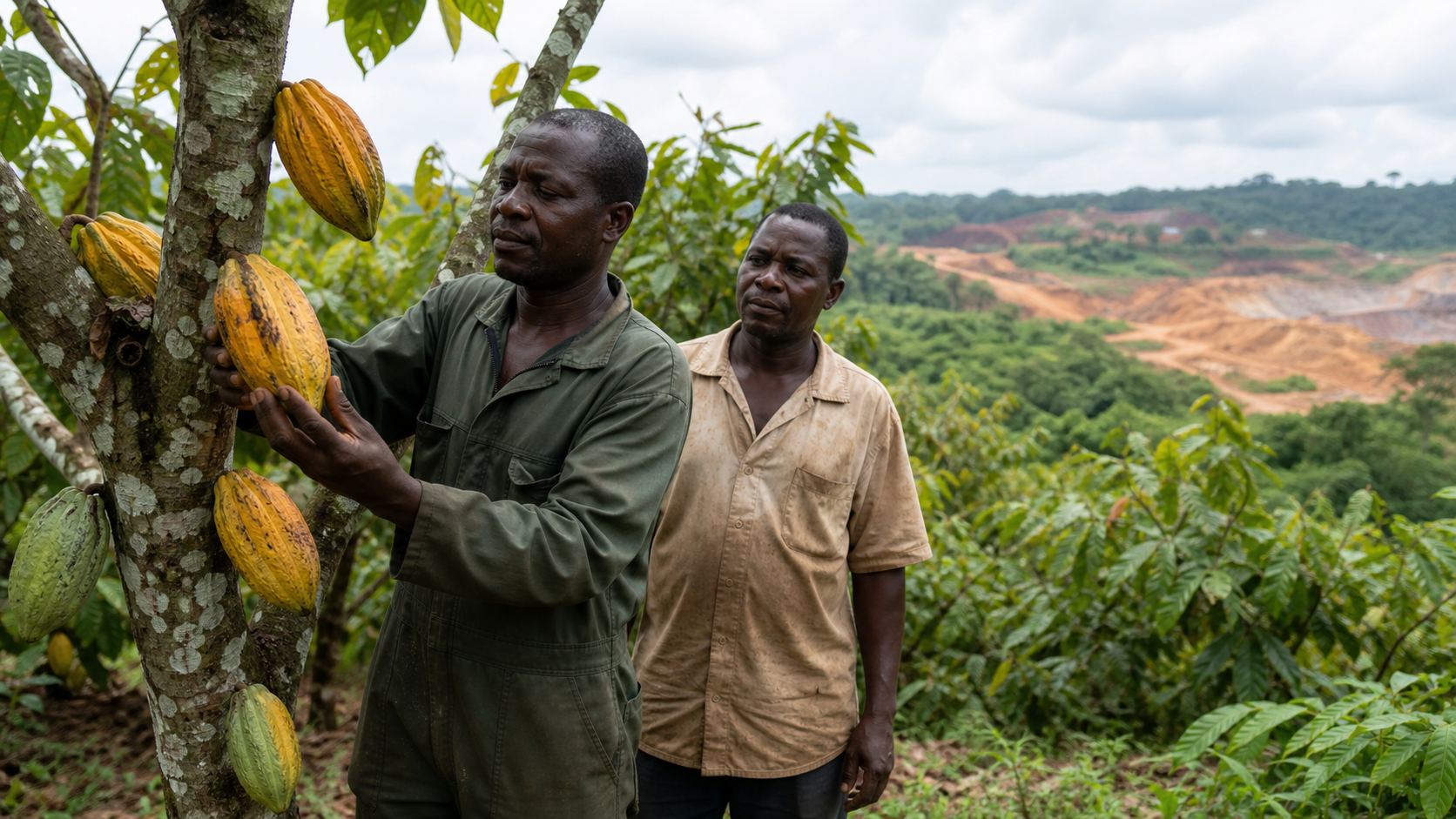
Ghana wants to protect cocoa farms from illegal mining and land conversion. Farmers say protection cannot work if the people carrying the industry are left carrying the cost alone.
Ghana has moved to protect one of Africa's most important export crops with one of the toughest tools a government can use: criminal law.
Parliament has passed a bill that could send cocoa farmers to prison for up to 20 years if they convert cocoa farms to other uses without government approval. The measure, reported by the Associated Press and Africanews, gives cocoa farms protected status and targets the conversion of cocoa land, especially where illegal gold mining is eating into farmland and damaging water systems.
The bill has not yet been signed by President John Mahama. But it has already opened a bigger debate than one country's farm law. Ghana is asking how to preserve cocoa land. Farmers are asking who preserves them.
That question matters far beyond Ghana. Cocoa is not just a crop. It is the base of a global chocolate economy, a source of export revenue, and a livelihood for hundreds of thousands of West African families. Ghana earns nearly 15% of its export revenue from cocoa beans, while neighboring Ivory Coast earns about 40%. When cocoa farms disappear, the consequences move through village incomes, national budgets, global supply chains, and supermarket shelves.
The government argument is easy to understand. Illegal mining, known locally as galamsey, has become one of Ghana's most damaging land-use crises. It can destroy farms, pollute rivers, and turn long-term agricultural land into short-term extraction sites. If cocoa is treated as a national asset, then the state has an interest in stopping its destruction.
But the farmer argument is just as serious. Cocoa farmers often spend years acquiring land, clearing it, planting trees, maintaining crops, and waiting for income. Many operate under price controls and rising production costs while facing climate stress, disease, and market swings they do not control. A law that restricts what they can do with land, without enough support to make cocoa profitable, can feel less like protection and more like punishment.
That is why the strongest line in this story comes from the farmers themselves. If cocoa is a national asset, then the farmer should be supported like one.
The tension is sharpened by the global market. Cocoa futures surged above $12,000 per metric ton in 2024, then fell to around $4,000 as supply conditions shifted. Those swings may look like numbers on a trading screen in London or New York. In farming communities, they can shape whether a family keeps investing in cocoa, looks for another crop, sells land, or accepts money from miners.
Ghana's Cocoa Board Bill 2026 is not only punitive. Local reporting says it also includes a guarantee that farmers receive at least 70% of the world market price realized by COCOBOD, alongside pension and education support mechanisms. Those provisions matter. They point toward a more complete bargain: protect the crop, but also protect the people whose labor keeps the crop alive.
For diaspora readers, this is the part worth watching. Ethical consumption conversations often focus on whether chocolate is deforestation-free, traceable, or certified. Those standards are important, but they can hide the human question underneath: are African farmers being paid and supported well enough to make sustainability possible?
If Europe demands deforestation-free cocoa, if chocolate companies need reliable supply, and if Ghana wants to stop illegal mining from swallowing farmland, then farmers cannot be treated as the cheapest line item in the system. They are the first infrastructure of the cocoa economy.
The best version of Ghana's law would not simply threaten farmers. It would create a stronger social contract around cocoa land: fairer prices, faster payments, better farm support, credible anti-mining enforcement, transparent regulation, and real alternatives for young people in farming communities.
The worst version would criminalize desperate choices while leaving the deeper economics untouched.
Ghana is right to take the destruction of cocoa land seriously. But the country now faces a test that many African economies know well: protecting a strategic resource without sacrificing the people who built their lives around it.
For the global chocolate industry, this should be a warning. Sustainability cannot be outsourced to African farmers while value is captured elsewhere. If cocoa is precious enough to protect with prison terms, then cocoa farmers are valuable enough to protect with power, income, and dignity.
Read Next
- Africa’s Solar Power Shift Is Becoming a Finance Story
- Mali’s Mining Windfall Test: Can Gold Build Roads, Water, and Power?
- AfCFTA Has A Local Business Problem. Solving It Could Change African Trade
Discover more from ADUNAGOW Magazine
Subscribe to get the latest posts sent to your email.