Dakar 2026: Africa's First Olympic Stage Begins With A Flame In Senegal
The Olympic flame's arrival in Dakar is more than a ceremony. It starts the public countdown to the first Olympic sporting event ever hosted in Africa, and gives Senegal a global stage for youth, culture, and continental confidence.
The Olympic flame has arrived in Senegal, and this time the symbolism is bigger than a torch.
Dakar 2026 will be the first Olympic sporting event ever hosted on African soil. That fact alone makes the Youth Olympic Games historic. But the deeper story is what Senegal is being asked to carry: not only a flame, but a continental message about youth, culture, readiness, and global belonging.
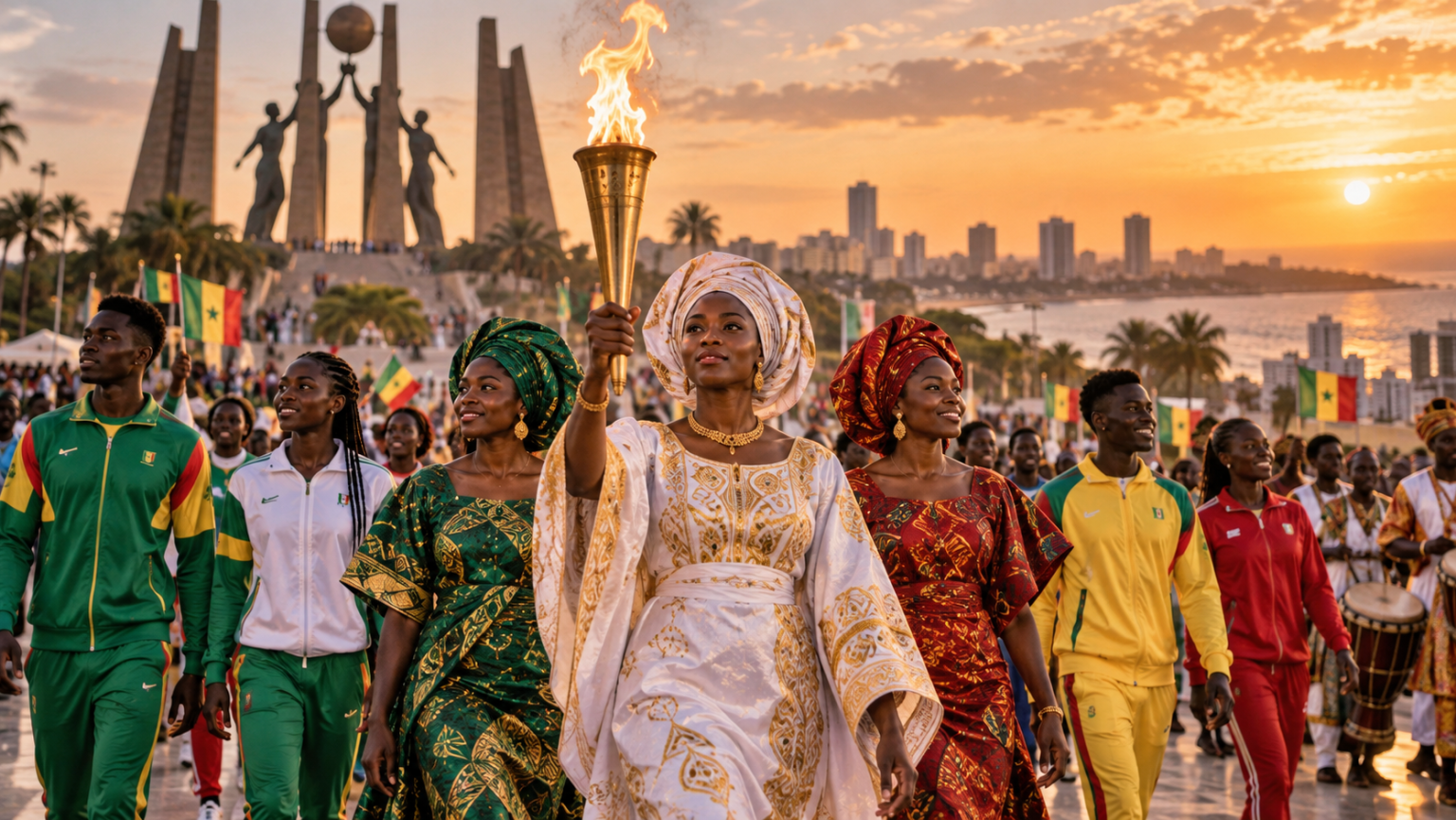
The flame was welcomed in Dakar with music, dance, and public ceremony at the Place du Souvenir Africain, a waterfront site surrounded by the memory of African and diaspora figures. That setting matters. It placed the event inside a story larger than sport: remembrance, identity, continuity, and the future of African youth.
According to Associated Press reporting, 100 Senegalese women known as "lingeer" carried the flame in a procession. The word refers to queens or royal women in Wolof, one of Senegal's major languages. Senegalese basketball legend Mame Maty Mbengue lit the cauldron. The Games are scheduled for October 31 to November 13, bringing about 2,700 athletes between 15 and 18 years old to compete across Dakar, Diamniadio, and Saly.
For ADUNAGOW readers, this is not just an event preview. It is a continental image shift.
Africa has produced Olympic greatness for generations. African athletes have made stadiums erupt in Europe, Asia, the Americas, and the Middle East. They have filled medal tables, rewritten records, carried flags, and turned personal discipline into national pride.
Now, for the first time, an Olympic event comes to Africa.
From Supplying Talent To Hosting The World
The importance of Dakar 2026 is not that it equals the Summer Olympic Games in size. The Youth Olympics are smaller and focused on young athletes. But the meaning is still large.
Hosting changes the frame.
It says African nations are not only sources of talent for stages built elsewhere. They can also host, organize, welcome, broadcast, perform, and define the atmosphere around global sport.
Senegal's role is especially powerful because the Games are built around youth. Africa has the world's youngest population, and sports often become one of the clearest languages of aspiration. For many young people, sport is not only entertainment. It is discipline, travel, education, identity, health, visibility, and sometimes a pathway into opportunity.
Dakar 2026 gives that generation a mirror.
Young Africans will see athletes close to their own age competing on African soil under the Olympic banner. That can change imagination. It can make global sport feel less distant, less foreign, and less dependent on leaving the continent before being recognized.
The torch relay also turns the event into a national conversation. Senegalese authorities and Olympic organizers have planned a journey through all 14 regions of the country before the opening ceremony. That matters because major events can become too concentrated in capital cities. A national relay gives communities outside Dakar a way to feel connected to the moment.
Why This Matters
Dakar 2026 is a test of how Africa converts symbolism into systems.
The ceremony is beautiful. The first-in-Africa headline is powerful. The cultural framing is rich. But the legacy question comes next.
Will the Games strengthen youth sports pathways? Will local coaches, volunteers, event workers, broadcasters, small businesses, artists, and tourism operators benefit? Will Senegalese and African girls see themselves in the women who carried the flame? Will young athletes leave with networks and confidence that last beyond November?
Those are the questions that determine whether a historic event becomes a durable development asset.
The diaspora has a role in the story too. African families abroad often connect to the continent through memory, food, music, language, sport, and major public moments that travel online. Dakar 2026 gives the diaspora a positive, future-facing event to share: not crisis, not conflict, not charity, but African youth on a world stage.
That does not mean the Games should be covered without scrutiny. Major events require public spending, planning discipline, transport readiness, security, accommodation, accessibility, and long-term facility thinking. They can inspire, but they can also expose weak systems if the legacy plan is thin.
ADUNAGOW's role is to hold both ideas at once: pride and seriousness.
Senegal's Cultural Advantage
What makes Dakar 2026 especially promising is that Senegal understands culture as a public language.
The flame ceremony did not present sport as separate from heritage. It placed women, music, language, memory, and youth at the center of the countdown. That is the right instinct. Africa should not host global events by simply copying ceremonies from elsewhere. It should host with its own cultural grammar.
That is where Senegal can make Dakar 2026 more than a logistical success.
If the Games show the world African youth performance, African creativity, African languages, African fashion, African music, African hospitality, and African confidence, they will do more than award medals. They will help correct the global imagination.
The Olympic flame has crossed many borders. In Senegal, it now carries something new.
It carries a message that Africa is not waiting to be invited into history.
Dakar is already lighting it.
Read Next
- Cameroon Women's Football Just Made History. Now The Investment Must Match The Glory
- AJ Dybantsa Goes No. 1: A Diaspora Basketball Moment Bigger Than Draft Night
- August 31 Is the Diaspora's Mirror: Why People of African Descent Day Matters Now
Sources
Discover more from ADUNAGOW Magazine
Subscribe to get the latest posts sent to your email.