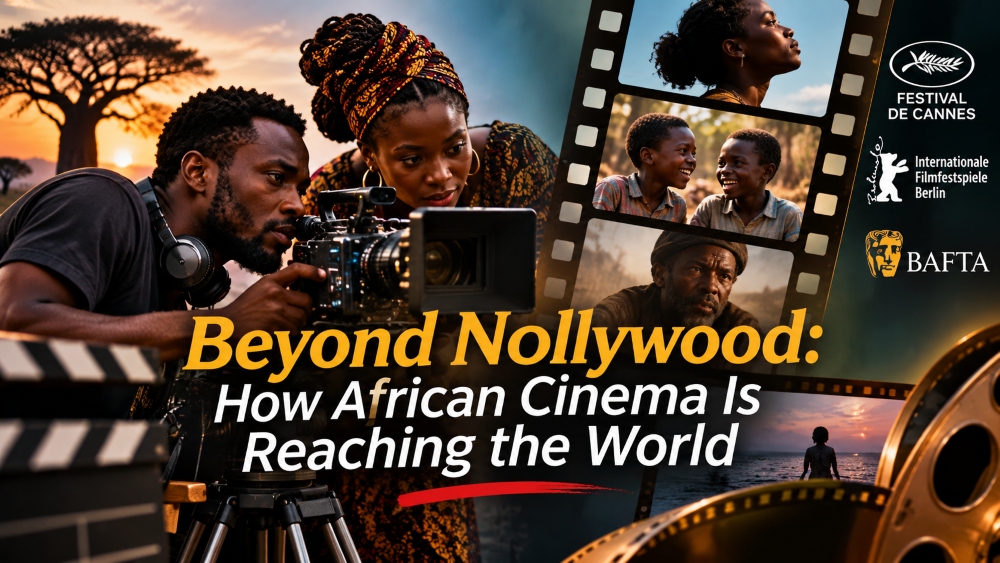
By Muhammad Shahzad | ADUNAGOW Magazine | Exclusive Guest Feature
For much of the past three decades, one word has dominated international conversations about commercially successful African cinema: Nollywood.
Nigeria’s film industry grew from videotapes sold in Lagos markets into one of the world’s most prolific filmmaking industries, building substantial audiences across Africa and its diaspora.
Yet African cinema has always extended beyond Nigeria. From Senegal’s pioneering filmmakers to the established cinematic traditions of North and Southern Africa, the continent possesses a rich and diverse storytelling heritage.
What is changing today is the scale of international access, recognition and commercial opportunity.
African films are climbing global streaming charts, receiving prestigious festival awards and securing international distribution. The transformation is not simply about individual successful films. It is about who finances the productions, who tells the stories and who gets to experience them.
The Streaming Revolution
Some of the clearest evidence of this transformation can be found in Netflix’s global viewing charts.
Kunle Afolayan’s Aníkúlápó, a Yoruba-language fantasy drama set in the historical Oyo Empire, reached number one on Netflix’s global non-English film chart during the week of October 3–9, 2022, recording 8.73 million hours watched.
Femi Adebayo’s Jagun Jagun continued that momentum in 2023, introducing international audiences to another ambitious Yoruba-language production rooted in African history, mythology and storytelling.
Then came Editi Effiong’s The Black Book, a thriller about a grieving father confronting corruption and injustice.
During the week of September 25–October 1, 2023, the film reached third place on Netflix’s global English-language film chart, recording 11.2 million views. According to Associated Press reporting, it appeared in Netflix’s Top 10 in 69 countries.
These achievements are significant not only because of their audience figures but also because of the filmmaking ecosystems behind them.
The Black Book was Effiong’s feature directorial debut, produced on a reported budget of approximately $1 million and backed by Nigerian investors, including entrepreneurs from the country’s technology sector.
Its success demonstrated how African capital could help bring locally developed stories to international audiences.
Netflix’s socioeconomic impact report, covering 2016–2022, also reported investments exceeding $23 million across more than 250 Nigerian licensed, co-produced and commissioned titles.
Streaming platforms have helped reduce the geographical barriers that historically limited the international distribution of African films. However, the foundations of this success were built by African filmmakers and audiences long before global streaming services arrived.
From Lagos to Cannes
Streaming is only half the story. The other half is unfolding at international film festivals, where artistic reputations are established and new distribution opportunities emerge.
In May 2025, My Father’s Shadow, directed by British-Nigerian filmmaker Akinola Davies Jr. and co-written with his brother Wale Davies, screened in the Un Certain Regard section of the Cannes Film Festival.
The semi-autobiographical film follows two young brothers spending a day with their estranged father in Lagos against the backdrop of Nigeria’s 1993 election crisis.
The production received a Caméra d’Or Special Mention at Cannes. In February 2026, the Davies brothers won the BAFTA for Outstanding Debut by a British Writer, Director or Producer.
The achievement illustrates how African and diaspora filmmakers can draw on personal experiences, historical memory and international production partnerships to create stories with global resonance.
The film’s appeal comes not from attempting to explain Africa to outsiders, but from exploring the intimate relationship between a father, his children and the society in which they live.
Beyond Nigeria: Africa’s Many Cinematic Voices
The growing international visibility of African cinema cannot be understood through Nollywood alone.
In 2024, French-Senegalese filmmaker Mati Diop’s Dahomey won the Golden Bear for Best Film at the Berlin International Film Festival.
The documentary follows the return of 26 royal treasures from France to the Republic of Benin in November 2021. The objects had been looted by French colonial troops in 1892.
Through discussions among students at Benin’s University of Abomey-Calavi, the film explores questions of cultural ownership, historical memory and restitution.
Diop’s earlier feature, Atlantics, had already won the Grand Prix at Cannes in 2019. Set in Dakar, the film examines love, migration, economic hardship and the aspirations of Senegalese youth through a distinctive blend of realism and supernatural storytelling.
Other African filmmakers are contributing to this expanding cinematic landscape.
Ramata-Toulaye Sy’s Banel & Adama competed for the Palme d’Or at Cannes in 2023. Set in northern Senegal, the film explores love, personal ambition and the expectations of community life.
That same year, Sudanese filmmaker Mohamed Kordofani’s Goodbye Julia received the Freedom Prize in the Un Certain Regard section at Cannes.
Through the intertwined lives of two women in Khartoum, the film examines tensions between northern and southern Sudanese communities during the final years of Sudan as a united country.
Together, these productions demonstrate that African cinema is not a single industry, aesthetic or experience.
It encompasses different languages, histories, societies and artistic traditions, each offering distinct perspectives on the world.
What Is Actually Different Now?
Three developments are helping reshape African cinema’s international position.
African Storytellers Are Expanding Their Reach
The stories attracting international attention are deeply connected to African experiences.
My Father’s Shadow draws on family memories and Nigerian history. Dahomey explores cultural restitution through contemporary Beninese perspectives. The Black Book confronts corruption, police brutality and injustice through a Nigerian thriller.
African filmmakers have long told their own stories. What is expanding today is their ability to distribute those stories internationally and participate in global conversations on their own terms.
The opportunity is not simply to gain international recognition, but to ensure that African perspectives remain central to how African experiences are represented.
The Diaspora Is Becoming a Creative Bridge
The Davies brothers represent filmmakers working across African and international creative environments, connecting British production networks with Nigerian talent and storytelling.
Mati Diop similarly works between Paris and Dakar, drawing on both African and European artistic traditions.
These connections offer opportunities to access funding, technical expertise, distribution networks and international audiences.
The diaspora can serve as a bridge through which resources and knowledge move in both directions, strengthening African creative industries while introducing their productions to wider audiences.
For that opportunity to become sustainable, however, international partnerships must also support local talent, entrepreneurship and creative ownership.
Audiences Are Crossing Borders
Nollywood demonstrated that African storytelling could build substantial audiences without waiting for approval from Hollywood or European cinema institutions.
Digital distribution has created additional opportunities for those audiences while making it easier for international viewers to discover African productions.
A viewer introduced to African cinema through a Nigerian thriller may subsequently discover a Senegalese drama, a Sudanese social commentary or a documentary about Benin’s cultural heritage.
This potential for discovery is one of the most exciting aspects of today’s international film environment.
African cinema can become a gateway through which audiences experience the continent’s cultural diversity, rather than viewing Africa through a single national industry or familiar set of narratives.
What Still Stands in the Way
None of these developments means the struggle is over.
Financing remains one of the most persistent challenges for African filmmakers, particularly independent creators working outside established commercial centres.
Although the reported $1 million budget behind The Black Book demonstrates what locally backed investment can achieve, many filmmakers continue to work with considerably fewer resources.
Cinema infrastructure also remains uneven across the continent. A film may receive an award at Cannes or Berlin and still struggle to secure widespread theatrical distribution in its country of origin.
The infrastructure needed to transform an individual production into a sustainable filmmaking career—including professional training, post-production facilities, marketing, financing and reliable distribution—is still developing across many African markets.
The growing influence of international streaming companies also raises an important question: who ultimately controls the intellectual property, distribution rights and economic benefits associated with African stories?
International visibility does not automatically guarantee financial sustainability or creative independence.
Building stronger African-owned production companies, distribution networks and investment structures remains essential to the industry's long-term development.
The challenge is not simply getting African films seen. It is ensuring that the people making them can build lasting careers and that African audiences can access the stories being told.
Why It Matters
African cinema’s growing international reach is about more than entertainment.
It is about cultural ownership and the power to shape how a continent understands itself and how others understand it.
For generations, international representations of Africa have frequently been shaped by external perspectives, with African societies reduced to backdrops for other people’s stories.
African filmmakers have long challenged those narratives, creating works that reflect the continent’s complexity, imagination, humour, history and everyday experiences.
Today, wider distribution and international recognition are allowing more audiences to encounter those perspectives.
The significance of this moment is not that African stories have suddenly become worthy of global attention.
They always were.
What is changing is the opportunity for more people to experience them.
Nollywood opened doors for millions of viewers to discover contemporary African cinema. Beyond those doors lies a continent of distinctive creative voices whose stories deserve to be seen, heard and supported.
The next chapter will depend not only on international recognition but also on Africa’s ability to invest in its filmmakers, strengthen its creative infrastructure and retain ownership of its cultural future.
African cinema is not waiting to be discovered. It is building its own future—and inviting the world to watch.
About the Author
Muhammad Shahzad writes about world cinema for FlickZada, a film review website covering international film industries, including Nollywood, Hollywood, Bollywood, Korean and Japanese cinema.
Website: https://bollywoodmovies.site
Editor's note: This guest contribution has been edited by ADUNAGOW Magazine for factual accuracy, clarity and broader African cultural context.
Discover more from ADUNAGOW Magazine
Subscribe to get the latest posts sent to your email.

