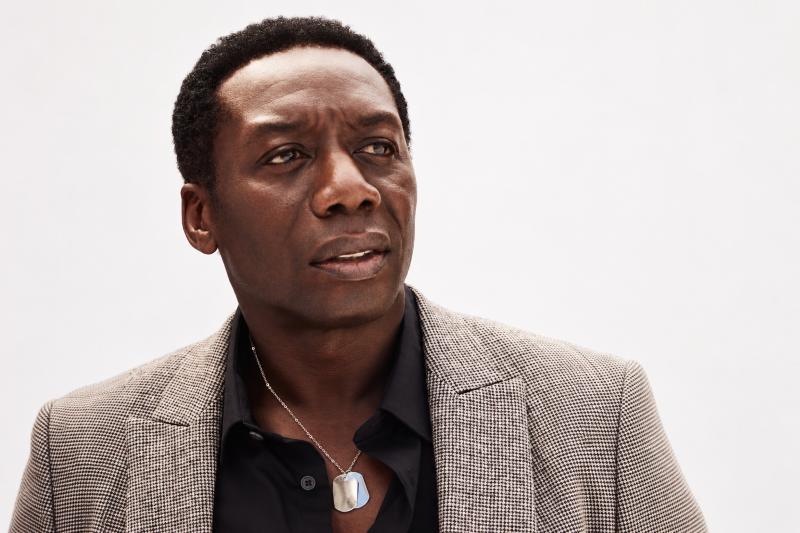
For more than three decades, Hakeem Kae-Kazim has built the kind of international career that makes his face familiar across different generations of film and television audiences.
From Hotel Rwanda, 24 and Black Sails to major international productions and African cinema, the Nigerian-born actor has spent much of his career moving between worlds—Africa, Britain, Hollywood and the wider global film industry.
His latest role brings him to Season 2 of Paramount+’s Average Joe, where he plays Sipho, a formidable South African figure whose presence immediately raises the stakes for Joe Washington and everyone around him.
But when ADUNAGOW Magazine sat down with Kae-Kazim for an exclusive conversation, Sipho became only the beginning.
What followed was a much bigger discussion about Africa, identity, history, creative power and ownership.
ADUNAGOW spoke with Hakeem remotely via Zoom while he was in Africa. The video excerpts retain the natural character of a live, long-distance conversation—a fitting setting, perhaps, for an interview that repeatedly returned to the continent itself.
The Man Behind Sipho

Sipho may initially appear to audiences as a man to fear, but Kae-Kazim says he approached the character from a different starting point: What happened to this man before we met him?
For him, creating Sipho meant developing the history beneath the character—the childhood trauma, experiences and internal demons that could explain who he eventually became.
“It’s never simple where you end up and a lot of it’s to do with where you began.”
That philosophy keeps Sipho from becoming simply another screen villain. Kae-Kazim sees him as a three-dimensional human being whose actions emerge from experiences carried forward from his past.
It is also revealing of the way Kae-Kazim approaches storytelling more broadly.
He is interested in what exists underneath the label.
Africa Is Not a Backdrop
 That same instinct shapes how he thinks about Africa on screen.
Kae-Kazim praised Average Joe for allowing South Africa to function as a meaningful part of the story instead of simply providing an exotic location. He spoke about the production engaging with townships, different social environments and a visual identity grounded in South Africa.
For him, that matters.
But even when international productions improve the way they depict the continent, Kae-Kazim believes the deeper goal must be Africans gaining the ability to tell those stories themselves.
“It’s very important for us to be able to tell our stories as Africans from our own perspective.”
And that requires more than representation.
It requires access to production.
Distribution.
Capital.
And eventually, ownership.
The Africa He Carries
 When asked what part of his African identity enters the room with him wherever he works, Hakeem’s answer was immediate:
“All of it, all of it walks into the room with me.”
His identity, he explains, is complex. He was born in Nigeria but has lived in America, England, South Africa and elsewhere. Each of those experiences helped shape him.
Yet Africa remains central.
That complexity will resonate with many across the diaspora: people whose lives may span countries, languages and cultures while still carrying a deep internal relationship with the continent.
When the conversation turned to the meaning of home, Hakeem ultimately returned to the same place.
For him, home can be family. It can be wherever he feels comfortable at a particular moment. But when the question becomes where the soul feels most settled, he speaks of Africa.
Representation Was Only the Beginning

Then came perhaps the clearest answer of the entire conversation.
ADUNAGOW asked Hakeem which conversation feels more important at this stage of his career: representation or ownership?
His response:
“Ownership, without a doubt ownership.”
The distinction is important.
Representation asks whether African and Black artists are visible inside the industry.
Ownership asks who decides which projects get financed, who controls intellectual property, who distributes the work—and whose perspective ultimately shapes the finished story.
Kae-Kazim argues that Africans cannot expect stories financed entirely from outside the continent to always emerge with an African worldview.
He wants to see African investors put meaningful capital behind African film and television. He also speaks about the need for African-controlled distribution and even imagines a major streaming platform capable of carrying African and diaspora films throughout the continent and around the world.
The objective, in his words, is to tell our stories “from our perspective, with our own soul.”
This is where the conversation stops being solely about Hakeem Kae-Kazim’s career.
It becomes an argument about the infrastructure of African storytelling itself.
Behind the Camera, History Comes Into Focus

Decades of acting have also influenced what Kae-Kazim now wants to accomplish behind the camera.
He speaks about learning how films are actually made—the many creative disciplines and contributions necessary to build something worthwhile.
More importantly, those years have clarified which stories he believes deserve more attention.
Again and again, he returns to African history.
Kae-Kazim wonders why young Africans routinely encounter dramatizations of Western political leaders and historical figures while comparatively few major films introduce them to the Pan-Africanists, liberation leaders and postcolonial figures who shaped Africa’s own history.
His conclusion is one of the strongest statements in the conversation:
“Without understanding our history, we can never have an understanding of our future.”
It’s the Blackness
 That movement behind the camera becomes personal with It’s the Blackness.
Kae-Kazim describes the project as both African and diasporic, drawing partly from his experience growing up as a young Black man in Britain and Europe.
The pressures, struggles and glass ceilings encountered along that journey are woven into the story.
He describes the film as semi-autobiographical in important ways, particularly in the journey its characters experience.
After decades of inhabiting other people’s characters, Hakeem Kae-Kazim is increasingly interested in shaping the stories himself.
Passing the Baton
 And he is thinking about who comes next.
Throughout the interview, Kae-Kazim repeatedly uses the image of a baton.
Younger African actors and filmmakers, he says, need to see that a global career is possible—and then take what previous generations have built and develop their own vision of what African film and television should become.
His advice is straightforward:
Work hard.
Believe in yourself.
Learn from artists you admire.
Adapt what you learn into your own creative identity.
And:
“Don’t be afraid to fail, be brave.”
Legacy

Asked what he hopes people will eventually say about his body of work, Kae-Kazim does not describe awards or fame.
He hopes simply to have contributed to African and global storytelling.
And even after a career that has already crossed continents, he says he still hopes to make a greater contribution by telling stories about African people and African history.
That may be the clearest way to understand this stage of Hakeem Kae-Kazim’s career.
The actor is still acting.
But the storyteller is increasingly looking beyond the role.
Put the Money Down
 ADUNAGOW ended the conversation by asking Hakeem to speak directly to Africans on the continent and throughout the diaspora.
His message was not complicated.
“Put money down and take ownership of our story.”
Do not wait for Hollywood, he argues, to decide which African stories deserve to exist.
Invest in them.
Finance them at a level capable of competing internationally.
Build the infrastructure necessary to distribute them.
And recognize film and television for what they are: not merely entertainment, but powerful vehicles through which cultures teach future generations who they are.
He specifically connects that investment with helping African children know and celebrate African heroes.
That is ultimately where our conversation with Hakeem Kae-Kazim landed.
Not on the next role.
Not on celebrity.
Not even solely on representation.
On ownership.
Because for Hakeem, the next chapter of African storytelling will not be determined only by whether Africans appear on the screen.
It will be determined by whether Africans possess the power to decide what appears there in the first place.
Watch the ADUNAGOW Exclusive
Hakeem Kae-Kazim: The Story Is Ours to Tell
An ADUNAGOW Magazine Exclusive
The ADUNAGOW Conversation: Hakeem Kae-Kazim in His Own Words
This conversation has been edited for clarity and length while preserving Hakeem Kae-Kazim’s meaning and voice.
ADUNAGOW: Sipho enters Average Joe as a man audiences are almost immediately told to fear. What did you discover about him that you wanted audiences to understand beyond the gangster label?
Hakeem Kae-Kazim: For me as an actor, developing a character means giving him a backstory and understanding where he came from. With Sipho, you begin to see some of the trauma that happened to him as a child and how that helped shape who he became.
It was about giving him depth and making him three-dimensional. It’s never simple where you end up; a lot of it has to do with where you began. I wanted to carry those early experiences forward into the man Sipho has become.
ADUNAGOW: With part of Average Joe unfolding in South Africa, what responsibility do you feel when portraying African characters and environments to global audiences?
Hakeem: I’m very conscious of how Africa is presented. One of the things I love about the show is that South Africa becomes a major character rather than a sideline.
You see different sides of the country and people operating from a South African perspective. I believe it’s very important that Africans are able to tell our stories from our own perspective.
Ultimately, nobody coming from outside will tell our truth in quite the way we can. We need the means of production and distribution so we can tell those stories ourselves.
ADUNAGOW: What part of your African identity do you carry into every room?
Hakeem: All of it.
My identity is complex. I was born in Nigeria, but I’ve lived in America, England, South Africa and other places. All those experiences have helped refine and define me.
But my Africanness remains front and center. That’s the place of my birth and my parents. It is what resonates deeply within me.
ADUNAGOW: After living across so many countries and cultures, what does “home” mean to you today?
Hakeem: Home is wherever I am at a particular moment and feel comfortable. Home is also my family.
But I love being on the continent more and more. If you ask where my soul feels most at rest and comfortable, it comes back to being in Africa.
ADUNAGOW: Representation or ownership—which conversation matters more now?
Hakeem: Ownership. Without a doubt.
If we want to tell our stories from our perspective, then we have to own those stories. We have to put money into them and into the pipeline that allows those stories to be seen.
We need African investment in African films and stronger distribution. Streaming makes things easier, but we need platforms capable of carrying African and diaspora movies throughout the continent and throughout the world, on our terms.
ADUNAGOW: How has acting influenced the stories you now want to tell behind the camera?
Hakeem: Acting has given me a wonderful understanding of what it takes to put a film together—the nuances, subtleties and contributions everybody makes.
It has also helped me understand what kinds of stories I want to tell.
I’m very interested in African history and in stories about the Pan-Africanists and people who fought for liberation. We see so many films about Western historical figures, but where are the stories our young people can relate to about African heroes?
Without understanding our history, we can never understand our future.
ADUNAGOW: What does It’s the Blackness mean to you personally?
Hakeem: It is an African story, but it is also part of the diaspora.
In some ways, it reflects my own experience growing up in London, England and Europe as a young Black man—the trials, the glass ceilings and some of the things that Blackness puts you up against.
So in that sense, it is semi-autobiographical in a lot of ways.
ADUNAGOW: Do you think about what your journey represents to the next generation?
Hakeem: I do.
Being visible on the world stage helps younger people understand that this is a journey they can take too.
They have to take the baton, run with it, grow it and develop their own vision of what African television and film will look like.
That’s part of the legacy—helping the next generation carry the baton forward.
ADUNAGOW: What advice would you give a young African actor trying to build a lasting career?
Hakeem: Work hard and believe in yourself.
Be conscious about the work you do. Watch actors and creative people you admire. Learn from them, take what inspires you and adapt it into your own creativity.
And especially while you’re young, don’t be afraid to fail. Be brave and go for it.
ADUNAGOW: With complete creative freedom, what story would you most want to put on screen?
Hakeem: One of my passion projects is an adaptation of Shakespeare set in West Africa and translated into Pidgin English.
It takes something considered part of the Western canon and brings it onto the continent so that it breathes West Africa and has a West African rhythm.
I want to show that we can take a story from anywhere and make it authentically our own.
And I also want to tell stories about the great postcolonial Pan-Africanists.
ADUNAGOW: What do you hope your legacy will be?
Hakeem: That Hakeem Kae-Kazim contributed to African and global storytelling.
It may be a small contribution, but I hope people recognize it. And I hope I can make a bigger contribution by telling the stories of our people and our history.
ADUNAGOW: Finally, what message would you leave with Africans and the diaspora around the world?
Hakeem: Put money down and take ownership of our story.
Don’t wait for Hollywood or somebody else to finance our stories and expect them to tell them in our way.
We need to invest in our stories at a level that allows us to compete globally. Africans and the diaspora need to come together and understand the power of film and television.
We need to tell these stories from our African perspective so that our children can begin to celebrate our heroes.
Discover more from ADUNAGOW Magazine
Subscribe to get the latest posts sent to your email.